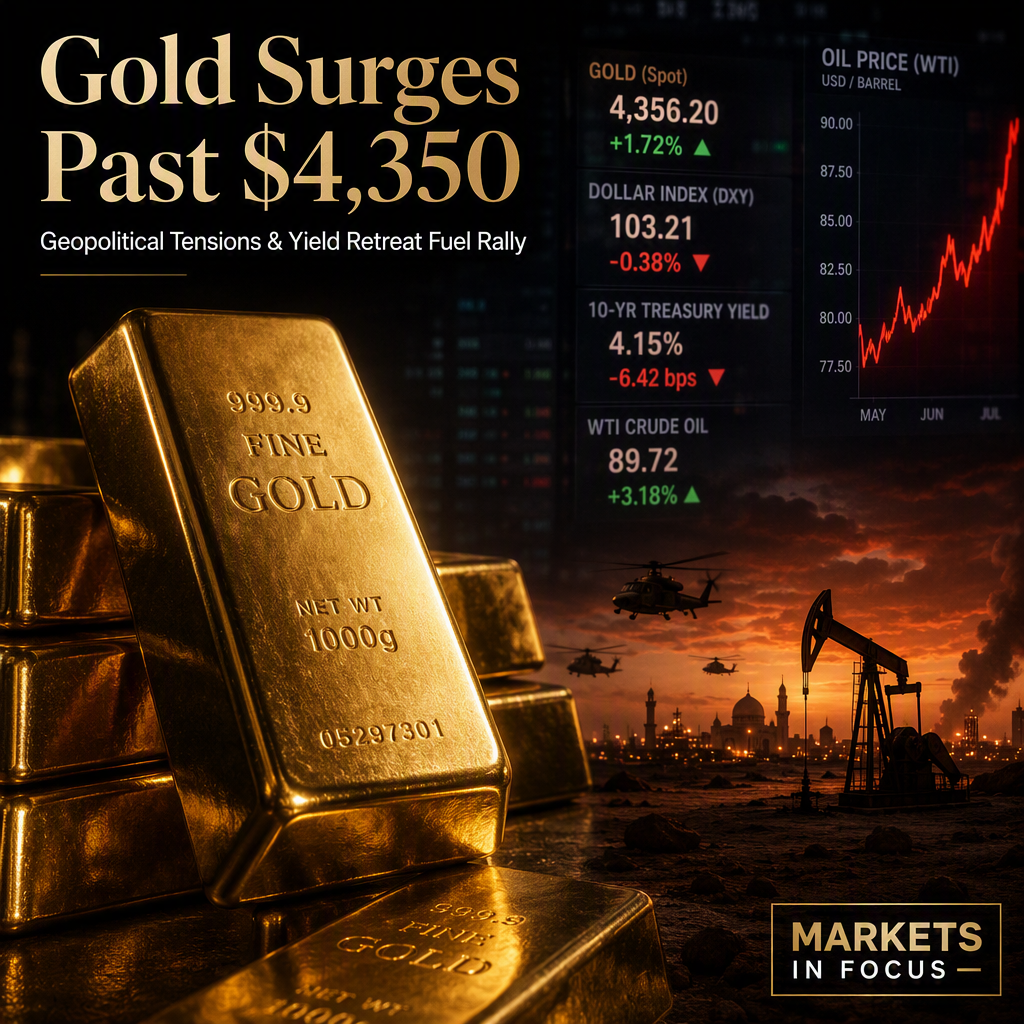
Gold prices (XAU/USD) rebounded from a nearly one-month low to around $4,385 during the early Asian session on Thursday, driven by a retreat in the US Dollar and Treasury yields from recent highs [1]. The move comes ahead of the US August Nonfarm Payrolls (NFP) data, which is due later on Friday and is closely watched by market participants [1]. US Treasury yields eased after previously surging to multi-year highs, with Federal Reserve Bank of New York President John Williams attributing the rise in long-term bond yields to a solid economy rather than inflation fears [1].
David Meger, director of metals trading at High Ridge Futures, noted that the tick down in yields for the day allowed gold to bounce off recent lows [1]. However, escalating tensions in the Middle East, including US airstrikes on Iranian targets and subsequent counter strikes by Tehran in Bahrain, Kuwait, Jordan, and Iraq, have fueled concerns about a wider renewal of hostilities and energy-driven inflation [1]. US President Donald Trump confirmed the US launched 'large and powerful' strikes on Iranian targets near the Strait of Hormuz in retaliation for a 'failed attempt' at laying mines along the trade route [1].
Commodities strategists at ING reported that gold prices had 'eased to a two-week low, slipping below $4,300/oz,' as rising oil prices and Middle East tensions forced markets to reassess the outlook for US interest rates [1]. They cautioned that higher energy costs could add to inflationary pressures and reduce the scope for near-term Federal Reserve easing, a backdrop seen weighing on non-yielding assets such as gold [1]. Traders are now pricing in a 62.3% probability of an interest rate hike at the Fed's policy meeting this month, according to the CME FedWatch tool [1].
Fed's Williams delivered a mildly less hawkish tone, emphasizing strong economic growth and contained inflation expectations, while highlighting that rising yields are driven by robust investment demand and geopolitical factors, including Middle East conflict and tariffs [1].
CONCLUSION
Gold's rebound above $4,350 reflects a complex interplay between easing yields, geopolitical tensions, and shifting expectations for US interest rates. While the retreat in the US Dollar and Treasury yields has supported gold, rising oil prices and Middle East conflict may limit further upside by fueling inflation and reducing prospects for Fed easing. Market participants remain focused on upcoming US economic data and Fed policy decisions.