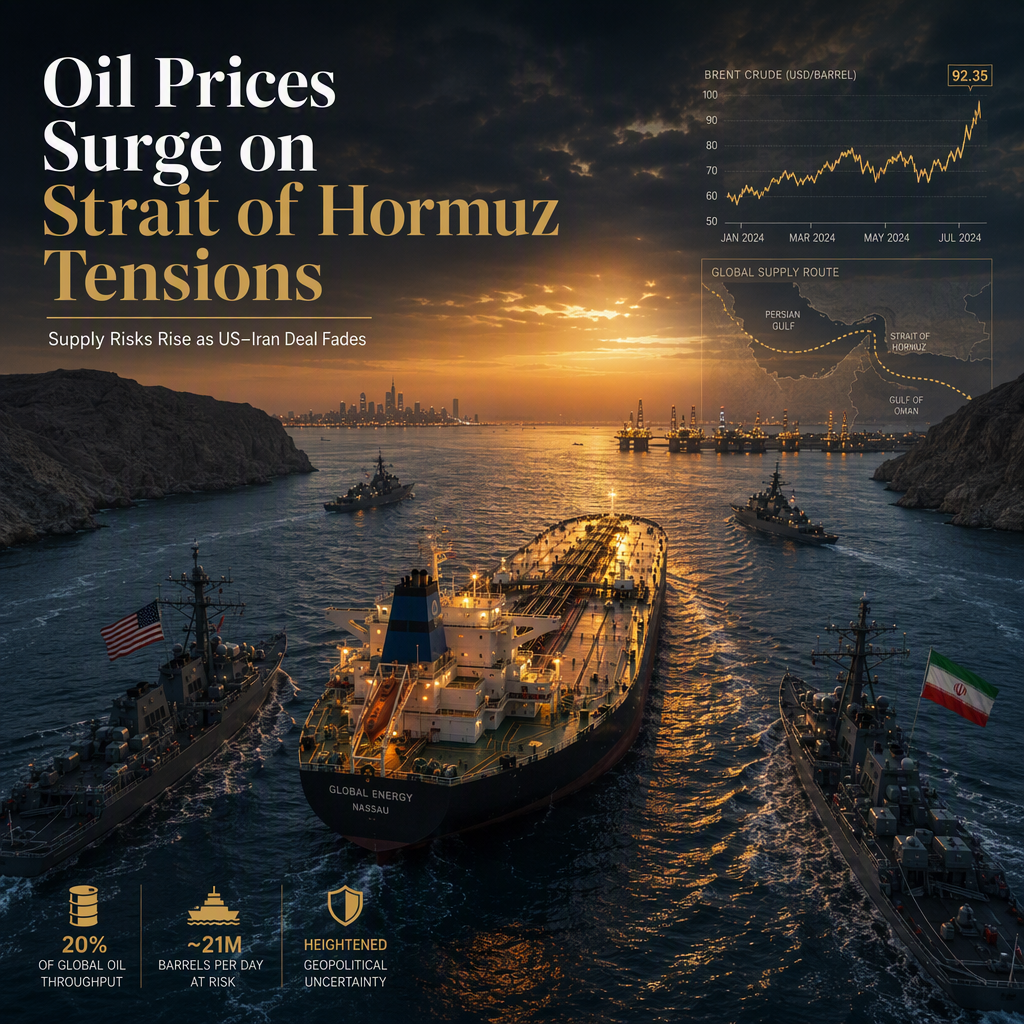
Oil prices have strengthened amid escalating uncertainty over the reopening of the Strait of Hormuz and diminishing optimism for a US–Iran deal, both of which are contributing to heightened supply risks in the market [1][2]. ING analysts Warren Patterson and Ewa Manthey note that oil prices are trading stronger as hopes for a US–Iran agreement fade, prompting the market to reprice ongoing supply disruptions [1]. They emphasize that the oil market remains highly sensitive to headlines, with prices reacting sharply to developments related to US–Iran negotiations [1].
West Texas Intermediate (WTI) futures on NYMEX rose 1.55% to around $82.70 during the European trading session on Tuesday, marking the highest level in over a week [2]. This increase is attributed to deepening uncertainty regarding the reopening of the Strait of Hormuz, a vital passage for nearly one-fifth of global energy supply [2]. The uncertainty intensified following US President Donald Trump's remarks demanding reparations from Iran for war damages and holding Iran responsible for damages and deaths in Lebanon, Syria, Yemen, and Gaza [2]. Over the weekend, Iran outlined conditions for reopening Hormuz, including compensation for war damage, unfreezing of Iranian assets, removal of the US naval blockade on Iranian sea ports, and lifting of sanctions [2].
Despite ongoing disruptions, oil continues to flow through the Strait of Hormuz, demonstrating the market's resilience in maintaining supply even amid periodic turbulence [1]. Iraq’s state oil marketing company reported oil shipments of around 2 million barrels per day in August, compared to pre-war exports of approximately 3.4 million barrels per day through the Strait [1]. Middle East tensions and tight refined product stocks are cited as factors skewing risks to the upside for oil, especially as the Northern hemisphere winter approaches [1].
Technical analysis indicates that WTI oil maintains a bullish near-term bias, trading above the 20-day exponential moving average at $79.76, with the Relative Strength Index at 54.11 suggesting steady upside momentum [2]. Key resistance levels are identified at the July 31 high of $85.11 and the July 23 high of $92.25, while support is seen at the $80 area and the mid-$70s region [2]. Investors are awaiting further remarks from Iran and Oman regarding their proposed framework for managing traffic near Hormuz, though the finalization of this framework is expected to face opposition from global leaders who support freedom of navigation through the passage [2].
CONCLUSION
Oil prices have surged on deepening supply uncertainty linked to the Strait of Hormuz and fading prospects for a US–Iran deal. With ongoing Middle East tensions and tight refined product stocks, risks remain skewed to the upside, especially as winter approaches. The market is expected to remain volatile and headline-driven in the near term.