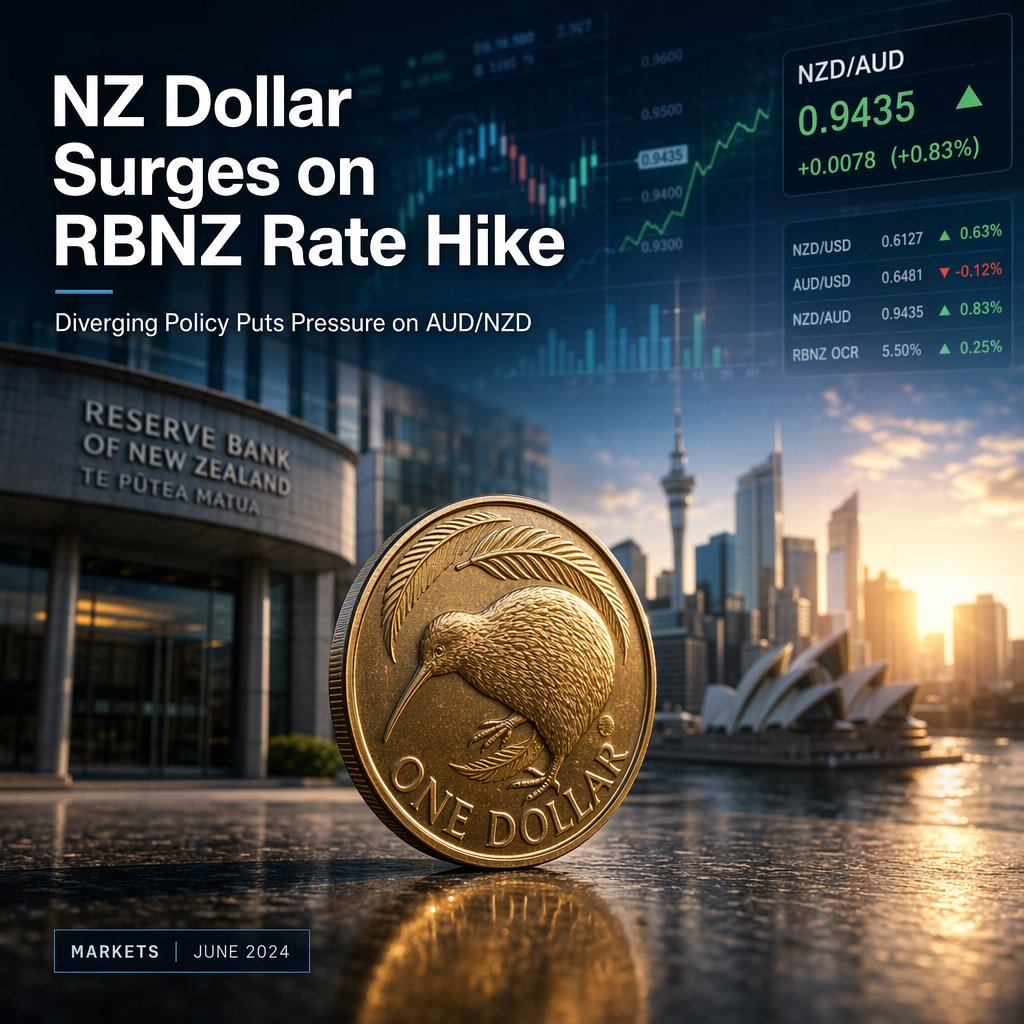
The New Zealand Dollar (NZD) strengthened against the Australian Dollar (AUD), with the AUD/NZD currency pair declining nearly 0.25% to trade around 1.2170 during Asian hours on Wednesday, following the Reserve Bank of New Zealand's (RBNZ) latest interest rate decision [1]. The RBNZ raised its Official Cash Rate (OCR) by 25 basis points to 2.50% at its June policy meeting, in line with widespread market expectations [1]. The central bank's Monetary Policy Review indicated that further reductions in monetary stimulus may be necessary to return inflation to its 2% target midpoint, as economic activity continues to strengthen [1]. The RBNZ emphasized that future OCR adjustments will be strictly data-dependent, guided by incoming economic indicators, price-setting behavior, and medium-term inflationary pressures [1].
Meanwhile, Reserve Bank of Australia (RBA) Assistant Governor Sarah Hunter commented that the Australian economy remains resilient despite recent oil price shocks impacting consumer and business confidence [1]. Hunter reiterated the RBA's commitment to taking necessary action to curb inflation and maintain sustainable full employment [1]. Despite this hawkish stance, financial markets are currently pricing in a pause for the RBA's August meeting, expecting the central bank to hold its cash rate steady after three rate hikes earlier this year [1].
The RBNZ's monetary policy actions are designed to achieve price stability, defined as inflation within the 1% to 3% Consumer Price Index (CPI) band, and support maximum sustainable employment [1]. Higher interest rates are generally positive for the NZD, as they increase yields and make New Zealand more attractive to investors [1]. The RBNZ's focus on data-driven decisions and its willingness to further tighten policy if necessary signal a proactive approach to managing inflation and economic growth [1].
CONCLUSION
The RBNZ's 25 basis point rate hike has boosted the New Zealand Dollar and pressured the AUD/NZD pair, reflecting market confidence in the central bank's inflation-fighting stance. While the RBA maintains a hawkish outlook, markets expect a pause in its rate hikes, highlighting diverging monetary policy paths. The NZD's gains underscore investor optimism about New Zealand's economic outlook and the effectiveness of the RBNZ's policy measures.