
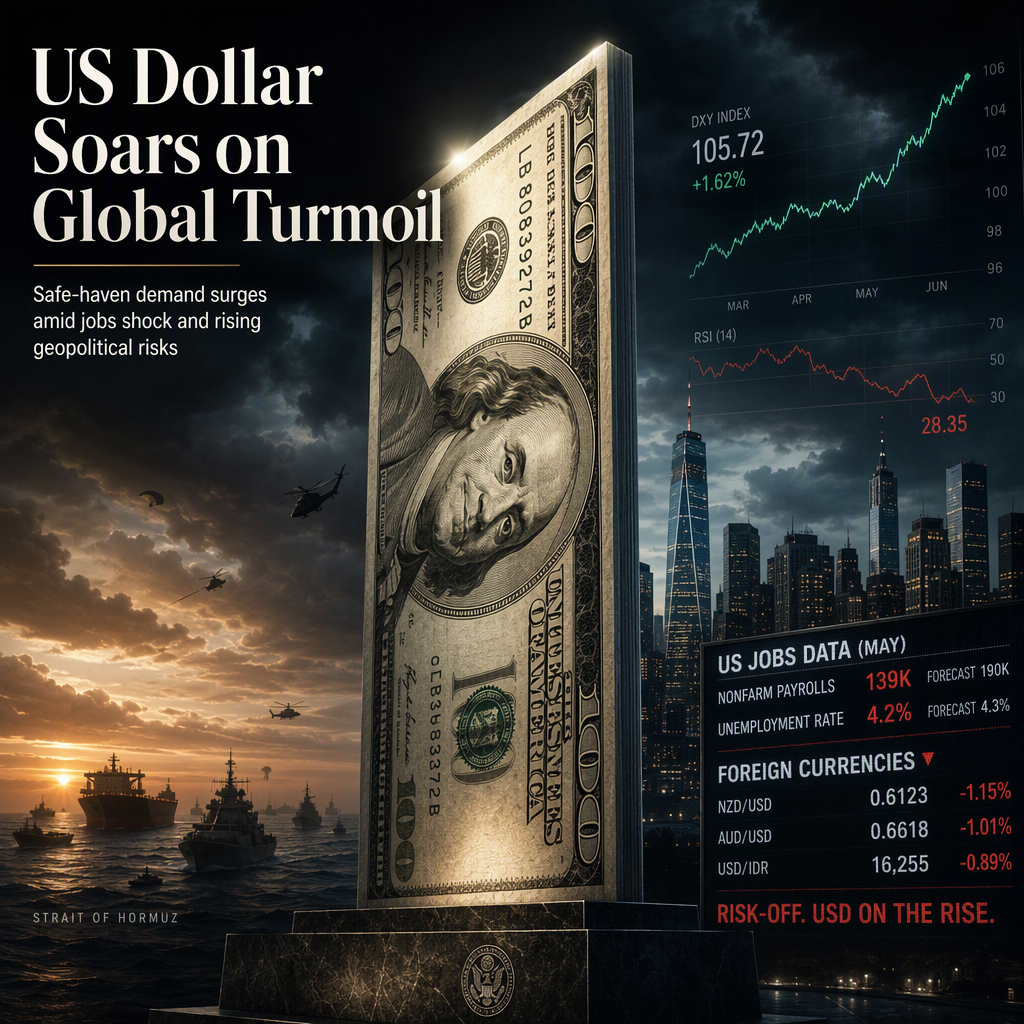
The US Dollar Index (DXY) rallied to a fresh high since April 2025, trading near 102.30 and up around 0.35% for the day, as safe-haven demand intensified following dismal US jobs data and escalating geopolitical risks in the Middle East and Ukraine [2]. The US Nonfarm Payrolls report showed only 29K jobs added in September, with the unemployment rate rising to 4.2%, and wage growth remaining soft, tempering expectations for an October Federal Reserve rate hike [2][6][7]. Despite this, traders are still pricing in over an 85% chance of a rate hike by year-end, according to CME Group's FedWatch Tool [2]. However, DBS Group Research notes that the Dollar's rally is losing monetary-policy support, as senior Fed officials push back against expectations for another hike at the October 28 FOMC meeting, and rising long-dated Treasury yields driven by concerns over debt supply and fiscal sustainability may offer less support than Fed-driven tightening [1][3].
Geopolitical tensions have further boosted the Greenback, with Iran's parliament speaker threatening to keep the Strait of Hormuz closed until conditions are met, and Saudi-backed forces in Yemen launching offensives to reclaim territory from Houthi forces, including the seizure of the Bab el-Mandeb strait [2][5][6]. Ukraine also reported deadly Russian air strikes, with President Zelenskyy vowing a response [2]. These developments have led to broad risk aversion, pressuring risk-sensitive currencies such as the New Zealand Dollar (NZD), which hit fresh year-to-date lows at 0.5585 against the USD, and the Australian Dollar (AUD), which weakened to 0.6940 amid subdued inflation and RBA policy uncertainty [1][5]. The Indonesian Rupiah (IDR) also depreciated, with USD/IDR trading around 17,950, as elevated import costs and energy prices weighed on Indonesia's balance of payments [6].
Technical analysis across several pairs shows oversold conditions: NZD/USD's Relative Strength Index (RSI) is at 24, and AUD/USD's RSI is at 29.3, both indicating overstretched bearish cycles but suggesting potential for selling fatigue [1][5]. Silver (XAG/USD) bounced from two-month lows to trade above $61.30, drawing support from a mild pullback in US Treasury yields after the soft US labor data, but remains below key resistance at $62.40, keeping the broader bearish trend intact [7].
Forward-looking statements from analysts highlight caution. DBS Group warns that higher term premia driven by fiscal concerns may not support the Dollar as much as Fed tightening, and the upcoming FOMC meeting minutes, ISM Services PMI, and speeches from Fed officials are expected to provide further cues for market direction [1][2][3][5][6]. MUFG/BTMU analysts note that the US labor market remains in a 'low-hire, low-fire' dynamic, weakening the case for an October Fed hike but not signaling a sharp downturn [6].
CONCLUSION
The US Dollar's surge is driven by safe-haven flows amid geopolitical turmoil and weaker US jobs data, but its rally faces limits as monetary-policy support wanes and fiscal concerns rise. Risk-sensitive currencies and precious metals remain under pressure, with technical indicators suggesting oversold conditions. Market participants await further guidance from upcoming US economic releases and Fed communications to determine the next direction.