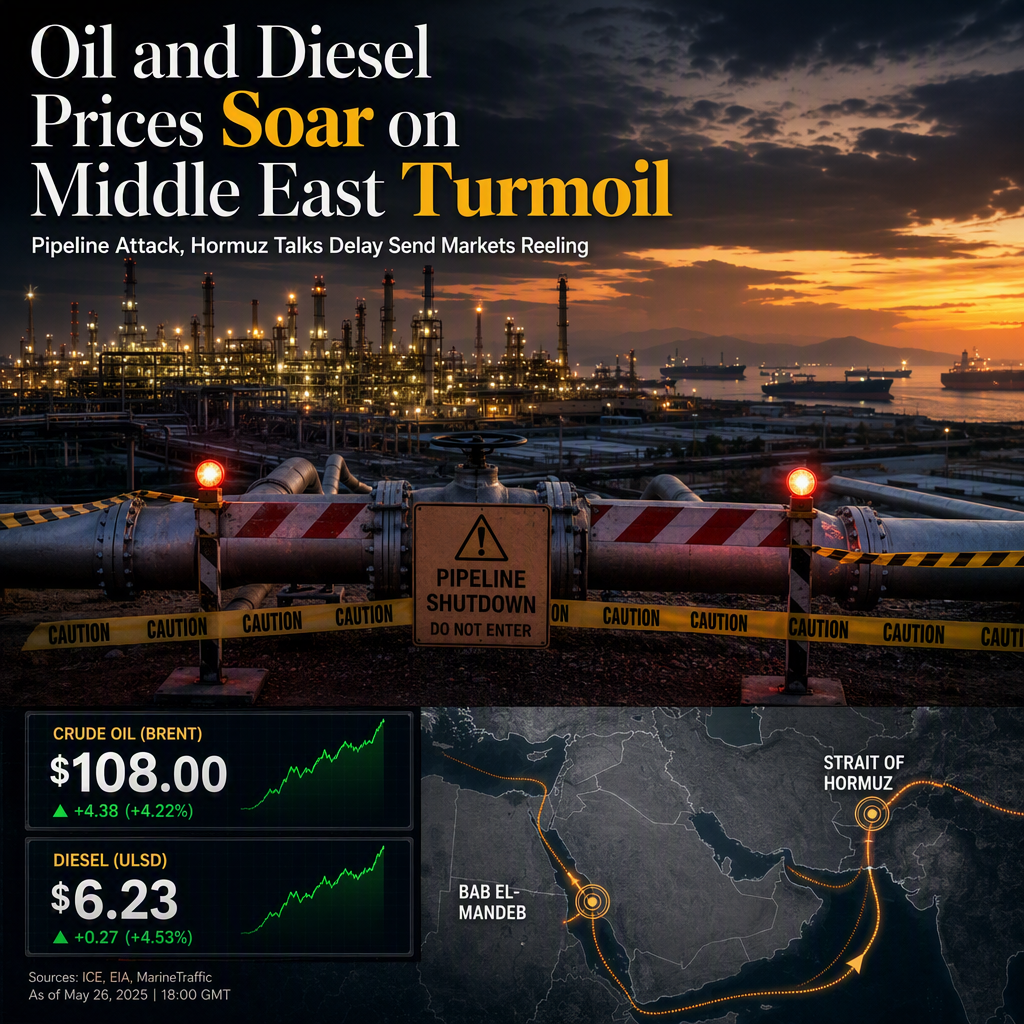
Oil prices surged on Monday following the shutdown of a critical Saudi pipeline and the postponement of talks regarding the Strait of Hormuz, both of which were triggered by recent attacks and ongoing regional tensions. The international oil benchmark, Brent crude, climbed as high as $108 per barrel, while U.S. crude oil reached $103 per barrel, reflecting significant market anxiety over supply disruptions [1]. The Saudi energy ministry announced the pipeline was closed as a precaution after attacks, but did not specify when operations would resume [1]. These attacks coincided with Iran-backed Houthi rebels in Yemen making substantial territorial gains, tightening their control over the Bab el-Mandeb Strait, another vital shipping route [1].
The situation was further complicated by the postponement of a key meeting between Iran and Gulf countries about the future of the Strait of Hormuz. The meeting, originally scheduled for Monday, was delayed at the request of Riyadh, according to statements from Oman’s foreign minister and Tehran [1]. Vessel traffic through the Strait of Hormuz has plummeted, with only 14 ships passing on Sunday, compared to even lower numbers in preceding days, highlighting the severity of the disruption [1].
As a result of these supply concerns, gasoline and diesel prices in the U.S. have soared. The national average price for unleaded regular gasoline rose to $4.31 per gallon on Monday, marking an increase of more than 45% since the onset of the war with Iran on February 28. U.S. crude oil prices have jumped over 50% in the same period [1]. Diesel fuel, crucial for transportation and logistics, set a new all-time high at $6.23 per gallon, according to AAA [1]. Economists, including KPMG chief economist Diane Swonk, warn that elevated diesel prices could drive inflation across the economy, as higher transportation costs impact the price of goods and services broadly [1]. Swonk anticipates that this inflationary pressure will persist for months [1].
In response to the escalating energy crisis, President Donald Trump called on Ukraine to halt attacks on Russian energy infrastructure, signaling the geopolitical complexity and urgency of the situation [1].
CONCLUSION
The shutdown of a key Saudi pipeline and delays in Hormuz negotiations have driven oil and diesel prices to record highs, intensifying inflationary pressures across the U.S. economy. With no clear timeline for resolution and ongoing regional instability, markets are likely to remain volatile and sensitive to further developments.