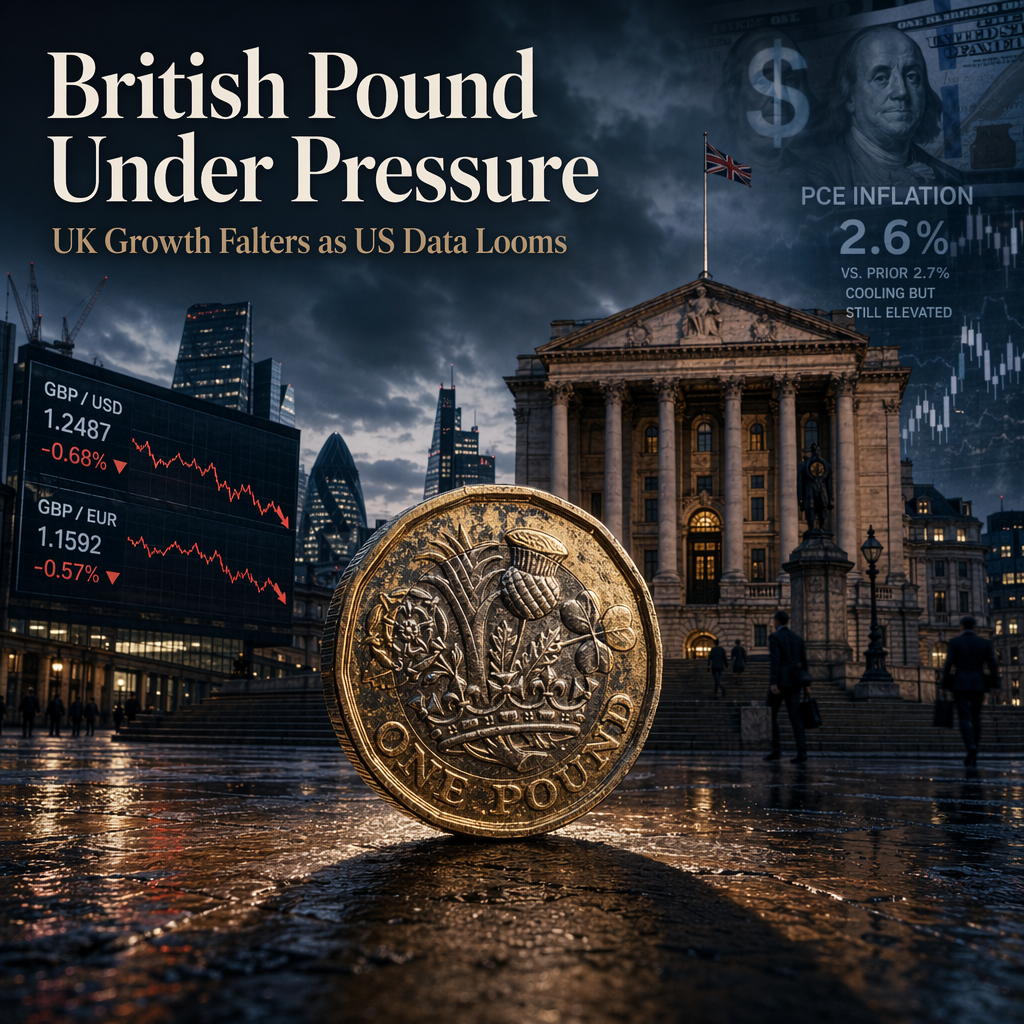
The British Pound Sterling (GBP) faced renewed pressure this week as macroeconomic data highlighted the United Kingdom's lack of growth momentum. June flash Purchasing Managers Index (PMI) readings fell short of expectations, with the Services PMI dropping to 48.7 compared to a consensus of 50.0, signaling deeper contraction in the sector. In response, GBP/USD (Cable) initially dipped below 1.3200 before a late-session rebound brought it back near that level; however, the recovery was described as hollow, with the Pound closing lower and continuing its monthly decline [1].
Despite the brief bounce, there was no positive UK data or shift in Bank of England (BoE) rate expectations to justify the move. The article suggests the uptick was likely due to short-covering rather than genuine Sterling demand. Technical indicators remain bearish, with GBP/USD trading well below both the 50-day and 200-day Exponential Moving Averages (EMAs) near 1.3400, indicating that the Pound is pausing rather than recovering [1].
Looking ahead, the UK economic calendar is notably sparse, with no major domestic data releases scheduled for the rest of the week. The only potential market-moving events are speeches from BoE officials, which are expected to be dovish. Political uncertainty persists following the Prime Minister's resignation, and there is no clear growth catalyst on the horizon. As a result, the Pound's direction is likely to be dictated by movements in the US Dollar rather than domestic developments [1].
The key event for markets this week is the release of the US May Personal Consumption Expenditures Price Index (PCE) on Thursday at 12:30 GMT. Core PCE is forecast at 0.3% month-over-month and 3.4% year-over-year, both higher than the previous month. A stronger-than-expected PCE print would reinforce the Federal Reserve's hawkish stance and could further strengthen the Dollar, pushing GBP/USD lower. Additional US data releases, including the final Q1 GDP, Durable Goods Orders, and jobless claims, as well as comments from Fed officials, are also expected to influence market direction [1].
Technical resistance for GBP/USD is noted at 1.3250 and 1.3300, with a more significant barrier at the moving average cluster around 1.3400. Until the Pound reclaims this zone, rallies are likely to be viewed as selling opportunities rather than the start of a sustained recovery [1].
CONCLUSION
The British Pound remains under pressure amid weak UK economic data and a lack of domestic catalysts. With the market's focus shifting to key US data releases, particularly the PCE inflation report, Sterling's near-term direction will likely be determined by Dollar movements and external factors. Technical signals suggest further downside risk unless GBP/USD can break above key resistance levels.