
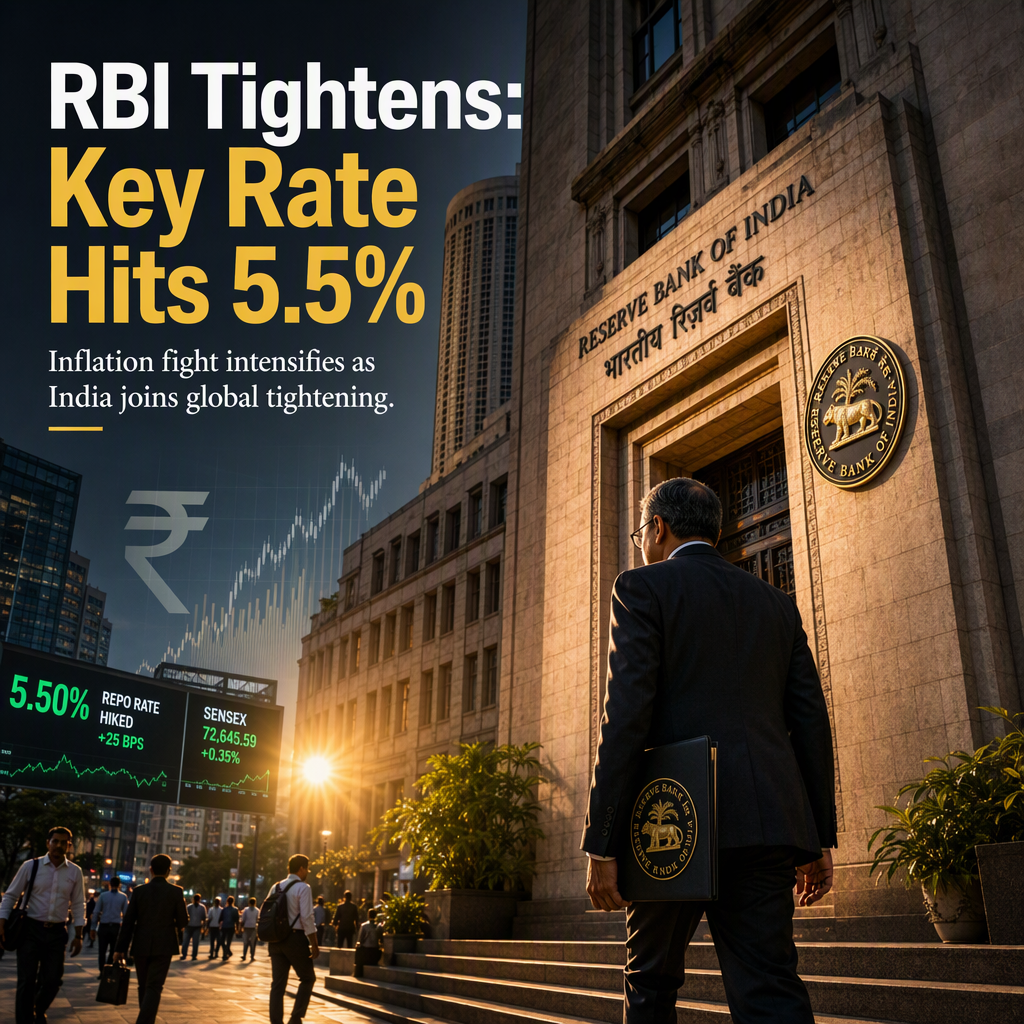
On October 7, 2026, the Reserve Bank of India (RBI) raised its key interest rate by 25 basis points to 5.50%, marking its first rate hike since February 2023 as inflationary pressures intensified beyond the central bank's target level [1][2][3]. This move aligns India with other major central banks that have recently tightened monetary policy in response to rising global inflation [1][3]. The RBI's Monetary Policy Committee also shifted its stance from 'neutral' to 'calibrated tightening,' as announced by Governor Sanjay Malhotra [2][3].
The decision was widely anticipated, with the actual repo rate increase matching both consensus and previous forecasts at 5.5% [2][3]. Retail inflation in India has been on the rise for 10 consecutive months, reaching 4.8% in August, which is above the RBI's medium-term target of 4% [3]. Despite this, Source 2 notes that inflationary pressures have remained within the RBI's tolerance band of 2%-6% [2], while Source 1 and 3 emphasize that inflation has breached the target and is not as benign as in the previous year [1][3].
India's economy has shown resilience, with GDP growth surprising at 7.8% in the June quarter, outperforming the RBI's own forecast of 6.4% and providing some cushion for tighter monetary policy [1][2][3]. However, the World Bank projects that growth will moderate to 7.1% in the financial year ending March 2027, down from 7.8% in the previous year [3]. The RBI's move is expected to temper inflation expectations and support the rupee, which has faced depreciation pressure amid high oil prices and global volatility [1]. Technical analysis suggests the rupee could find support, with key resistance at 83.50 against the U.S. dollar, and bond yields are expected to rise, with the 10-year government bond yield likely to test 7.20% [1].
Market reaction has been relatively muted, with the USD/INR trading around 96.37 after the announcement [2]. Market sentiment has shifted to cautious optimism, with expectations of increased volatility in equities and fixed income markets [1]. HSBC and Goldman Sachs anticipate another rate hike by the RBI in December, and analysts warn that a dovish perception could hurt India's appeal among global investors [3]. The RBI indicated that further hikes may be considered if inflation remains above the target range [1][3].
India faces additional risks from external factors such as the ongoing war in Iran, fluctuating oil prices, and the potential impact of El Niño on food prices, as the country is highly dependent on fuel imports and has experienced one of its driest June-August periods since 1960 [1][3].
CONCLUSION
The RBI's 25 basis point rate hike to 5.5% marks a significant policy shift to address persistent inflation, aligning India with global tightening trends. While the move was widely expected and market reaction has been muted, analysts foresee potential further hikes if inflation persists. The RBI now faces the challenge of balancing inflation control with sustaining economic growth amid ongoing external risks.