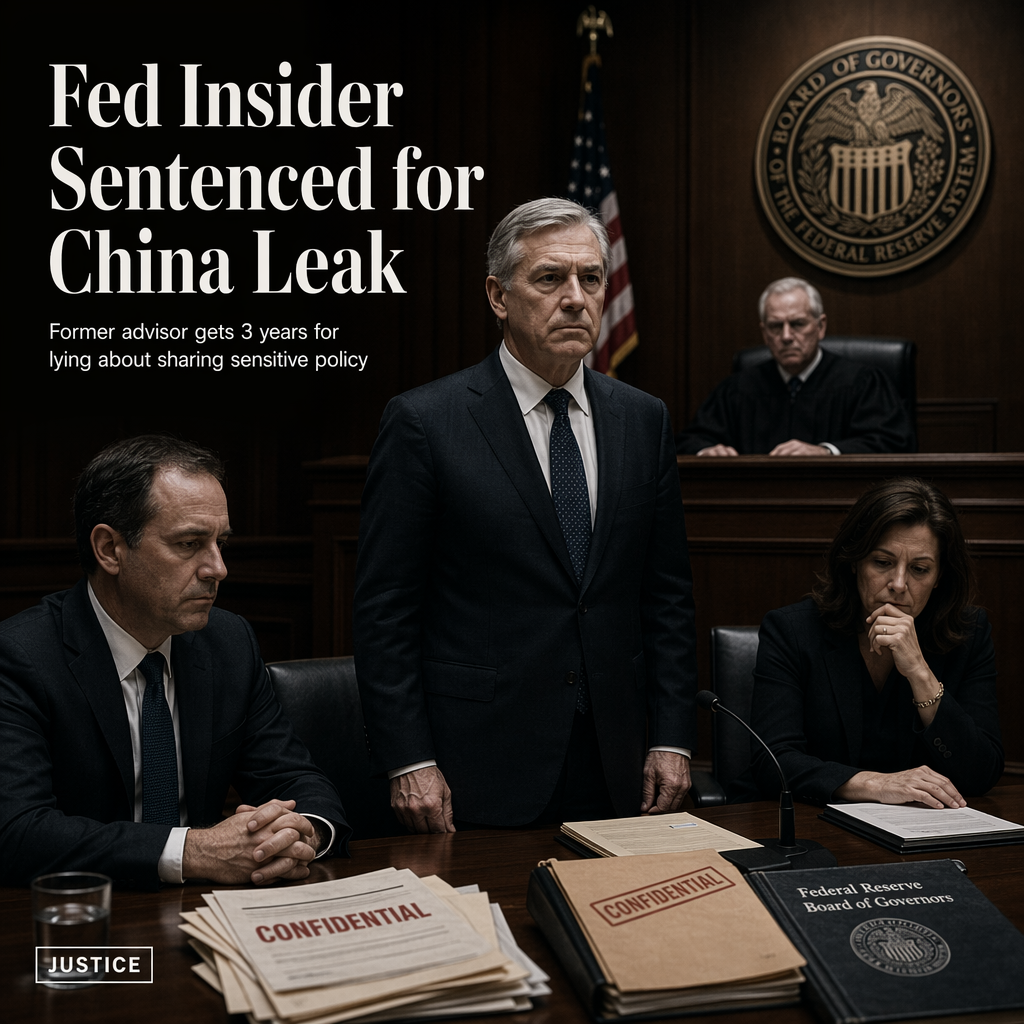
John Harold Rogers, a former senior advisor to the Federal Reserve Board of Governors, was sentenced to over three years in prison for making false statements to federal investigators regarding his sharing of restricted central-bank information with Chinese intelligence operatives, according to the Justice Department [1]. Rogers, aged 64, was found guilty in February of lying to investigators when he denied sharing sensitive information on monetary policy, but was acquitted of the more serious charge of conspiracy to commit economic espionage [1]. U.S. Attorney Jeanine Pirro stated, 'John Rogers spent years secretly funneling sensitive Federal Reserve information to Chinese spies, then looked investigators in the eye and lied about it. And when that wasn't enough, he lied again under oath at trial' [1].
U.S. District Judge Dabney Friedrich ordered Rogers to serve an additional 12 months of supervised release following his prison term. Defense lawyers requested no further jail time beyond the approximately 18 months Rogers had already spent in custody, which will be credited toward his sentence [1]. Rogers, a U.S. citizen with a Ph.D. in economics, worked at the Federal Reserve Board's division of international finance from 2010 to 2021, granting him access to nonpublic material on monetary policy and Federal Open Market Committee deliberations [1].
Prosecutors argued that sharing advance knowledge of Fed interest-rate decisions could have enabled Beijing to generate 'enormous profits' from trading its roughly $1.5 trillion in U.S. Treasurys [1]. Rogers allegedly began a clandestine relationship in 2017 with Hummin Lee, a Chinese intelligence operative, and conveyed Fed information during meetings in China, often under the guise of teaching academic classes. He reportedly printed restricted documents before traveling, emailed materials to his personal account after removing classification markings, and forwarded sensitive information to a professor at Fudan University. In exchange, Rogers received university professorships and financial benefits [1].
The sentencing occurs amid intensified efforts by the Trump administration to pursue alleged economic espionage by Beijing [1]. The Chinese ministry of foreign affairs did not respond to CNBC's request for comments [1].
CONCLUSION
The sentencing of John Harold Rogers underscores heightened U.S. scrutiny of information leaks and alleged economic espionage involving China. The case highlights the potential risks to financial markets from unauthorized disclosures of Federal Reserve policy, especially given the scale of China's U.S. Treasury holdings. Market participants may view this as a signal of increased enforcement and vigilance around sensitive economic data.