
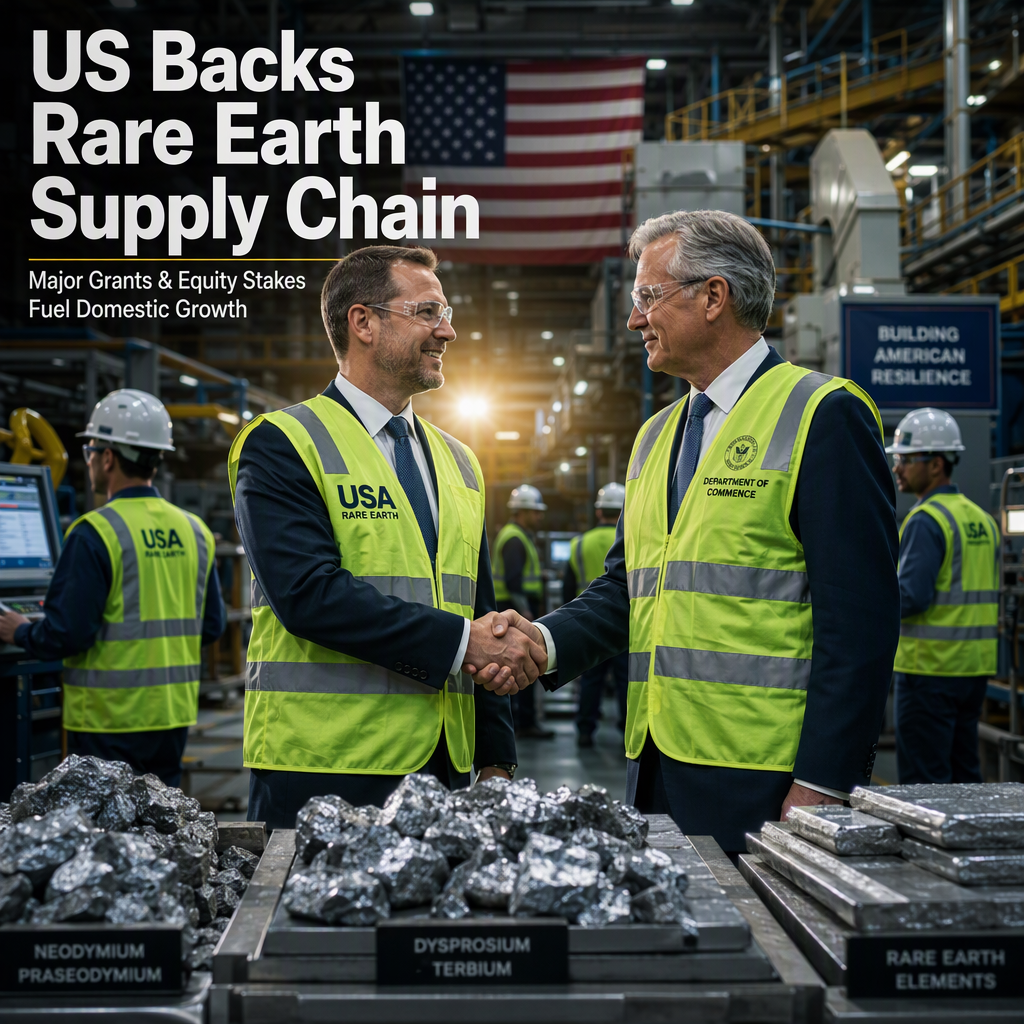
The United States is intensifying its efforts to boost domestic rare earth production, according to an ING report authored by Coco Zhang and Ewa Manthey [1]. Federal support has expanded beyond traditional grants and loans to include purchase agreements, price floors, and equity investments in key industry players [1]. In June 2026, the Department of Commerce finalized a deal with USA Rare Earth, providing $277 million in direct grants and a $1.3 billion senior secured loan to facilitate vertically integrated production. Additionally, the government will acquire a 16% equity stake in USA Rare Earth, marking a significant commitment to developing a domestic rare earth supply chain [1].
Similarly, in 2025, the Department of Defence announced it would acquire a 15% stake in MP Materials (ticker: MP), alongside a 10-year purchase agreement for the company’s magnets and a 10-year price floor for neodymium-praseodymium (NdPr) oxide, a critical input for permanent magnets [1]. These measures are designed to address supply chain bottlenecks and stimulate new refining and magnet capacity, with government support beginning to deliver tangible results in rising output [1].
Despite these advances, the report notes that high production costs remain a significant challenge. While some segments of the supply chain may scale rapidly due to federal backing, others are expected to develop more slowly [1]. No specific market reactions or analyst opinions are provided in the article [1].
CONCLUSION
The US government's expanded financial and strategic support for rare earth production is driving increased output and capacity development, particularly through major investments in USA Rare Earth and MP Materials. While these actions are expected to strengthen the domestic supply chain, high production costs could slow progress in certain areas. Overall, the market impact is likely to be significant as federal backing continues to reshape the industry landscape.