
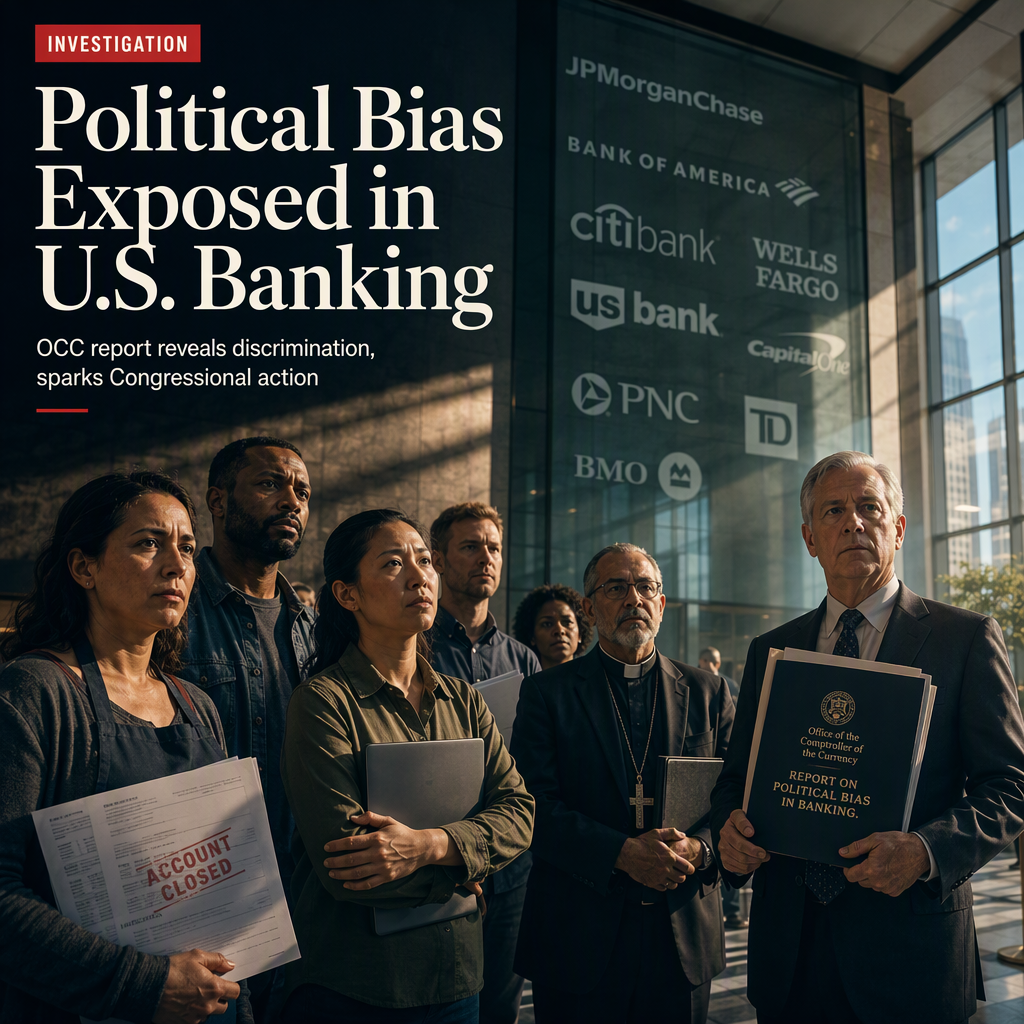
The Office of the Comptroller of the Currency (OCC) has found 'irrefutable evidence' that the nine largest U.S. banks have denied, debanked, and discriminated against customers and lawful businesses, including on the basis of political views, according to Comptroller of the Currency Jonathan Gould [1]. The OCC's investigation focused on JPMorgan Chase Bank, Bank of America, Citibank, Wells Fargo Bank, U.S. Bank, Capital One, PNC Bank, TD Bank, and BMO Bank [1].
A 47-page OCC report cited specific incidents, including a payment processor owned by one bank closing the account of a merchant selling merchandise promoting President Trump and the MAGA brand in February 2021, and another bank declining to provide financial services to a public education organization due to its partisan leanings in 2023 [1]. The report also noted that at least one bank, until 2025, treated businesses engaged in 'partisan activity' as presenting high reputation risk, leading to denial of services based on constitutionally protected views, while organizations deemed 'bipartisan' received services [1].
Comptroller Gould emphasized that 'Americans should have access to financial services regardless of their beliefs, affiliations, or political views,' and stated that fair access is a mandate, not just a mantra [1]. Senate Banking Committee Chairman Tim Scott called the report 'damning' and described debanking over faith or politics as 'simply un-American,' indicating that the Banking Committee will address the issue further when Congress returns [1].
The OCC's review was conducted in compliance with an executive order signed by President Donald Trump in August 2025, which directed the agency to determine whether bank policies or practices influenced denial or limitation of financial services based on political or religious beliefs or lawful business activities [1].
CONCLUSION
The OCC's findings highlight significant concerns about political bias in banking practices among the nation's largest financial institutions. With Congressional attention promised and regulatory scrutiny increasing, banks may face heightened oversight and potential policy changes regarding fair access to financial services.