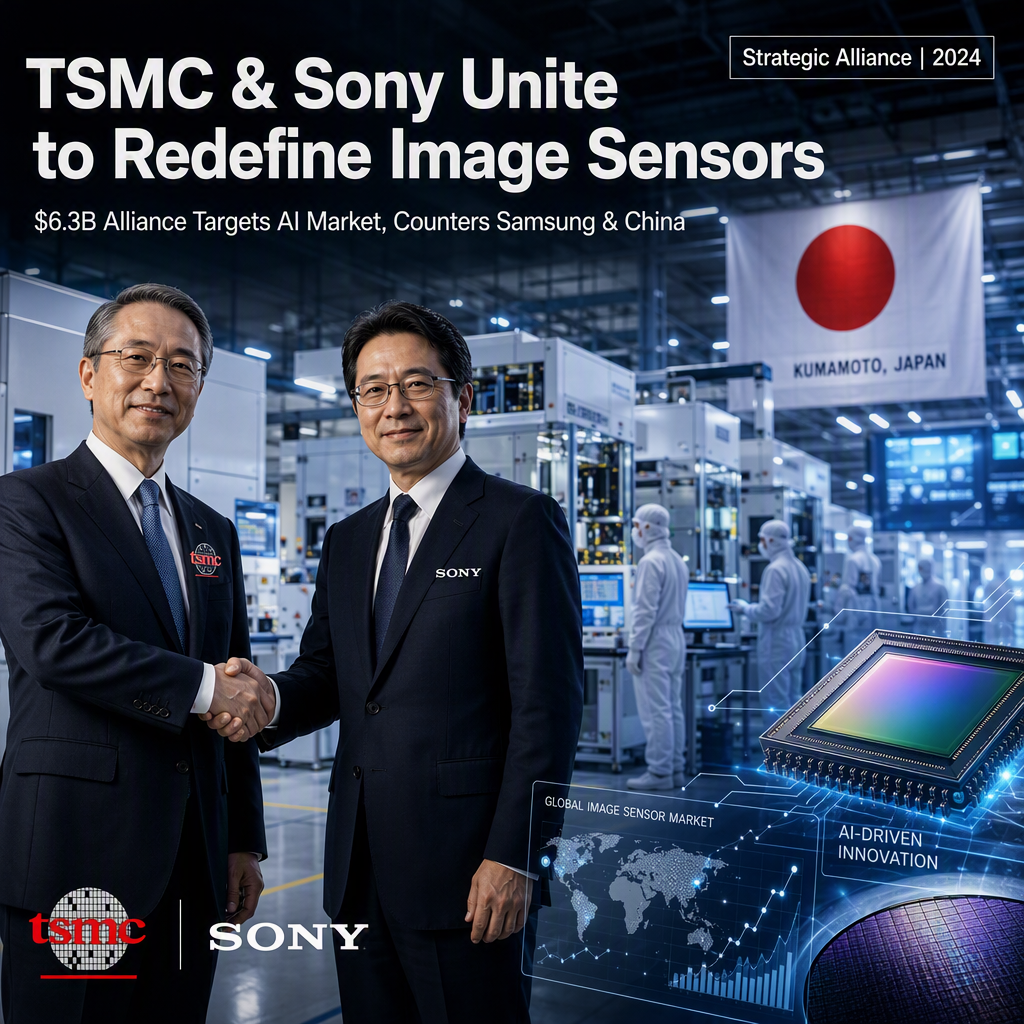
Taiwan Semiconductor Manufacturing Co. (TSMC) has entered into a rare partnership with Sony Group to jointly produce next-generation image sensors, marking a significant strategic move in response to a stagnant smartphone market and intensifying competition from South Korean and Chinese rivals such as Samsung and Chinese chipmakers [1]. Sony, recognized as the world leader in image sensors for smartphones and other devices, brings its technological dominance to the alliance, while TSMC aims to leverage this expertise to expand its presence in the physical AI segment [1].
The collaboration is seen as a direct response to industry anxieties, with the smartphone market plateauing and regional semiconductor exports from South Korea and Taiwan surpassing those of Japan for the first time [1]. Although the article does not disclose the financial terms of the partnership, it references recent news that Sony and TSMC plan to invest $6.3 billion in an advanced image sensor plant in Kumamoto, Japan, highlighting the scale and strategic importance of the venture [1].
This alliance is expected to help TSMC diversify its revenue streams beyond its traditional foundry business, while Sony seeks to reinforce its technological edge in the high-value image sensor market [1]. The partnership comes amid an AI-driven surge in the semiconductor industry, with memory makers reporting cash flows of up to $90 billion, underscoring the rapidly evolving competitive landscape [1].
Market implications are significant, as the collaboration positions both companies to maintain and potentially grow their market share in the face of global competition, particularly from Samsung and Chinese chipmakers [1]. No specific forward-looking statements or analyst opinions are provided in the article.
CONCLUSION
TSMC and Sony's partnership signals a strategic response to mounting competition and a shifting global semiconductor landscape. The alliance is poised to strengthen both companies' positions in the image sensor market and diversify TSMC's business, with a substantial $6.3 billion investment underscoring its importance. Market impact is expected to be high as the companies seek to secure their roles in the AI-driven semiconductor supply chain.