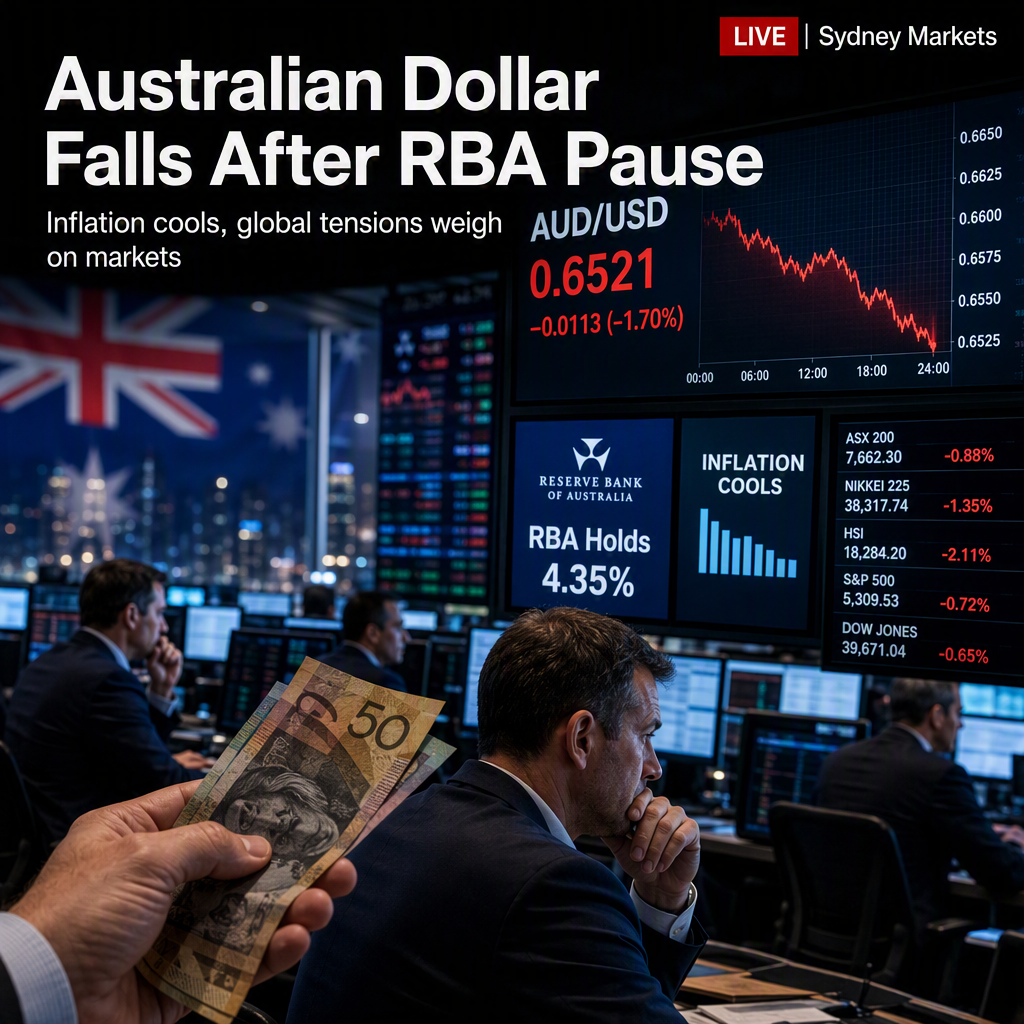
The Reserve Bank of Australia (RBA) decided to keep its Official Cash Rate (OCR) unchanged at 4.35% for the second consecutive meeting, a move widely anticipated by financial markets due to lower-than-expected inflation in the second quarter of the year [3][4]. Following the announcement, the Australian Dollar (AUD) experienced a decline against both the US Dollar (USD) and the Japanese Yen (JPY), with AUD/JPY trading 0.15% lower at around 112.20 during the Asian session on Tuesday [4]. The RBA noted that the impact of the Middle East conflict on inflation has so far been less than expected, which disappointed some market participants and contributed to the AUD's weakness [3].
TD Securities commented that the RBA is now firmly in 'pause and observe mode,' viewing current policy as restrictive, especially as domestic activity, particularly in housing, is slowing in response to earlier rate hikes. The strategists highlighted that the lower-than-expected Q2 trimmed mean CPI gave the RBA space to pause, and OIS markets are pricing close to 0% odds of a hike [4]. The RBA stated that inflation is not expected to return to the midpoint of its target range until late 2027 and acknowledged upside risks to this projection, indicating it will do what is necessary to bring inflation back to target, including the possibility of further rate increases [3].
Investors are now awaiting remarks from RBA Governor Michele Bullock, whose press conference is scheduled for 05:30 GMT, for further insights into the central bank's monetary policy outlook [4]. Meanwhile, traders remain cautious ahead of key US inflation data releases—the Consumer Price Index (CPI) and Producer Price Index (PPI)—later in the week, as these figures could influence the USD and, by extension, the AUD/USD pair [3].
In related markets, the Japanese Yen (JPY) traded higher against major peers despite Japan's Ministry of Finance reporting a surprise current account deficit of JPY 92.3 billion for June, the first deficit since January 2025, compared to an expected surplus of JPY 1,512 billion [4].
Technical analysis shows the AUD/USD pair is caught between the 100-day Simple Moving Average (SMA) at 0.7053 as resistance and the 200-day SMA at 0.6928 as support, leaving the near-term bias neutral [3].
CONCLUSION
The RBA's decision to hold rates steady, combined with softer-than-expected inflation data, has put downward pressure on the Australian Dollar. Market participants are now focused on upcoming US inflation data and comments from RBA Governor Bullock for further direction. The central bank's cautious stance and acknowledgment of persistent inflation risks suggest a wait-and-see approach in the near term.