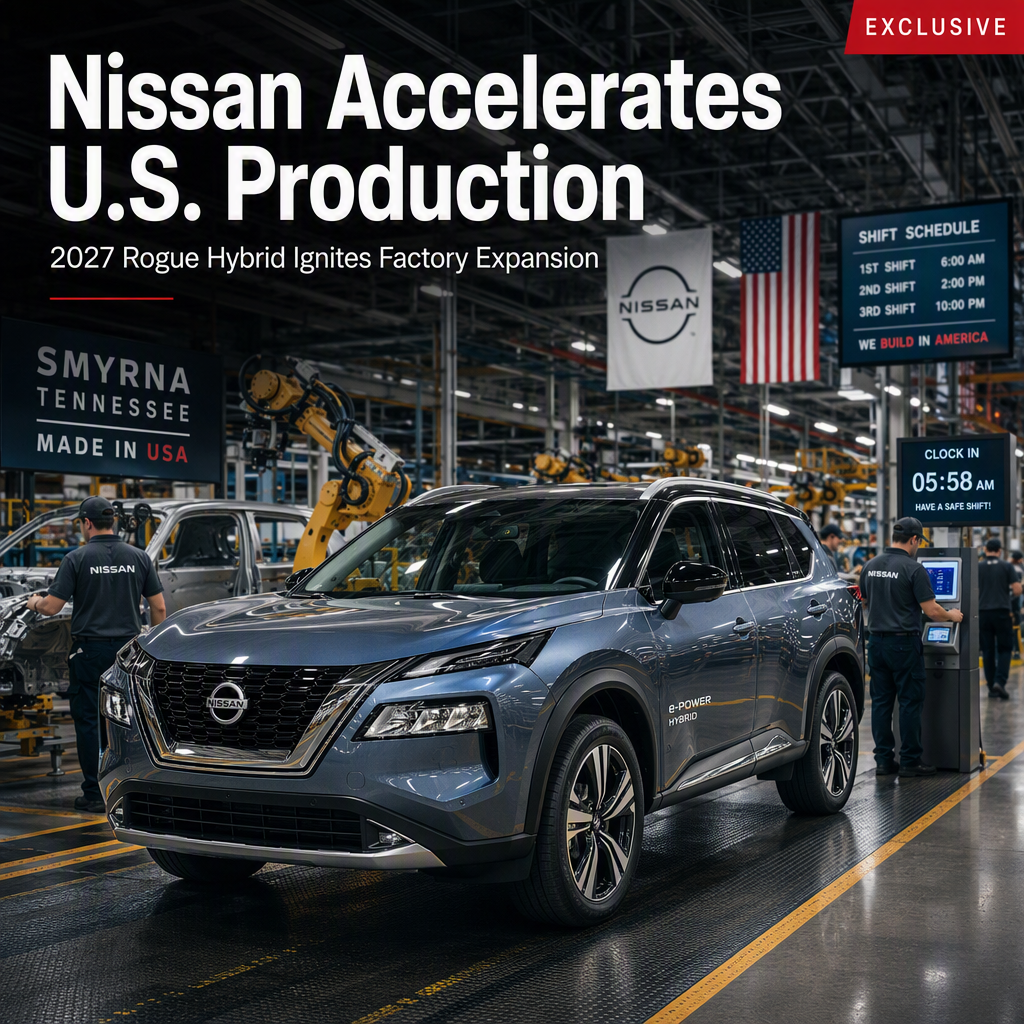
Nissan Motor is considering a significant increase in its U.S. production capacity with the upcoming launch of the 2027 Rogue crossover, which will include a new hybrid model featuring the company's 'e-Power' technology. Christian Meunier, chairman of Nissan Americas, stated that the company is currently operating at maximum production capacity in the U.S. and is optimistic about adding a third shift at its assembly plants to accommodate the new Rogue, especially the hybrid variant, which is expected to launch in the next couple of months [1].
Currently, Nissan produces the Rogue and other models at a 6 million-square-foot facility in Smyrna, Tennessee, operating on two shifts, and also manufactures the Altima and Frontier at a plant in Canton, Mississippi. The addition of a third shift could potentially increase Nissan's U.S. production to approximately 1 million units annually, up from nearly 487,000 in 2025, and would likely result in the creation of hundreds or thousands of new jobs [1].
U.S. manufacturing of the Rogue hybrid is set to begin next year, following the spring 2027 launch of the traditional gas-engine Rogue in Tennessee. In the interim, Nissan plans to import the hybrid model from Japan to accelerate its market entry and support the company's ongoing global turnaround plan [1]. Nissan aims to produce 80% of the vehicles it sells in the U.S. domestically by 2030, but currently has no plans to build a new plant, relying instead on maximizing existing facilities [1].
The newly revealed Rogue hybrid utilizes Nissan's 'e-Power' series hybrid system, which uses the engine solely as a generator for the electric motors, distinguishing it from traditional hybrids and extended-range electric vehicles. Meunier emphasized that launching the Rogue hybrid and reviving the Xterra SUV are his top priorities, and noted that the Rogue is a sales leader for Nissan in the competitive U.S. small crossover market [1].
CONCLUSION
Nissan's strategy to boost U.S. production with the 2027 Rogue hybrid launch signals a strong commitment to domestic manufacturing and innovation in hybrid technology. The potential addition of a third shift and increased output could have a significant positive impact on U.S. jobs and Nissan's market position. The company's focus on maximizing existing capacity rather than building new plants reflects a cautious but ambitious approach to growth.