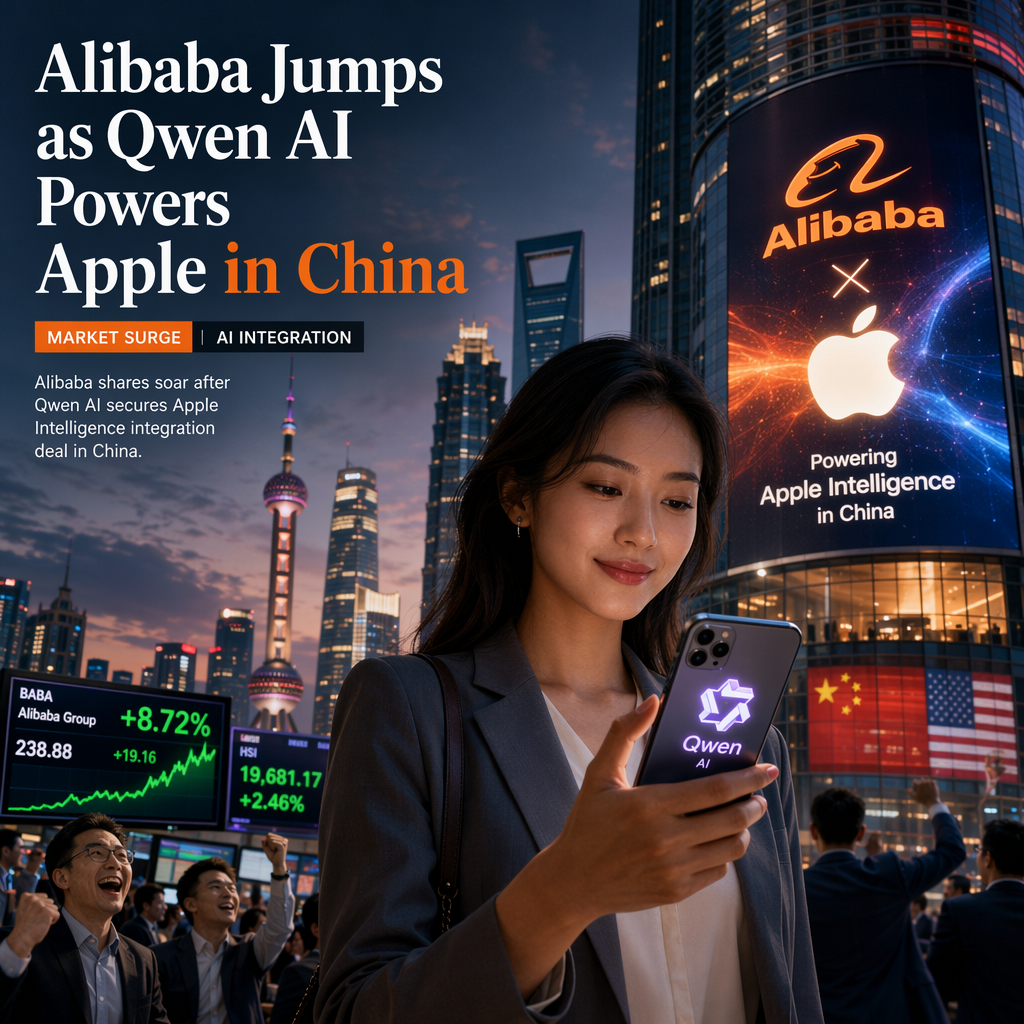
Alibaba's U.S.-listed shares rose by 3.7% in premarket trading on Wednesday following the announcement that its Qwen AI model will be integrated into Apple Intelligence experiences for users in China [1]. An Alibaba spokesperson confirmed that Qwen will be accessible within iOS, iPadOS, macOS, and visionOS, enabling users to leverage text and image understanding and generation capabilities without switching between tools [1]. This integration was made possible after the Cyberspace Administration of China approved Apple AI services, listing them alongside offerings from domestic companies such as Huawei [1].
The approval marks a significant milestone for Apple, which has faced a lengthy process to secure Beijing's greenlight since first announcing its AI service in 2024 [1]. The development occurs amid heightened technological rivalry between the U.S. and China, with U.S. lawmakers considering measures to limit the adoption of Chinese AI models by American companies [1]. Earlier this month, Alibaba banned employees from using Anthropic's AI, and Meta was reportedly compelled to unwind its $2 billion acquisition of Chinese company Manus following a directive from Beijing [1].
In a related advancement, PrismML—a Khosla Ventures-backed startup—released compressed versions of Alibaba's open-source Qwen model, reducing its size from approximately 54 GB to less than 4 GB. This compression allows all 27 billion parameters of the model to run on an iPhone 15 or newer, potentially broadening the accessibility and utility of Qwen AI on Apple devices [1].
The integration of Qwen AI into Apple Intelligence is expected to enhance user experience in China and may have broader implications for the competitive landscape of AI technology between the U.S. and China [1].
CONCLUSION
Alibaba's Qwen AI integration into Apple Intelligence has driven a notable rise in Alibaba's U.S.-listed shares, reflecting positive market sentiment. The approval by Chinese authorities and technical advancements enabling Qwen AI to run on iPhones signal a significant step forward for both companies in the Chinese AI market. This development underscores the intensifying competition and regulatory scrutiny in the global AI sector.