
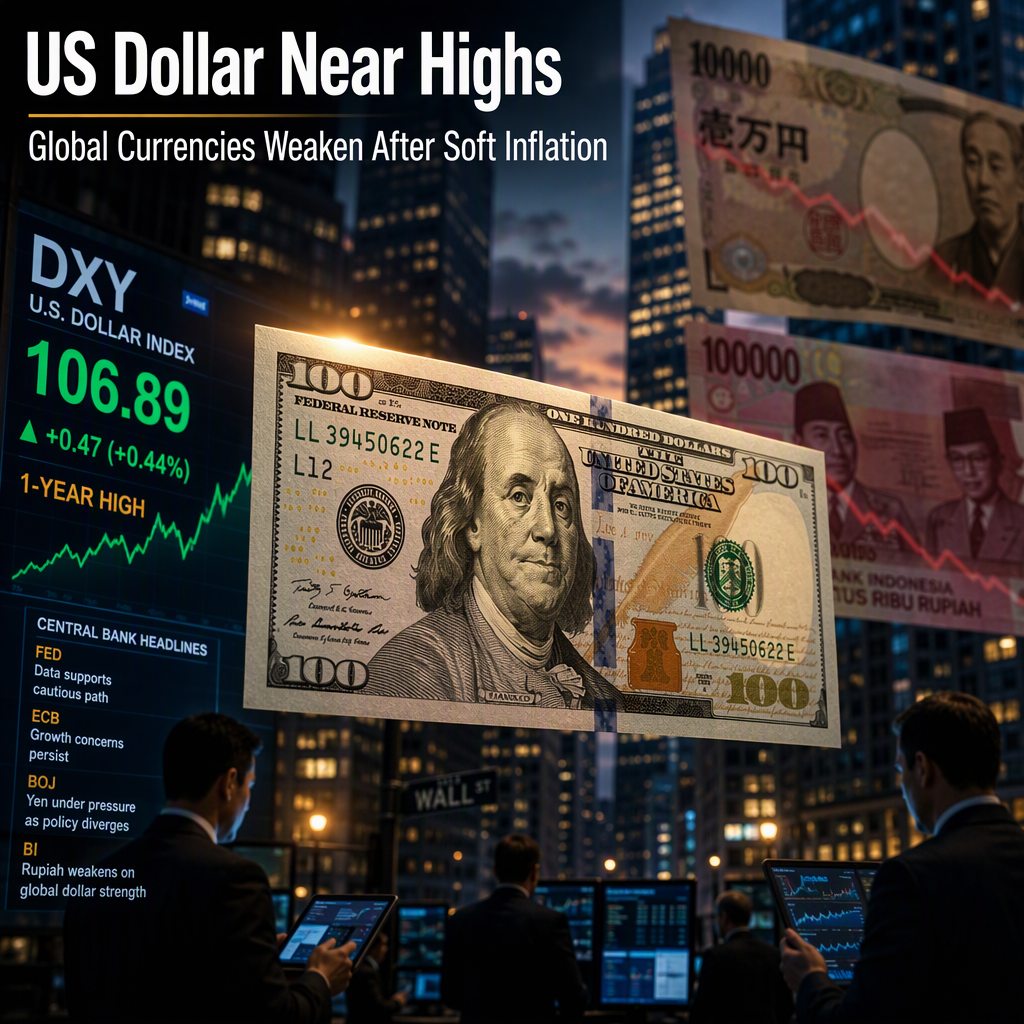
Recent US economic data and central bank signals have led to a repricing of Federal Reserve rate hike expectations, with significant implications for global currency markets. Softer US Personal Consumption Expenditures (PCE) revisions have reduced the perceived urgency for a Federal Reserve rate hike in October, lowering market-implied odds from 47% to 37% by Tuesday's close, and decreasing the amount of hikes priced by year-end by -2.5bps to 29.6bps [1][4]. Despite this, Deutsche Bank economists maintain the expectation of a December hike, citing inflation that remains well above target [1][4]. The core PCE print for August was +0.25% month-over-month, slightly below the +0.3% expected, with downward revisions to previous months improving the overall inflation outlook [1].
The US Dollar Index (DXY) remains near its yearly highs, supported by resilient US activity data, including strong consumer spending and signs of accelerating payroll growth as indicated by the latest ADP report [2]. ING's Chris Turner notes that the DXY is testing the highs of the year at 101.80, and that the cyclical strength of the US economy is reinforcing the Federal Reserve's hawkish stance [2]. Market participants are now focused on the upcoming September nonfarm payrolls report, with consensus forecasts expecting 90,000 jobs added and the unemployment rate steady at 4.1% [4].
The strength of the US Dollar has had notable effects on other currencies. The Japanese Yen weakened by about 0.5% against the Dollar, with USD/JPY rising to 158.44 after the Bank of Japan's (BoJ) Summary of Opinions failed to signal an imminent rate hike in October [3]. Japanese rate markets have scaled back BoJ tightening expectations, though MUFG still anticipates another hike in December [3]. The BoJ's summary emphasized that underlying inflation is approaching the 2.0% target, but the central bank appears to be maintaining a gradual approach to tightening [3].
Similarly, the Indonesian Rupiah depreciated, with USD/IDR trading around 17,980, as the US Dollar gained amid rising Treasury yields and elevated oil prices [4]. US Treasury yields climbed to multi-decade highs, with the 10-year yield reaching 5.34% and the 30-year yield at 5.681%, reflecting concerns over persistent energy-driven inflation [4]. In Indonesia, headline inflation accelerated to 3.28% YoY in September, a three-month high, driven by food price pressures and higher oil costs [4]. Despite these challenges, Bank Indonesia has intervened to stabilize the Rupiah through various market operations [4].
Overall, while softer US inflation data has eased immediate Fed hike expectations, the US Dollar remains strong on the back of robust economic data and persistent inflation concerns. Market attention is now turning to upcoming US labor market data and central bank policy meetings for further direction.
CONCLUSION
Softer US inflation data has reduced the likelihood of an October Fed rate hike, but expectations for a December move remain intact. The US Dollar continues to trade near yearly highs, pressuring global currencies such as the Japanese Yen and Indonesian Rupiah. Market participants are closely watching upcoming US economic releases and central bank signals for further guidance.