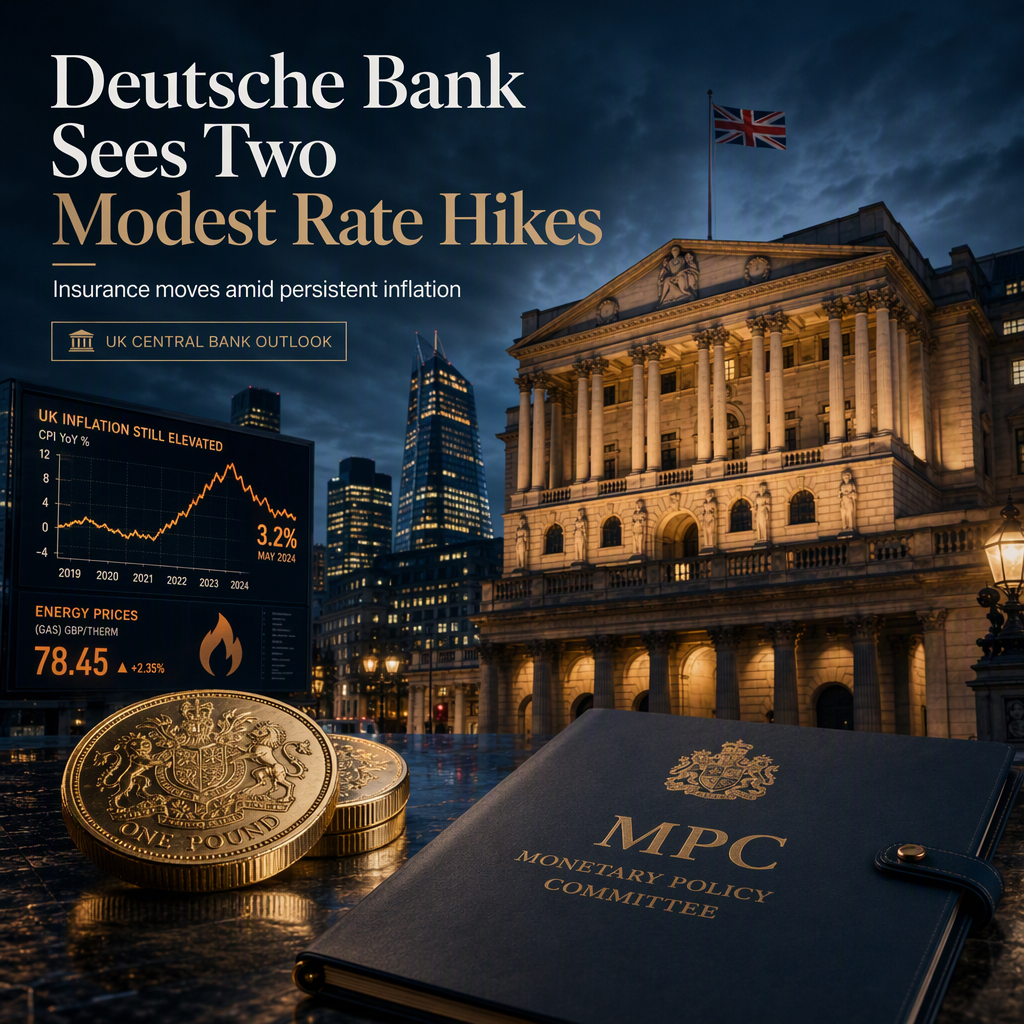
Deutsche Bank Research’s UK economists, Sanjay Raja and Maui Brennan, have revised their base case for the Bank of England (BoE), now expecting two 25 basis point rate hikes—one in November and another in February—following the central bank's September decision [1]. The economists argue that the current Bank Rate of 3.75% is already restrictive, as most centrist members of the Monetary Policy Committee (MPC) believe it sits above their estimates of the neutral rate, which ranges from 3% to 3.5% [1].
The report highlights that the current inflation wave is largely driven by energy prices, with limited evidence of second-round effects so far. As a result, Deutsche Bank does not anticipate an aggressive tightening cycle from the BoE. Instead, they foresee a modest 'insurance' tightening path, with no more than two or three quarter-point hikes, provided energy prices follow market expectations [1].
Taylor Rule estimates from Deutsche Bank suggest that policy rates should be only slightly above 4%, reflecting stronger-than-expected GDP and a firmer inflation outlook. However, these estimates still support only a modest increase in the Bank Rate, in contrast to the aggressive hiking cycle seen in 2022 [1].
The economists note that the BoE's approach is influenced by the persistence of the energy shock. If consumer price inflation (CPI) remains high, the risk of second-round effects increases, prompting the MPC to consider modest rate hikes as an insurance policy. Conversely, a rapid decline in energy prices could weaken the case for further hikes in the coming weeks [1].
CONCLUSION
Deutsche Bank now expects the Bank of England to implement two modest rate hikes as an 'insurance' measure against persistent inflation, primarily driven by energy prices. The outlook for further tightening will depend on the trajectory of energy prices and the evolution of inflationary pressures.