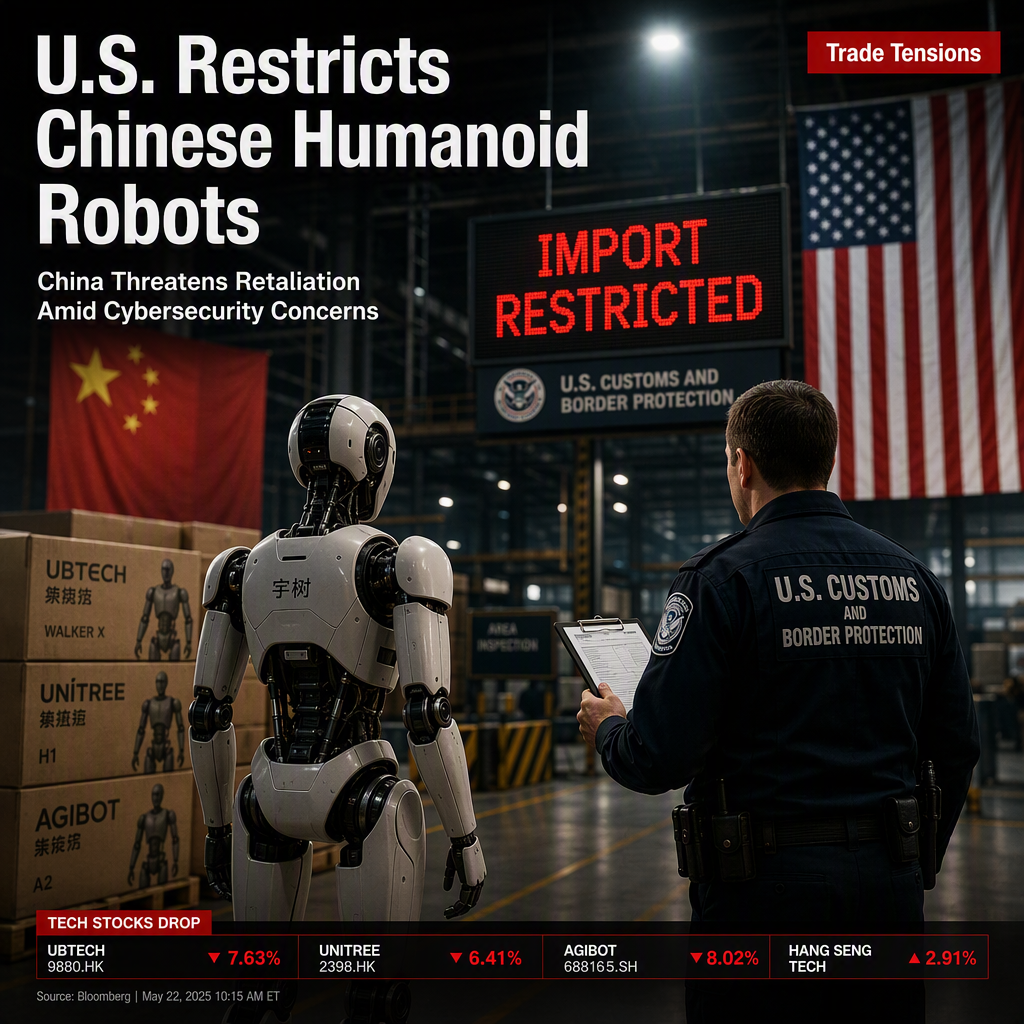
The U.S. Federal Communications Commission (FCC) announced this week that it is restricting new imports of foreign-made humanoid robots due to cybersecurity risks, adding advanced robotic devices—including humanoids—to a list of restricted imports. The FCC's statement did not specify a country, but retailers are still permitted to import models previously approved by the FCC [1]. In response, China's commerce ministry criticized the move, calling it an escalation of restrictions on Chinese goods and claiming it 'severely damages China-U.S. economic and trade stability.' The ministry urged the U.S. to withdraw the decision and threatened countermeasures if it failed to do so [1].
Marc Einstein, research director at Counterpoint Research, commented that the FCC's decision is negative for Chinese humanoid robot producers planning IPOs in the coming months. He noted that China could retaliate by further restricting rare earth sales to American companies or limiting market access for U.S. firms such as Tesla and NVIDIA [1]. According to Counterpoint, Chinese companies Agibot, Unitree, and UBTech held the top-three installation market shares for humanoid robots last year, with Tesla's Optimus ranking fifth. Hong Kong-listed UBTech shares briefly fell more than 6% in Thursday morning trading following the news, while Unitree and Agibot have filed to go public [1].
The commerce ministry's statement comes ahead of a scheduled meeting between U.S. President Donald Trump and Chinese President Xi Jinping in September. Tensions over technology have intensified, with U.S. Treasury Secretary Scott Bessent indicating that the U.S. could sanction China over alleged AI model 'theft.' President Trump commented Thursday that the U.S. might adopt a more cautious stance on AI controls to maintain American tech leadership over China [1].
Robostore, a distributor of Chinese humanoid robots in North America, has been preparing for the restrictions by expanding its U.S.-based capabilities, according to CEO Teddy Haggerty, though no further details were provided [1].
CONCLUSION
The FCC's restriction on foreign-made humanoid robot imports has triggered a strong response from China, raising the prospect of retaliatory measures and further escalating tech tensions between the two countries. The move has already impacted market sentiment, with shares of UBTech falling and uncertainty looming for Chinese robot producers planning IPOs. The upcoming Trump-Xi meeting and ongoing discussions about AI controls suggest continued volatility in the sector.