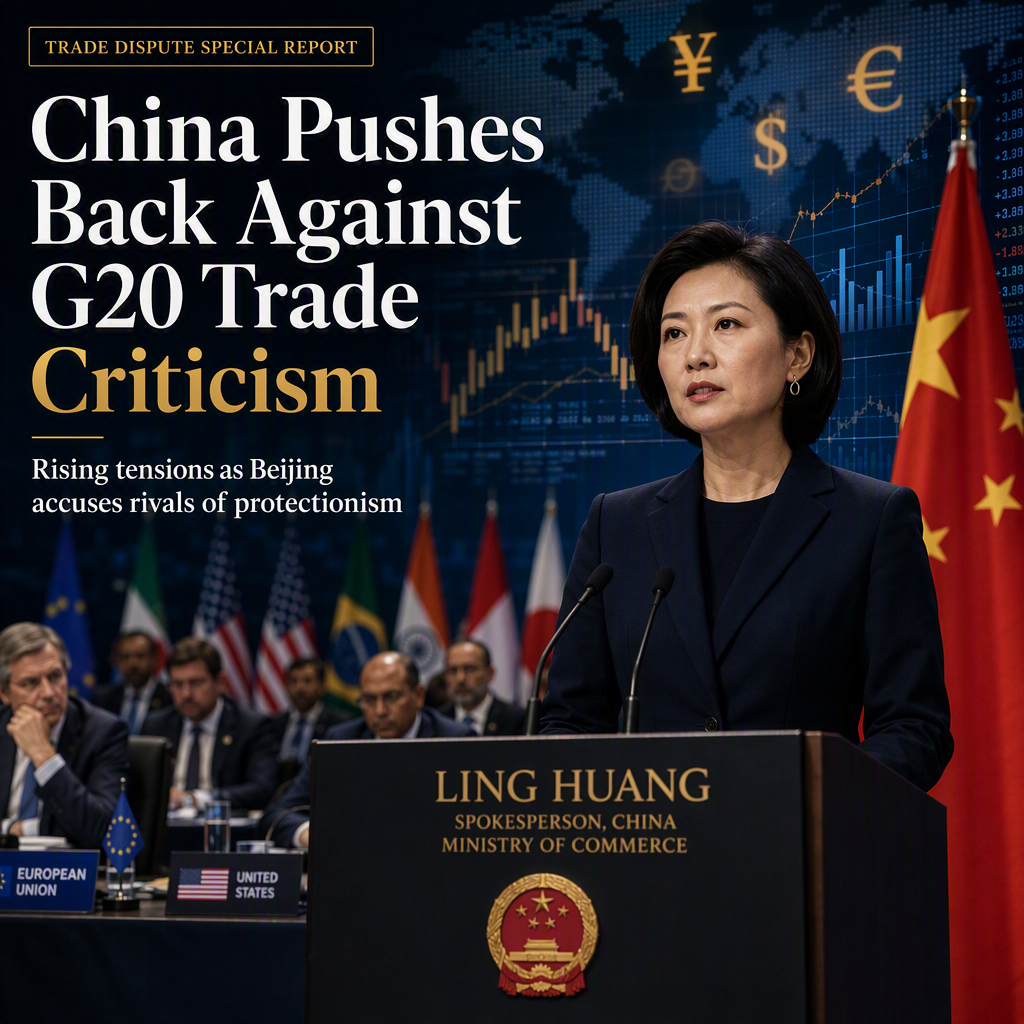
China has strongly pushed back against a G20 statement that criticized economies heavily reliant on exports, with the Chinese Commerce Ministry accusing G20 nations of 'promoting protectionism.' Ling Huang, spokesperson for the Commerce Ministry, stated that using multilateral mechanisms like the G20 to highlight 'economic imbalances' and 'overcapacity' is essentially promoting protectionism, which China firmly opposes. She warned that such actions would disrupt the global economic and trade order and harm the healthy development of the global economy [1].
The dispute centers on a joint G20 statement, from which China was the only member to dissent, following U.S. Treasury Secretary Scott Bessent's remarks that 19 G20 members agreed to address the 'unsustainable equilibrium' caused by a 'stream of cheap exports.' The Commerce Ministry also pushed back against trade complaints from the U.S. and Europe, labeling them as 'an excuse to pressure and restrict China' [1].
The timing of these comments is significant, coming ahead of Chinese President Xi Jinping's planned visit to Washington, D.C. later this month. The Commerce Ministry also criticized recent U.S. sanctions targeting Chinese companies and citizens accused of aiding Iran, demanding the U.S. 'immediately correct its wrong practices and lift sanctions.' Huang warned that China is 'strongly dissatisfied and firmly opposes' these measures, and that any entity, including Chinese banks, facilitating money laundering or sanctions evasion on behalf of Iran could be cut off from the U.S. financial system [1].
Additionally, China urged France to halt the implementation of a new law aimed at curbing low prices charged by Chinese e-commerce companies such as Temu. Huang warned that if France continues, China will take 'necessary measures' to protect its enterprises, and France will 'bear all consequences.' Trade tensions between China and the European Union remain high, with ongoing talks as Europe seeks to reduce its record trade deficit with China by October [1].
CONCLUSION
China's forceful response to G20 criticism and ongoing trade disputes with the U.S. and Europe highlight rising global trade tensions. The Commerce Ministry's warnings and threats of retaliatory measures suggest potential escalation, especially ahead of President Xi Jinping's upcoming U.S. visit. Market participants should monitor these developments for possible impacts on global trade flows and regulatory actions.