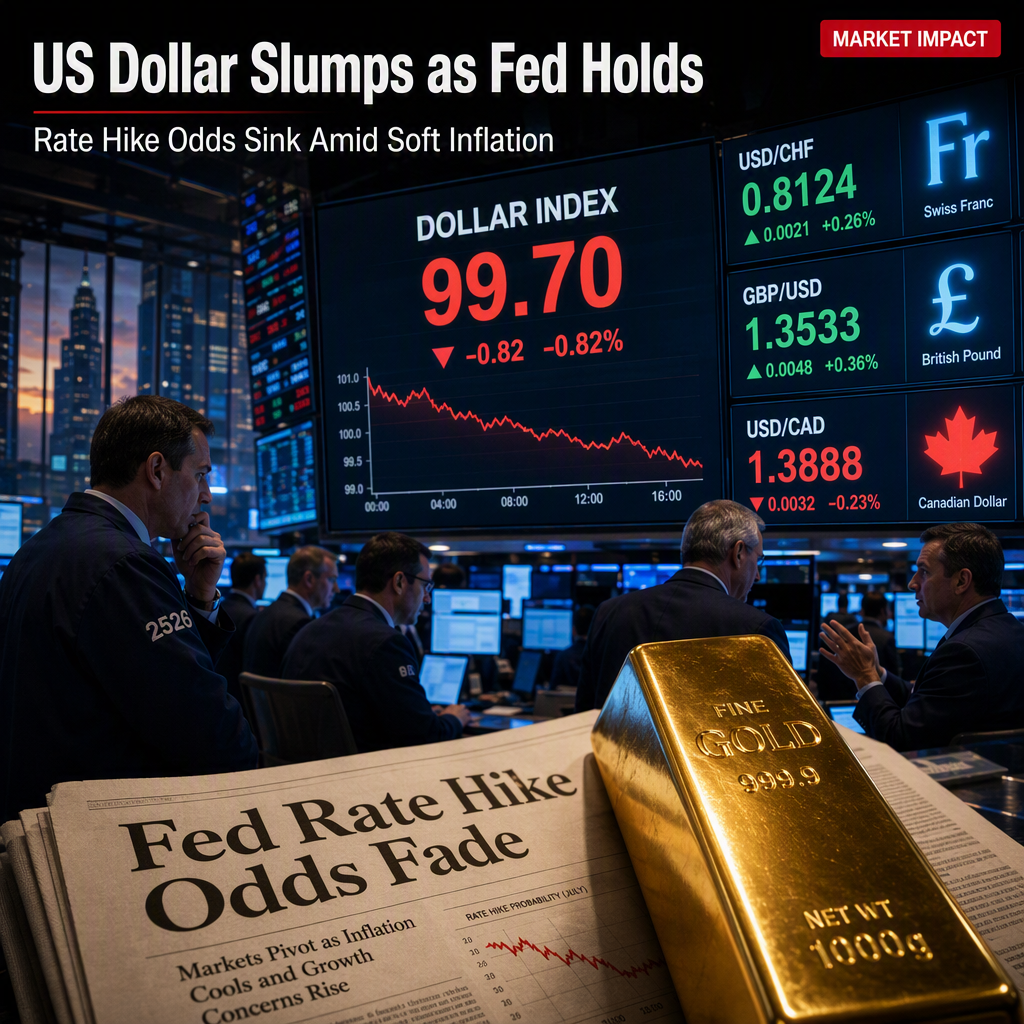
The US Dollar (USD) has weakened across major currency pairs as traders and analysts respond to a series of softer US economic data releases and fading expectations for a Federal Reserve (Fed) interest rate hike in September. The USD/CHF pair drifted to session lows below 0.8125, with the Swiss Franc (CHF) rebounding from two-week lows as futures markets slashed Fed tightening bets, pricing only a 30% chance of a 25 basis point hike next month, down from 67% two weeks ago [1]. Similarly, the British Pound (GBP) strengthened 0.35% to near 1.3533 against the USD, with the US Dollar Index (DXY) trading 0.23% lower at 99.70. The CME FedWatch tool now shows almost a 65% probability that the Fed will hold rates steady in September, a sharp repricing from 75% odds of two hikes a month earlier [2]. Commerzbank analysts note that July US CPI was broadly in line with expectations, showing no broad-based re-acceleration and giving policymakers more room to remain on hold [2].
Gold (XAU/USD) rebounded from a weekly low of $4,311 to trade around $4,350, supported by the softer USD and fading Fed hike bets. The metal remains below its two-month high of $4,449, with MUFG analysts highlighting that slowing private employment and wage growth, alongside limited spillover from higher energy prices, provide the Fed more leeway to leave rates unchanged. The CME FedWatch Tool indicates a 70% chance the Fed will keep borrowing costs unchanged in September [3]. However, persistent inflation risks and elevated oil prices could limit gold’s upside, keeping buyers cautious [3].
The US Dollar Index (DXY) is trading near the lower end of its recent 99.50–100.00 range, as cooling US CPI and PPI inflation in July trimmed the implied odds of a September Fed rate hike to nearly 30%, the lowest since the June 17 FOMC decision. Upcoming US retail sales and University of Michigan sentiment data are expected to show only modest changes and are unlikely to materially alter Fed funds futures pricing, according to Brown Brothers Harriman (BBH) [4]. July retail sales are expected to rise 0.1% month-over-month, down from 0.2% in June, while the policy-relevant control-group sales are seen rising 0.3% versus 0.5% in June. Long-term inflation expectations are forecast to remain unchanged at 3.3% for a third straight month [4].
The Canadian Dollar (CAD) outperformed most peers, with USD/CAD trading 0.32% lower at around 1.3888, partly due to optimism over US-Canada trade negotiations and the weaker USD. Analysts at Wells Fargo and Commerzbank agree that US inflation remains elevated but is improving, with July data showing only moderate inflationary pressure and unexpectedly weak jobs data easing pressure on the Fed to raise rates soon. USD/CAD technicals indicate a bearish near-term tone, with the pair below key moving averages and the Relative Strength Index in oversold territory [5].
Across all sources, the consensus is that recent US inflation and labor data have led to a significant repricing of Fed rate hike odds for September, resulting in broad USD weakness and supporting risk assets and other currencies.
CONCLUSION
Softer US inflation and labor data have prompted traders and analysts to sharply reduce expectations for a September Fed rate hike, leading to broad US Dollar weakness against major currencies and supporting assets like gold. The consensus across sources is that the Fed is likely to remain on hold, with upcoming US retail sales and sentiment data expected to have limited impact on policy outlook. This shift has had a high market impact, driving notable moves in FX and commodity markets.