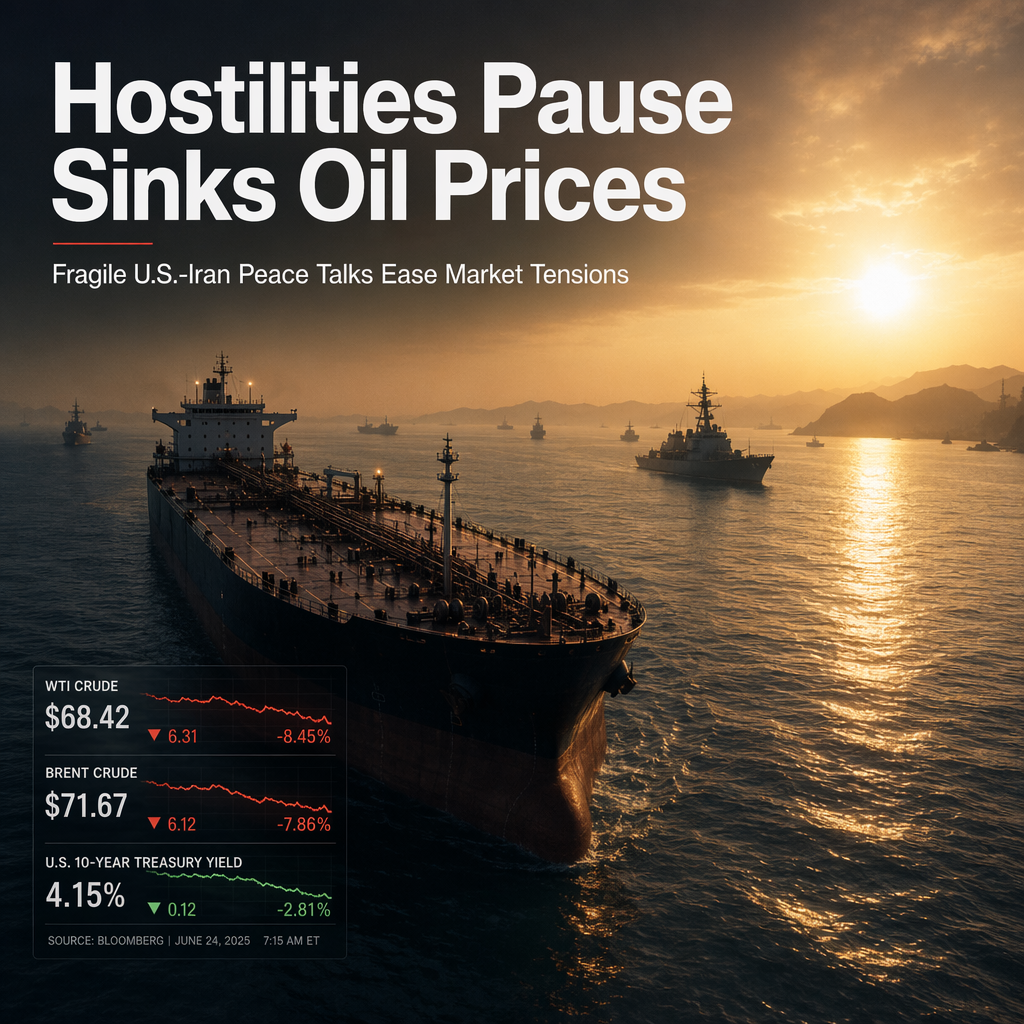
A temporary pause in hostilities between the U.S. and Iran held on Monday, following two weeks of military strikes and renewed diplomatic efforts to achieve lasting peace in the region [1][2]. The U.S. military ceased strikes on Friday, and Iran reciprocated by refraining from military operations against regional targets, influenced by a China-led initiative to restart diplomatic talks in Pakistan [1]. Despite the main actors halting direct conflict, other regional tensions persisted: Saudi Arabia conducted strikes on Iran-backed Houthi targets in Yemen after recent attacks on Red Sea shipping, and Ukraine reportedly struck an Iranian commercial vessel in the Caspian Sea, resulting in casualties [1]. These incidents underscore ongoing risks and the complexity of negotiations.
The market responded positively to the pause, with oil prices plunging by around 6% early Monday as futures markets pointed to strong performance on Wall Street [1]. Specifically, U.S. West Texas Intermediate futures dropped 5.34% to $84.55, while global benchmark Brent crude fell 5.77% to $91.20, reversing a recent climb toward $100 per barrel [2]. Treasury yields also declined, reflecting eased geopolitical tensions: the 10-year Treasury note yield fell more than 3 basis points to 4.6406%, the 2-year yield dropped 2 basis points to 4.3030%, and the 30-year yield decreased over 3 basis points to 5.1260% [2].
Negotiators face significant hurdles, including contentious issues such as Iran's nuclear program, sanctions relief, and Tehran's support for proxy groups in the Middle East [1]. Maritime security and the normalization of toll-free, two-way traffic through the Strait of Hormuz remain critical economic concerns, as the strait is still closed due to a U.S. blockade, disrupting a fifth of global oil supply [1]. Oman has emerged as a key mediator, with its delegation in Tehran seeking a provisional arrangement for shipping transit [1]. Both sides describe talks as constructive, but analysts warn that normalization of traffic is unlikely in the short term [1].
Deutsche Bank analysts highlighted that the main market risk remains on the energy and shipping front, with traffic through Hormuz severely disrupted and the conflict broadening into the Red Sea, raising the prospect of simultaneous disruption to Gulf and Red Sea export routes [1]. Investors are also watching for the Federal Reserve's upcoming interest rate decision, with consensus forecasts expecting rates to remain unchanged at 3.75% [2]. Additional U.S. economic data releases this week, including June's core PCE price index, quarterly GDP, and durable goods orders, are also in focus [2].
CONCLUSION
The pause in U.S.-Iran hostilities has led to a sharp drop in oil prices and Treasury yields, signaling improved market sentiment. However, ongoing regional tensions and unresolved negotiation points mean risks to energy and shipping markets persist. Investors remain cautious, awaiting further developments in peace talks and the Federal Reserve's rate decision.