
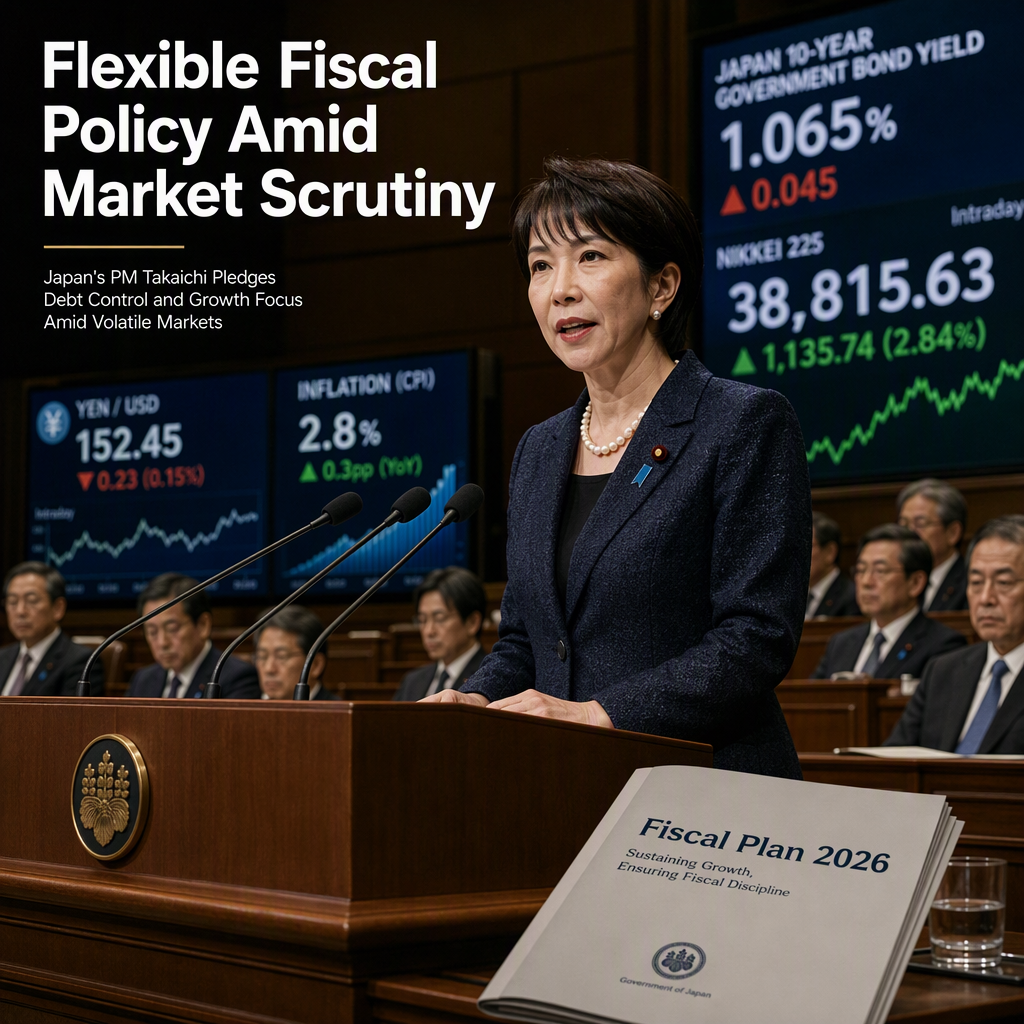
Japanese Prime Minister Sanae Takaichi addressed the parliament on October 5, 2026, seeking to reassure financial markets about her government's fiscal policy stance. Takaichi emphasized a commitment to respond 'flexibly' to economic and market conditions, while maintaining her administration's expansionary spending agenda [1]. She stated, 'We will respond flexibly to economic and market conditions,' but did not signal a shift away from increased government spending [1].
Amid heightened investor scrutiny over Japan's public finances, Takaichi specifically pledged to control annual debt issuance and to scrutinize the economy, prices, tax revenues, interest rates, debt-servicing costs, and market developments [2][3]. She also promised to enhance market trust by communicating closely with the public and both domestic and overseas market participants [2][3]. Additionally, Takaichi announced that a five-year investment plan would be drawn up and released by the end of the year [2][3].
The market context for Takaichi's remarks includes rising government bond yields and persistent inflationary pressures, with the Bank of Japan recently hiking rates to 1.25% and the Tokyo core inflation rate increasing [1]. The Nikkei average has regained the 70,000 mark, buoyed by optimism over artificial intelligence [1]. Meanwhile, the Japanese Yen traded around 158.00 against the US Dollar, with the USD/JPY pair down 0.02% at 157.80 as of the latest reporting [2][3]. The broader bearish trend for the Yen remains intact as global borrowing costs surge and the US Dollar retains its safe-haven appeal [2].
Japan's Consumer Confidence Index ticked down to 35.4 in September from 35.5 in August, slightly above market expectations of 35.3, indicating continued caution among consumers [2]. Market participants and analysts have called for tighter fiscal controls and clearer targets to ensure discipline, citing concerns over Japan's debt-to-GDP ratio and potential market volatility [1]. Takaichi reiterated that if the economy or markets make unexpected movements, the government would analyze the impact and respond nimbly as needed [3].
No specific price levels, support/resistance, or technical indicators were provided in the official statements [1].
CONCLUSION
Prime Minister Takaichi's assurances of flexible fiscal management and debt containment come at a time of heightened market scrutiny and rising borrowing costs. While her administration remains committed to expansionary spending, the pledge to control debt issuance and enhance market trust aims to stabilize investor sentiment. The market response has been cautious, with the Yen steady and consumer confidence subdued, reflecting ongoing concerns about Japan's fiscal trajectory.