
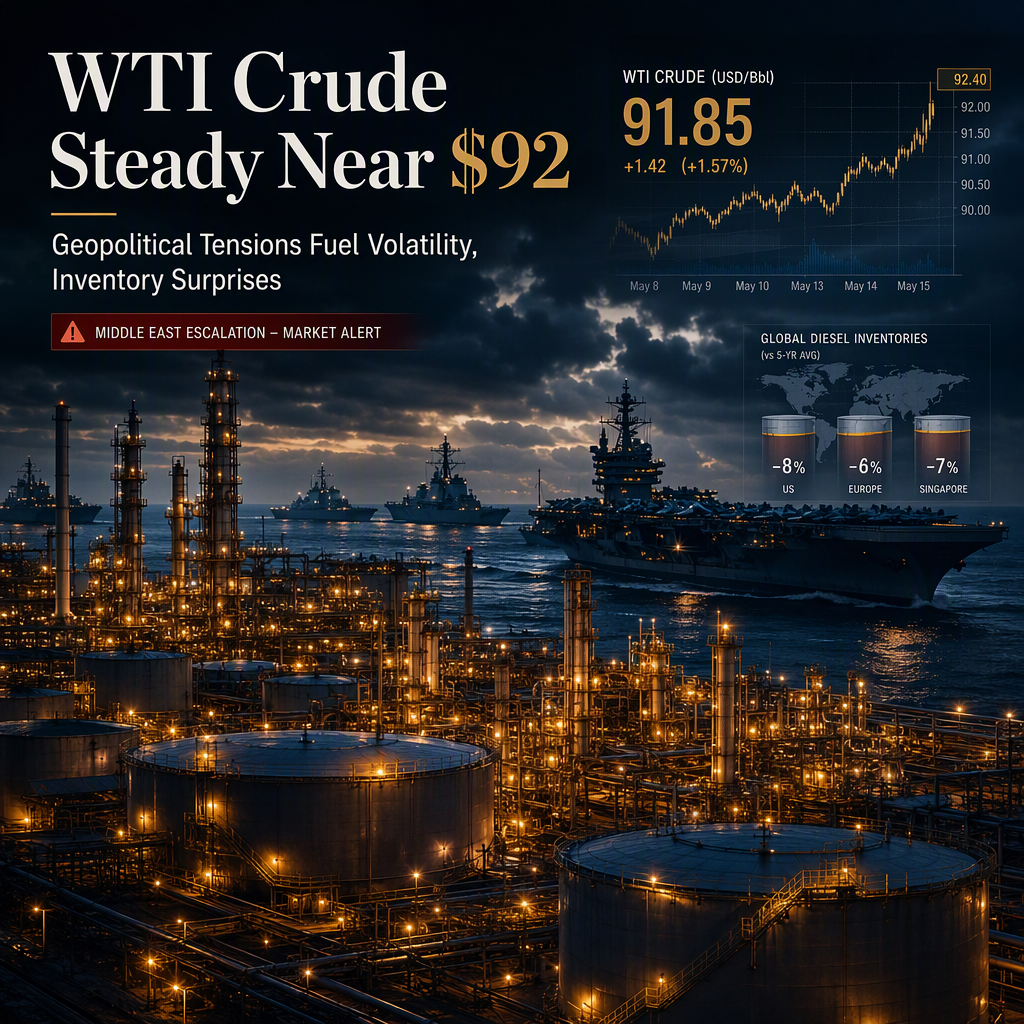
West Texas Intermediate (WTI), the US crude oil benchmark, traded around $91.75 during early Asian hours on Friday, remaining steady after a two-day gain as the United States considered deploying another aircraft carrier group to the Middle East [1]. According to The Wall Street Journal, the Pentagon may soon send a third aircraft-carrier strike group and 10,000 sailors and Marines to the Persian Gulf, a move prompted by US President Donald Trump's statement that increased military strikes against Iran were 'possible' after the November midterm elections [1]. This potential escalation led to a volatile session for WTI, as traders weighed the risks of conflict against improving oil flows from the region [1].
Analysts from ANZ Group Holdings Ltd., Brian Martin and Daniel Hynes, highlighted that the oil market remains highly susceptible to price spikes due to low inventory levels following six months of drawdowns. They noted growing investor concerns that Iran could retaliate against the US military buildup with attacks on US assets and energy infrastructure in the region [1].
On the supply side, US crude oil inventories unexpectedly increased last week. The Energy Information Administration (EIA) reported that crude oil stockpiles for the week ending September 25 rose by 922,000 barrels, compared to a surge of 2.969 million barrels in the previous week. This was in contrast to the market consensus, which anticipated a 300,000 barrel decline [1].
In response to global diesel shortages, the Trump administration urged the European Union to release diesel from emergency stockpiles to help avert US export curbs, according to Bloomberg. US Treasury Secretary Scott Bessent called on European allies to ease the global shortage [1]. Societe Generale’s Kit Juckes warned that banning exports, as proposed by President Trump, could lead to diesel accumulating in storage tanks rather than lowering prices for US consumers, and flagged potential negative implications for Eurozone growth if oil prices and bond yields remain elevated [1].
Technically, WTI maintains a constructive near-term outlook, trading well above the 100-day moving average and supported by the lower Bollinger Band [1].
CONCLUSION
WTI crude prices remain steady near $92 amid heightened geopolitical tensions and unexpected inventory builds. Market sentiment is cautious, with analysts warning of potential price spikes and broader economic risks if the situation in the Middle East escalates or if oil prices stay elevated.