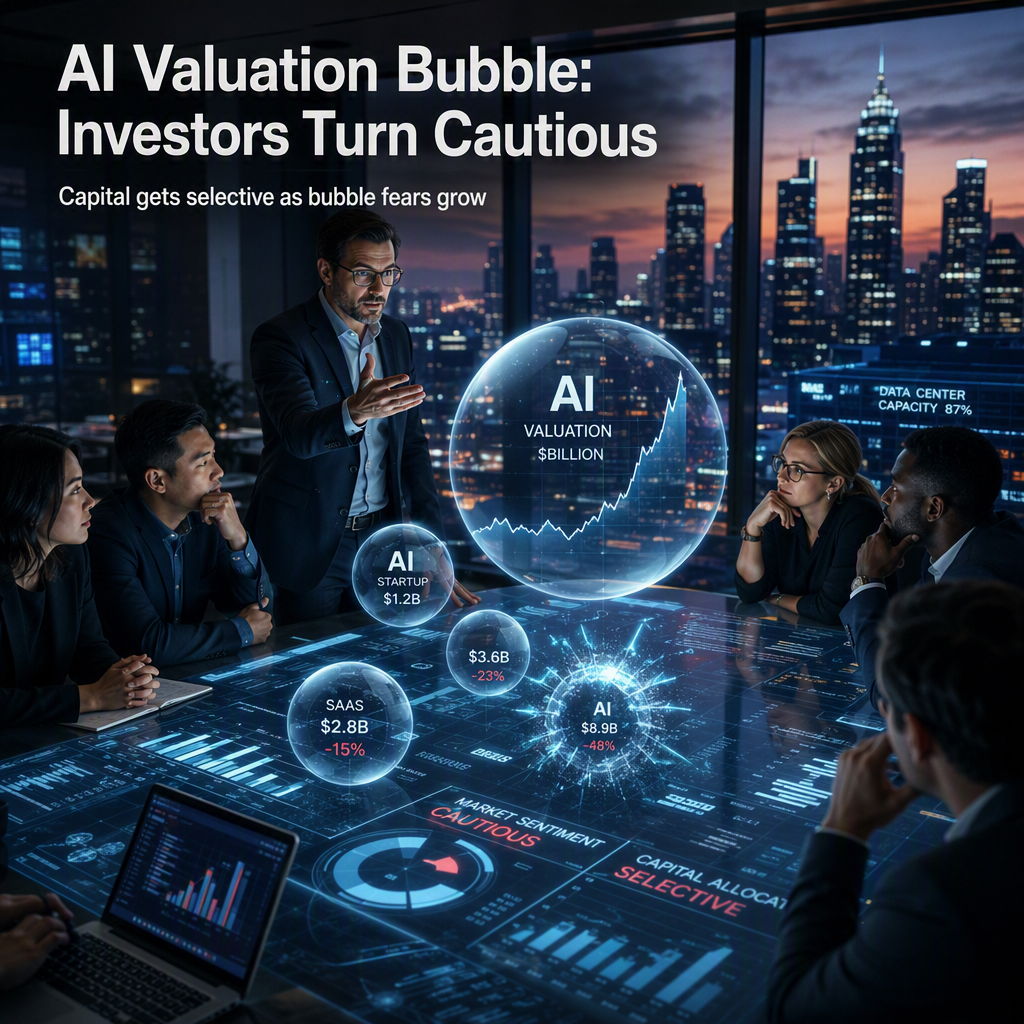
Investors and venture capitalists are raising concerns about excessive valuations in certain segments of the artificial intelligence (AI) sector, warning that a 'shakeout' may be imminent as capital becomes more selective. Jakub Nytra, founding partner at Purple Ventures, stated that investors are likely to become much more demanding over the next six to twelve months, focusing on where AI technology creates genuine value rather than superficial features presented as businesses [1].
The ongoing AI boom has led to significant investment in semiconductor companies beyond Nvidia, with the expectation that the expansion of AI data centers will benefit a wider range of chipmakers and infrastructure firms. However, there are persistent worries about a potential bubble, as companies continue to increase capital expenditures without clear evidence of sustainable growth [1]. David Ng, CEO of Arki Finance, emphasized the importance of determining whether AI applications and end users can generate enough productivity, revenue, and cash flow to justify these investments [1].
Nytra highlighted that not every company touting AI deserves high valuations, and that the true winners will be those solving expensive and complex problems with AI. He cited TASS Vision, a portfolio company, which uses edge AI and cameras to analyze customer movement in physical stores, providing actionable data for retailers [1].
Despite concerns about a possible bubble, Shane Chesson of Openspace Capital noted that even if a correction occurs, the infrastructure built during this period will remain valuable and transformative for many companies. He suggested that any fallout would primarily affect those who invested during the height of speculative enthusiasm [1].
CONCLUSION
The AI sector is facing increased scrutiny from investors as concerns about overvaluation and a potential bubble grow. While capital is expected to become more selective, experts believe that the underlying infrastructure and genuinely valuable AI applications will continue to drive long-term transformation in the market.