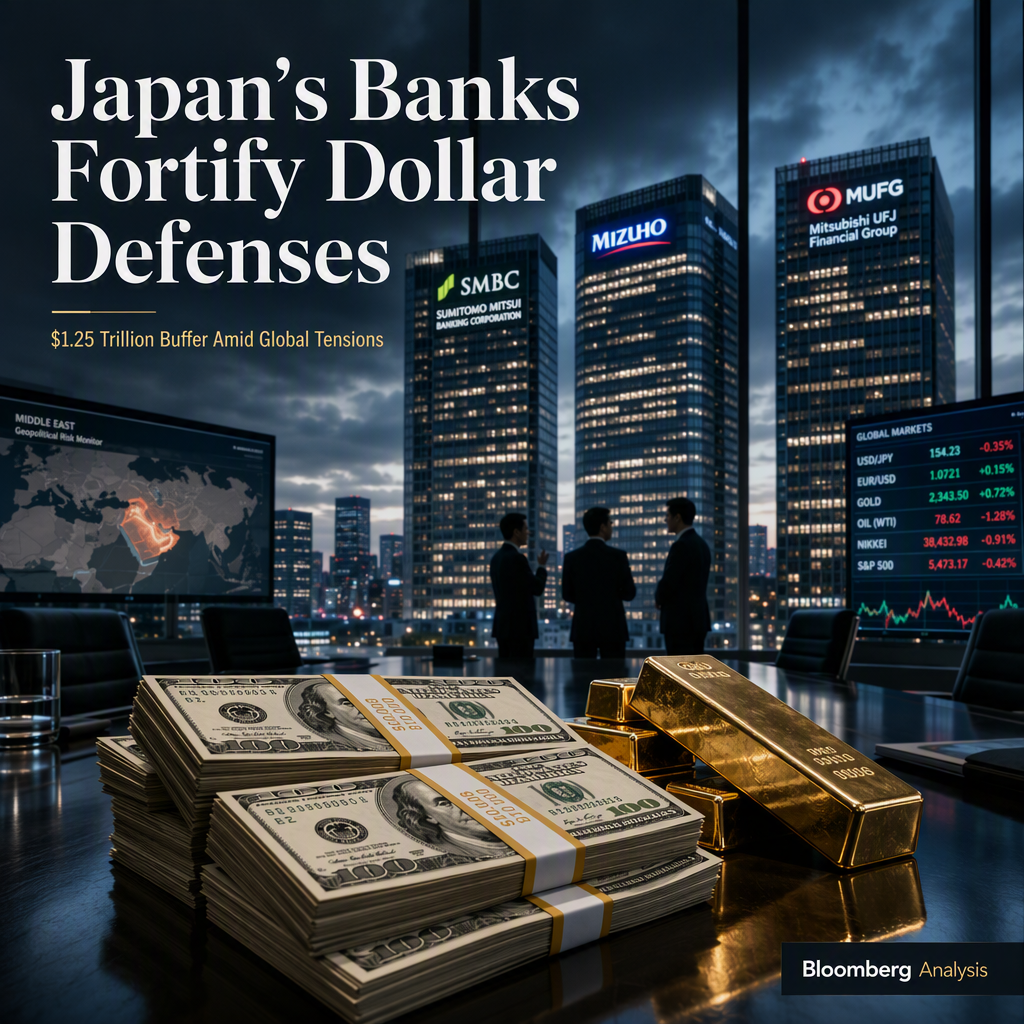
Japan's top three banks—Sumitomo Mitsui Banking Corp., Mizuho Bank, and MUFG Bank—have collectively increased their foreign currency liquidity buffers to $1.25 trillion in response to heightened geopolitical risks stemming from the ongoing U.S.-Iran conflict [1]. This move is designed to prepare for a potential surge in demand for dollar funding by Japanese corporate clients, who may face abrupt dollar shortages if the situation in Iran triggers global market volatility [1].
The banks are implementing several measures to strengthen their dollar liquidity, including raising the level of highly liquid foreign assets, expanding access to overseas funding lines, and collaborating with international counterparties to secure stable dollar supplies [1]. Additionally, they are conducting scenario analysis and stress testing to assess the resilience of their dollar liquidity under various crisis scenarios [1].
While the precise composition of the liquidity buffers has not been disclosed, sources indicate that the majority consists of highly liquid assets such as U.S. Treasurys and short-term deposits with major global banks [1]. These buffers are also intended to help the banks meet regulatory requirements for liquidity coverage ratios [1].
Industry observers note that Japanese banks have traditionally maintained ample yen liquidity but have been increasing their foreign currency buffers in recent years due to the growing internationalization of their client base. The current expansion represents a significant step in response to the ongoing uncertainty related to the U.S.-Iran conflict [1].
CONCLUSION
Japan's leading banks are proactively bolstering their dollar liquidity to mitigate risks from geopolitical tensions in the Middle East. This substantial increase in foreign currency buffers signals heightened caution and preparedness in Japan's financial sector. The move is likely to reassure corporate clients and regulators amid ongoing global uncertainty.