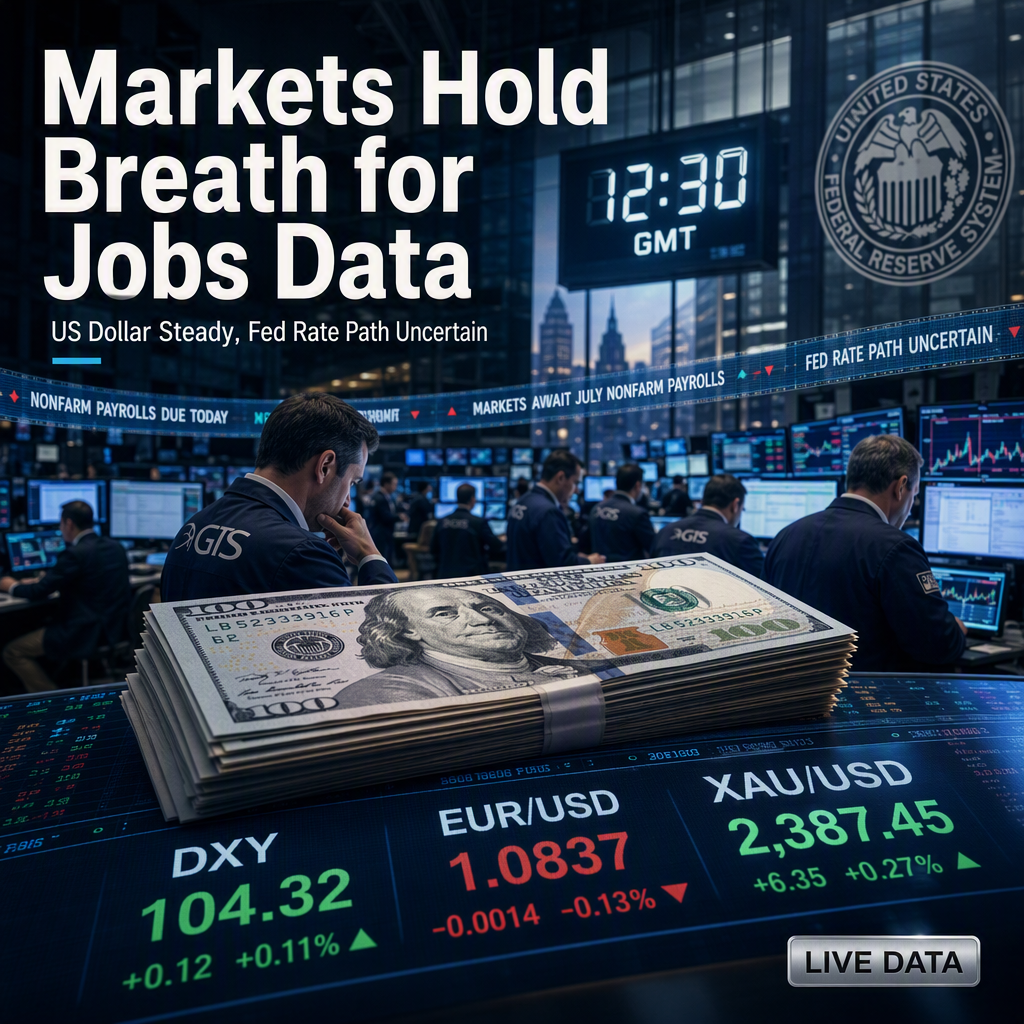
The US Dollar (USD) consolidated against major peers on Friday, with investors closely watching the July Nonfarm Payrolls (NFP) report, scheduled for release at 12:30 GMT, as a key determinant for Federal Reserve (Fed) interest rate expectations [2][4][5]. Consensus forecasts anticipate an NFP gain of 80,000 jobs, following a 57,000 increase in June, with the unemployment rate expected to remain unchanged at 4.2% [4][5]. Initial jobless claims rose by just 1,000 to 199,000, beating the 205,000 consensus and remaining below 200,000 for a third consecutive week, underscoring labor market resilience [1].
Strategists at DBS caution that a sub-80,000 NFP could weigh on the USD by dampening expectations for another Fed rate hike this year, while Brown Brothers Harriman (BBH) notes that even a strong payrolls print is likely to offer only limited and short-lived support for the USD, given that roughly 50 basis points of tightening are already priced in over the next year [2][5]. OCBC analysts argue that continued US economic resilience should eventually refocus tightening concerns, keeping the USD moderately bullish over the next one to two quarters, despite softer June inflation allowing the Fed to remain patient [1].
The US Dollar Index (DXY) traded flat at around 99.92, maintaining a bearish near-term bias as it held below the 20-day EMA at 100.46, with the RSI at 39.62 indicating downside pressure [2]. Technical analysis suggests immediate support at 99.49–99.48 and resistance at 100.04 and 100.46, with a daily close above these levels needed to ease the bearish tone [2]. Meanwhile, USDJPY edged back towards 160, keeping intervention risks on the radar [1].
Gold (XAU/USD) extended its recovery, trading around $4,322 and reaching a seven-week high, as technical buying accelerated and traders awaited the NFP report [4]. The precious metal gained more than 6% for the week, its strongest rise since January, after breaking above the $4,000–$4,200 range. The advance was initially fueled by optimism over a potential reopening of the Strait of Hormuz, which pushed oil prices lower and eased energy-driven inflation concerns, weighing on the USD and US Treasury yields [4]. However, geopolitical risks remain, with Iran reportedly striking hostile targets in the Strait and reviewing a bill to bar US and other hostile vessels from the waterway [4].
In the EUR/USD market, United Overseas Bank (UOB) analysts report that the pair retreated to 1.1524 after failing to break resistance at 1.1560. Strong support is seen at 1.1495, and a close above 1.1565 would open the way toward 1.1600, while a break below 1.1495 would signal a shift into range trading [3].
CONCLUSION
Markets are in a holding pattern ahead of the US July Nonfarm Payrolls report, with consensus expecting 80,000 jobs added and the unemployment rate steady at 4.2%. While a strong payrolls print could modestly boost the US Dollar, analysts expect any gains to be limited and short-lived, given current Fed rate expectations. Gold has surged on easing inflation concerns and geopolitical developments, while EUR/USD and DXY remain range-bound, awaiting clearer direction from upcoming US labor data.