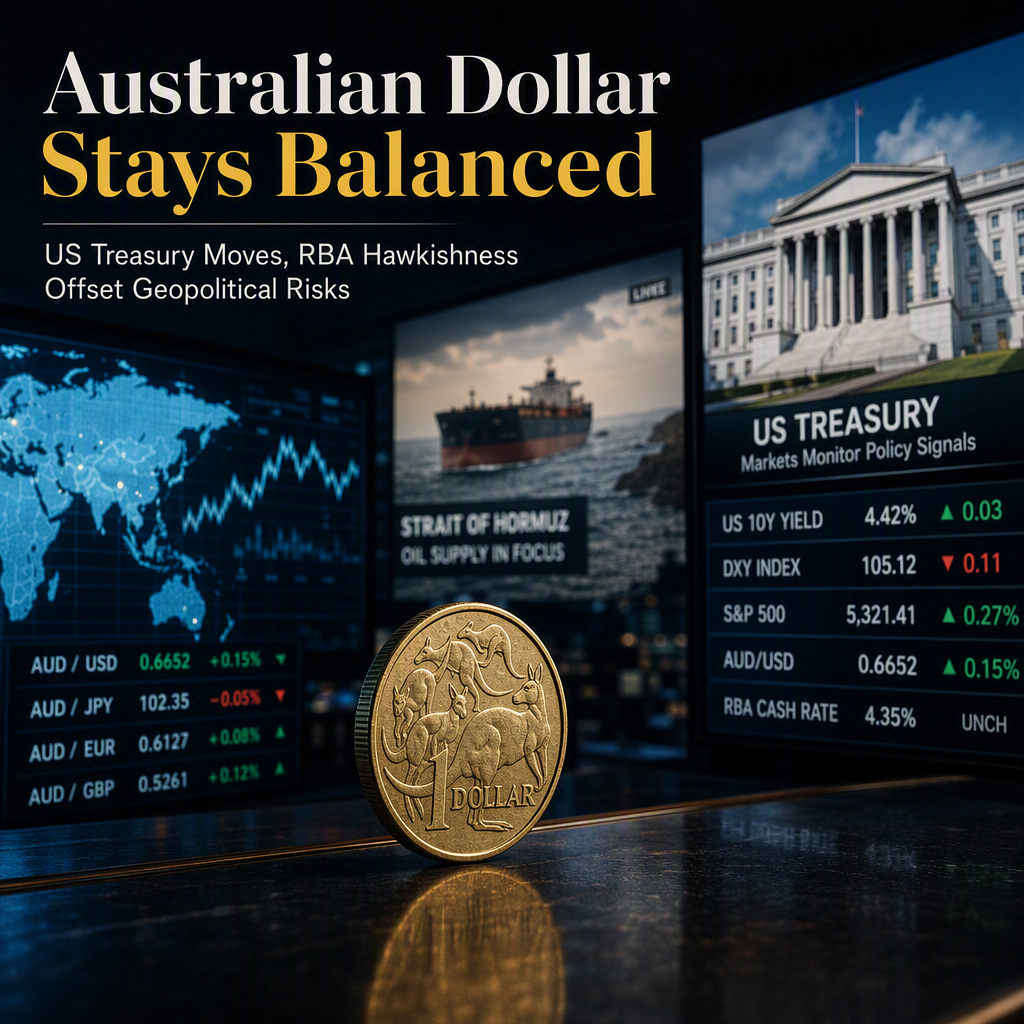
The Australian Dollar remained virtually unchanged against the US Dollar on Wednesday, with the AUD/USD pair trading at 0.7219, reflecting a flat performance amid a subdued economic calendar and competing market forces [1]. The US Treasury announced a buyback of up to $6 billion in outstanding securities maturing in the 10- to 20-year tranche for the September 10 auction, which initially boosted the US Dollar. However, this move faded as the North American session progressed [1]. US Treasury yields ended higher, with the 10-year yield rising five basis points to 4.845% and the 30-year yield, used for mortgage rates, increasing by four and a half basis points to 5.293% [1].
Geopolitical tensions persisted in the Middle East, particularly near the Strait of Hormuz, where Tehran continued attacks on US military facilities and warships, while the US targeted Iranian oil vessels. These hostilities contributed to market uncertainty but did not significantly move the AUD/USD pair [1]. In the US, the ADP Employment Change 4-week average rose from 10K to 12K, and market participants are now focused on the upcoming Producer Price Index (PPI) data, expected to rise from 0% to 0.4% month-on-month and from 4.7% to 5.3% annually. Core PPI figures are also projected to increase [1].
In Australia, Reserve Bank of Australia (RBA) Deputy Governor Hauser stated that the next policy meeting will focus on whether to raise interest rates, following the RBA's cumulative 75-basis-point hike to 4.35% this year [1]. The upcoming release of Consumer Inflation Expectations for September is seen as a potential catalyst; a reading above August’s 4.9% could prompt a more hawkish stance from the RBA [1].
From a technical perspective, AUD/USD is trading at 0.7220, maintaining its advance above key trend support and moving averages, with a bullish near-term bias. Resistance is noted at 0.7354, with further barriers at 0.8597 and 0.9394, while support lies at 0.7198 and lower trend-line levels [1].
CONCLUSION
The Australian Dollar's flat performance reflects a balance between US Treasury actions, rising yields, RBA hawkishness, and ongoing geopolitical risks. Market participants are awaiting key inflation data from both the US and Australia, which could influence future central bank decisions and currency movements.