
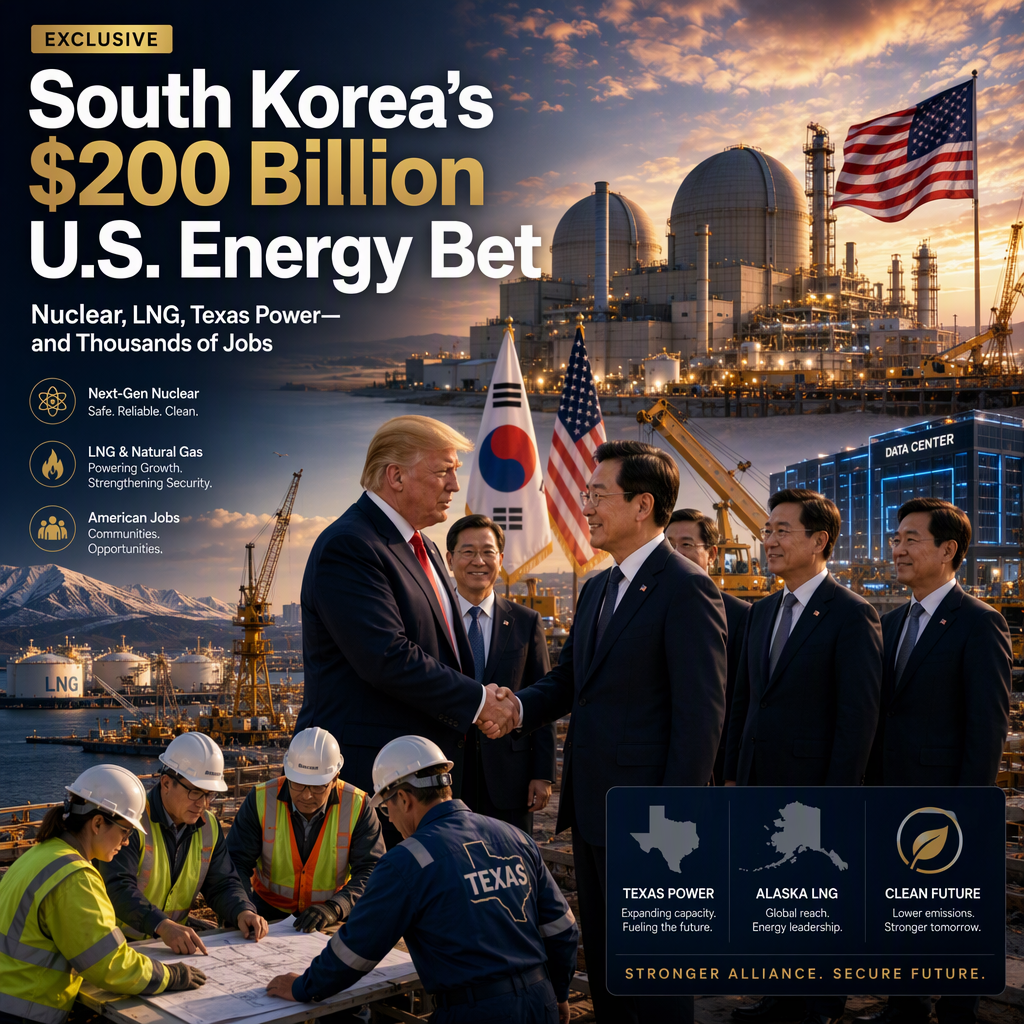
President Donald Trump announced that South Korea will invest up to $200 billion in U.S. energy infrastructure, calling it “one of the largest energy infrastructure investments in American history” [1]. The investment package spans nuclear power, natural gas facilities, and potentially the Alaska LNG project, though South Korea's participation in the latter is not yet finalized [1].
The package includes $22.3 billion for a 6,472-megawatt natural gas power facility in Encinal, Texas, which will supply electricity to co-located data centers. This project is led by Related Companies and NextEra Energy, with the first phase expected to begin commercial operations in 2029 and full completion by 2032 [1]. The U.S. and South Korea will work to expand Korean companies’ roles in equipment supply, engineering, construction, and long-term operations and maintenance for the Texas project and similar initiatives nationwide [1].
A significant portion, $120 billion, is earmarked for eight large-scale nuclear reactors in the U.S., with $100 billion allocated for construction and $20 billion for contingency reserves [1]. Trump emphasized that these investments would result in “huge construction projects” and create “tens of thousands of American jobs,” highlighting the anticipated boost to U.S. power capacity, manufacturing, and employment [1].
Regarding the Alaska LNG project, Trump stated that the countries had agreed to work on the project, valuing it at $50 billion. However, South Korea has not committed to the project due to concerns about its commercial viability, with Industry Minister Kim Jung-kwan describing it as “high-risk” unless it can generate sufficient cash flow [1]. The joint statement clarified that South Korea’s participation would depend on "commercial reasonableness," and no specific investment allocation was detailed [1]. The U.S. government pledged to facilitate favorable involvement of Korean vendors and suppliers if the project proceeds [1].
CONCLUSION
South Korea's planned investment marks a major commitment to U.S. energy infrastructure, with substantial allocations to nuclear and natural gas projects and the potential for further involvement in the Alaska LNG project. While the Texas and nuclear initiatives are moving forward, the Alaska LNG project remains uncertain pending commercial viability. The investments are expected to drive significant job creation and strengthen U.S.-Korea energy ties.