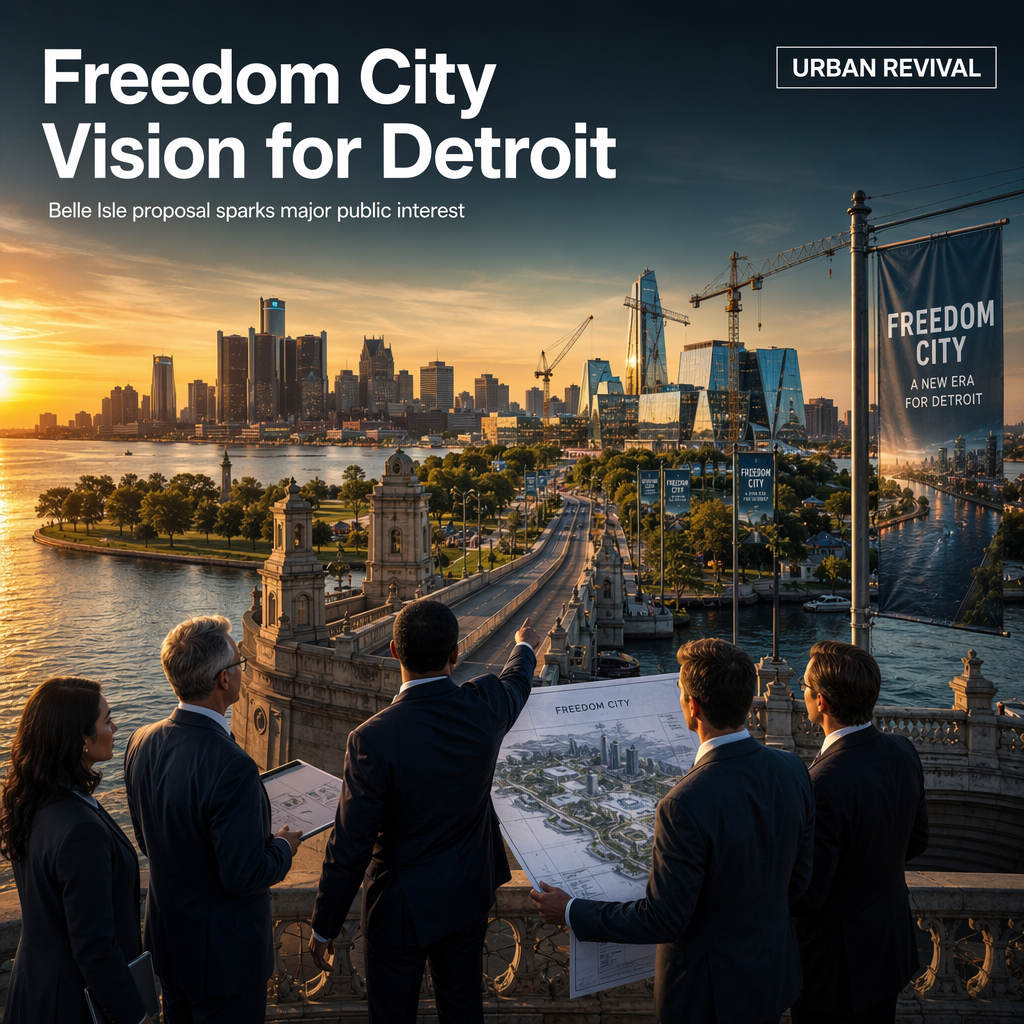
Rodney Lockwood, Board Chairman of the Mackinac Center for Public Policy, has proposed transforming Detroit’s Belle Isle into a self-governing 'Freedom City' as a blueprint for urban revival, citing high taxes as a primary reason why major cities like New York City, Los Angeles, and San Francisco are facing structural challenges [1]. Lockwood argues that progressive-led cities such as New York, Chicago, Boston, and Los Angeles are experiencing taxpayer flight due to high state and local taxes, crime concerns, and high costs of living, referencing a National Taxpayers Union Foundation (NTUF) study released April 7, 2026, which confirms that taxpayers are leaving high-tax environments for states with more favorable fiscal policies [1].
The NTUF 'Migration in Minutes' metric found that Texas surpassed Florida in 2022 as the state gaining a new taxpayer most frequently, with one new taxpayer every 4 minutes and 40 seconds [1]. Lockwood’s proposal for Belle Isle includes eliminating local income taxes and taxes on investments to attract residents and businesses, aiming to generate significant economic activity and private-sector jobs in Detroit, a city that has suffered decades of population decline [1].
Belle Isle, originally developed as a public park in the late 19th century, covers 982 acres—about 140 acres larger than New York City’s Central Park—and is currently leased to the State of Michigan under a 30-year agreement signed in 2013 [1]. Lockwood envisions private investors purchasing or leasing the island from Detroit to develop a mixed-use residential, retail, and commercial district [1].
Recent polling by Michigan pollster Steve Mitchell indicates strong public interest in bold economic solutions, with 68% of likely Detroit voters and 51% of voters overall expressing support for such initiatives [1].
CONCLUSION
Rodney Lockwood’s proposal to create a low-tax 'Freedom City' on Belle Isle reflects growing concerns about the economic viability of high-tax cities and the migration of taxpayers to lower-tax states. The plan has garnered notable public interest and could serve as a model for urban economic revitalization if implemented.