
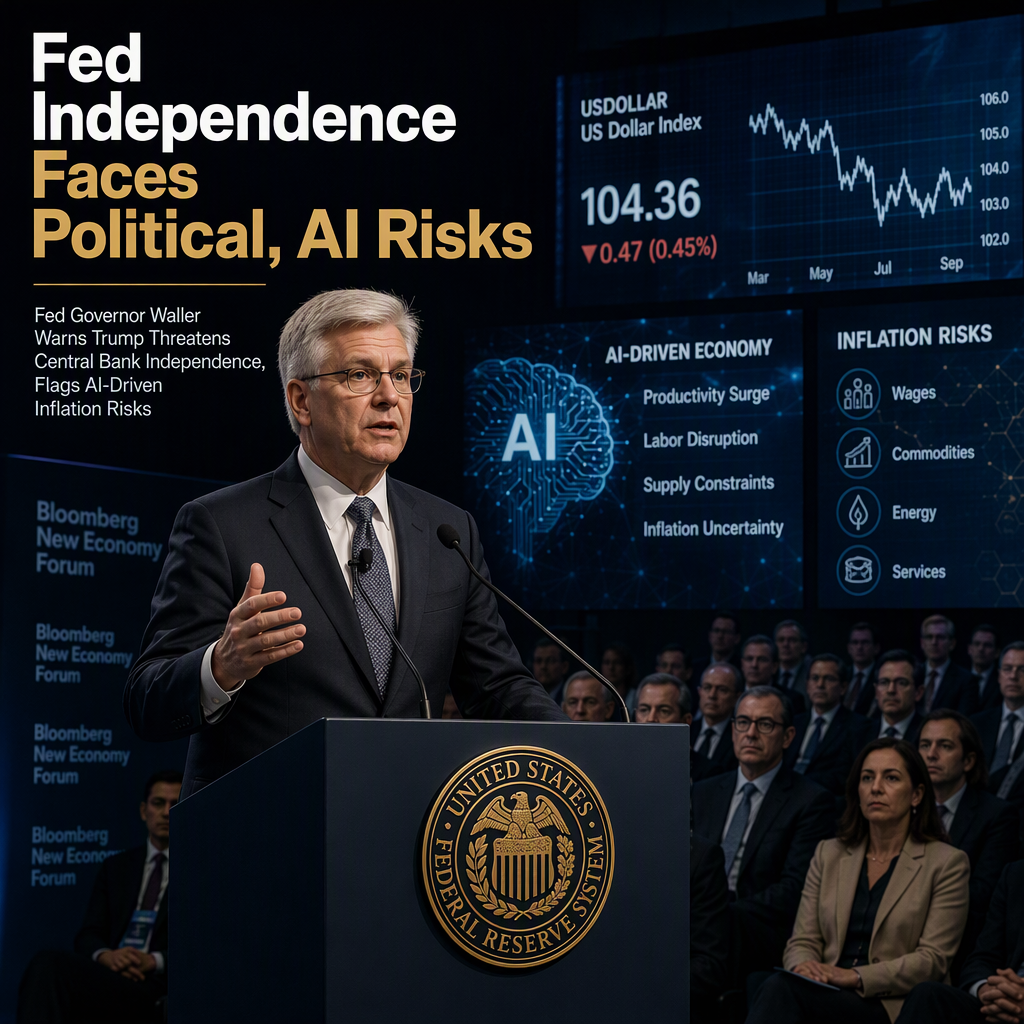
Federal Reserve Governor Christopher Waller stated during the Bloomberg New Economy Forum 2026 discussion that United States President Donald Trump poses a threat to the central bank’s independence, but emphasized that Trump has not succeeded in undermining it so far. Waller expressed confidence in Congress and the courts to protect the Fed’s autonomy, despite the perceived threat [1].
Waller also highlighted the impact of artificial intelligence (AI) on the economy, noting that AI could contribute to widening GDP per capita and is beginning to affect inflation due to increased demand during the build-out period. He warned that this AI-driven inflationary pressure could persist for 2–3 years, requiring the Fed to decide how to respond to the associated demand [1].
Market reaction to Waller’s remarks was muted, with no immediate movement in the US Dollar following his comments. The US Dollar Index (DXY) was down 0.3% to near 102.30 at the time of reporting [1]. The FXS Fed Sentiment Index fell by 1.52 points to 137.39, indicating a modest hawkish pullback but maintaining a deeply hawkish overall stance. Waller’s speech scored 6.2/10 on the FXS Speechtracker, slightly softer than the historical average of 6.7/10, yet still clearly hawkish in tone [1].
Waller’s emphasis on AI-driven demand, rising real yields tied to real growth, and the risk that AI build-out could lift inflation for 2–3 years underscores a medium-term upside risk to rates. The explicit warning about Trump’s threat to Fed independence is tempered by Waller’s confidence in institutional safeguards. Overall, the Fed remains focused on managing structurally stronger demand and inflation pressures, rather than shifting toward a dovish stance [1].
CONCLUSION
Fed Governor Waller’s remarks reinforce a hawkish outlook, highlighting medium-term inflation risks from AI and maintaining confidence in the Fed’s independence despite political threats. The market reaction was limited, but the overall tone suggests continued support for elevated rate expectations and a stronger Dollar bias.