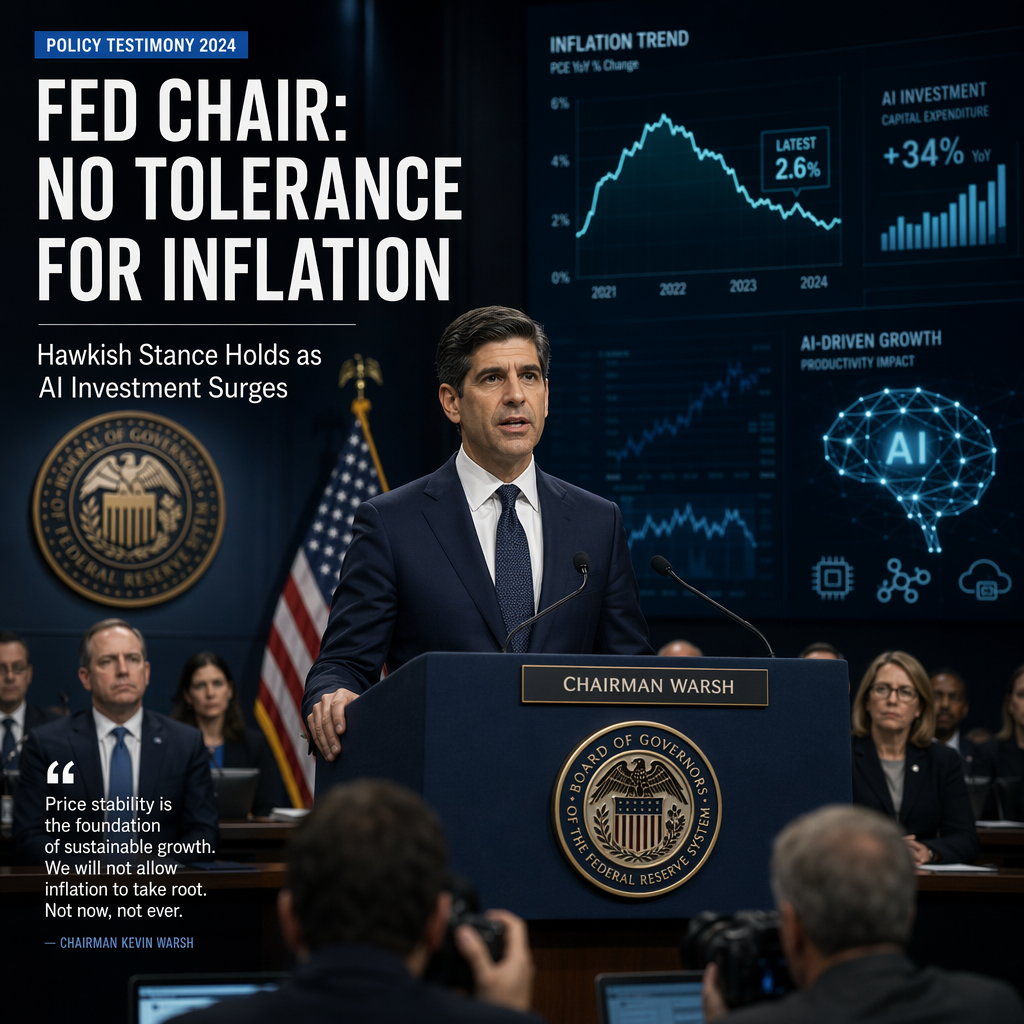
Federal Reserve Chairman Kevin Warsh, in his prepared remarks for the Semiannual Monetary Policy Report before the US House Financial Services Committee, emphasized that the Fed has 'no tolerance for persistently elevated inflation' and reiterated the central bank's commitment to bringing inflation under control through appropriate monetary policy measures [1]. Warsh stated, 'If we get policy right—and we will—the inflation surge of the last five years will be a thing of the past,' underscoring the Fed's resolve to address inflationary pressures [1].
Warsh highlighted several key economic indicators, noting that household consumption growth remains moderate and manufacturing output has increased steadily this year, while the housing sector continues to lag [1]. He described the current economic activity as expanding at a solid pace, demonstrating resilience despite recent developments [1]. A notable feature of the economy, according to Warsh, is the acceleration in business investment, particularly related to artificial intelligence (AI) projects and spending. Equipment investment rose about 8% in Q1, with high-tech spending growing at an annualized rate of nearly 25% [1]. Productivity growth has been strong, predating the gains from AI adoption, and the labor market appears broadly stable, with low unemployment, few layoffs, and solid nominal wage growth [1].
Warsh also mentioned that the Fed is closely monitoring the implications of these trends for inflation and the labor market, and that task forces have been established to review current practices and ensure the Fed meets its objectives [1]. The balance sheet task force will examine the advantages and disadvantages of the ample reserves regime and explore alternatives [1].
The FXS Speechtracker rated Warsh’s testimony a 7/10, consistent with the historical average, indicating a steady, firmly anti-inflation stance rather than an escalation in hawkishness [1]. The FXS Fed Sentiment Index remained at 127.19, confirming that the overall policy tone is firmly hawkish relative to the historical average [1]. This suggests that markets should interpret Warsh’s remarks as a continuation of the existing hawkish narrative [1].
CONCLUSION
Fed Chair Warsh’s testimony reinforced the central bank’s commitment to combating inflation, with no indication of a shift toward a more dovish stance. Strong business investment, especially in AI, and a stable labor market support the Fed’s confidence in the economy’s resilience. Markets are expected to view these remarks as a continuation of the current hawkish policy approach.