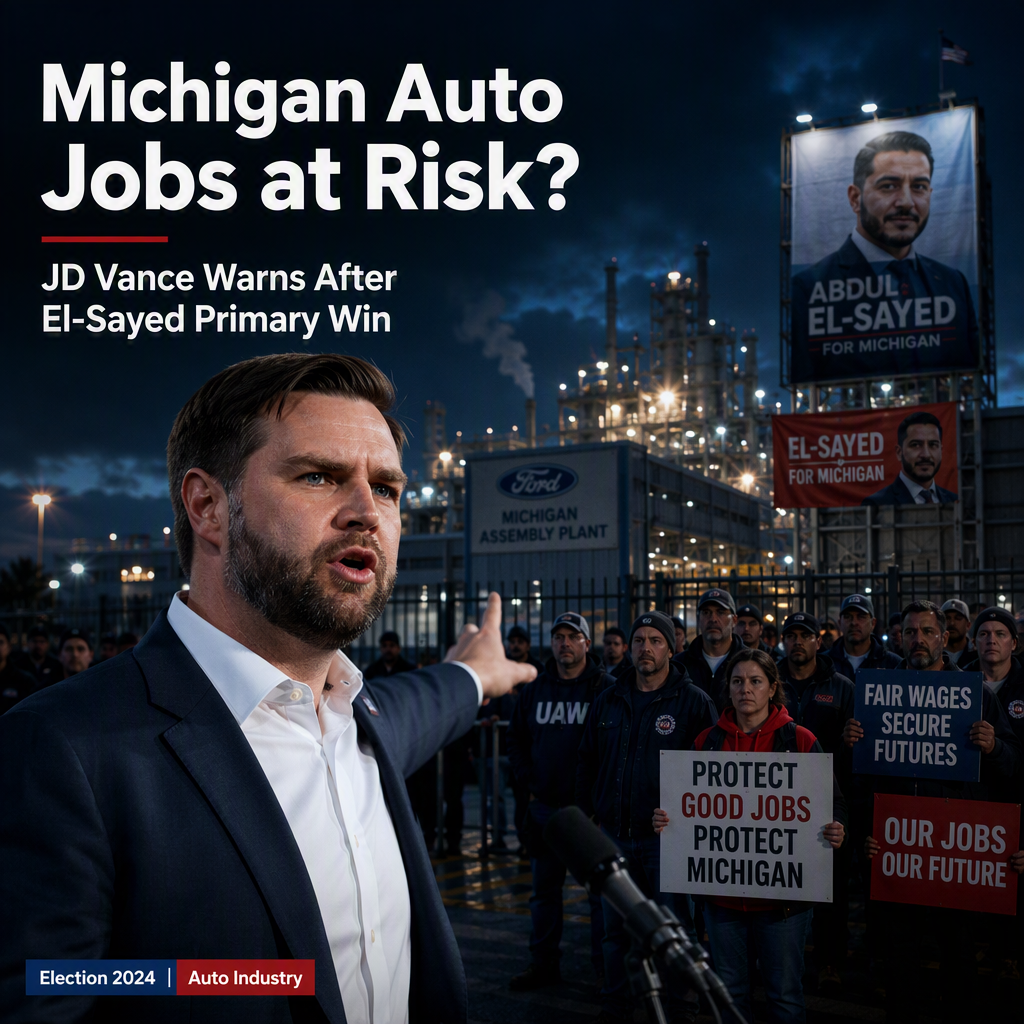
Vice President JD Vance issued a strong warning regarding the outcome of Michigan’s Democratic U.S. Senate primary, where Abdul El-Sayed, a progressive candidate backed by Sen. Bernie Sanders and Rep. Alexandria Ocasio-Cortez, narrowly defeated Rep. Haley Stevens and will face Republican Mike Rogers in November [1]. Vance, speaking on 'The Ingraham Angle,' labeled El-Sayed a 'limousine socialist' and argued that the Democratic Party is shifting further left, prioritizing wealth redistribution and open-border immigration over domestic industrial growth [1].
Vance specifically criticized El-Sayed’s opposition to Trump-era tariffs, which Vance claims have protected the Michigan auto industry, and accused him of supporting policies that would flood the state with low-wage immigrants, thereby depressing wages for working-class autoworkers [1]. He asserted, 'They're not promising you industry. They're not promising you good jobs. They're not promising self-sufficiency in a good industrial economy. What they're promising is redistribution' [1].
The vice president further argued that the Democratic base now favors more radical candidates, suggesting that El-Sayed’s platform, which includes 'Medicare-for-All' and campaign finance reform, is anti-industry and threatens the foundation of Michigan’s economy [1]. Vance contrasted El-Sayed’s approach with that of Stevens, who focused her campaign on manufacturing and the auto industry [1].
Fox News Digital reached out to the El-Sayed campaign for comment but did not receive an immediate response [1]. No specific market reactions or analyst opinions were provided in the article.
CONCLUSION
Vice President JD Vance’s remarks highlight concerns about the potential impact of progressive policies on Michigan’s auto industry and working-class wages. The Democratic primary win by Abdul El-Sayed signals a shift in the party’s direction, with possible implications for industrial policy and labor markets in the state. Market participants may view the outcome as increasing policy uncertainty for Michigan’s key industries.