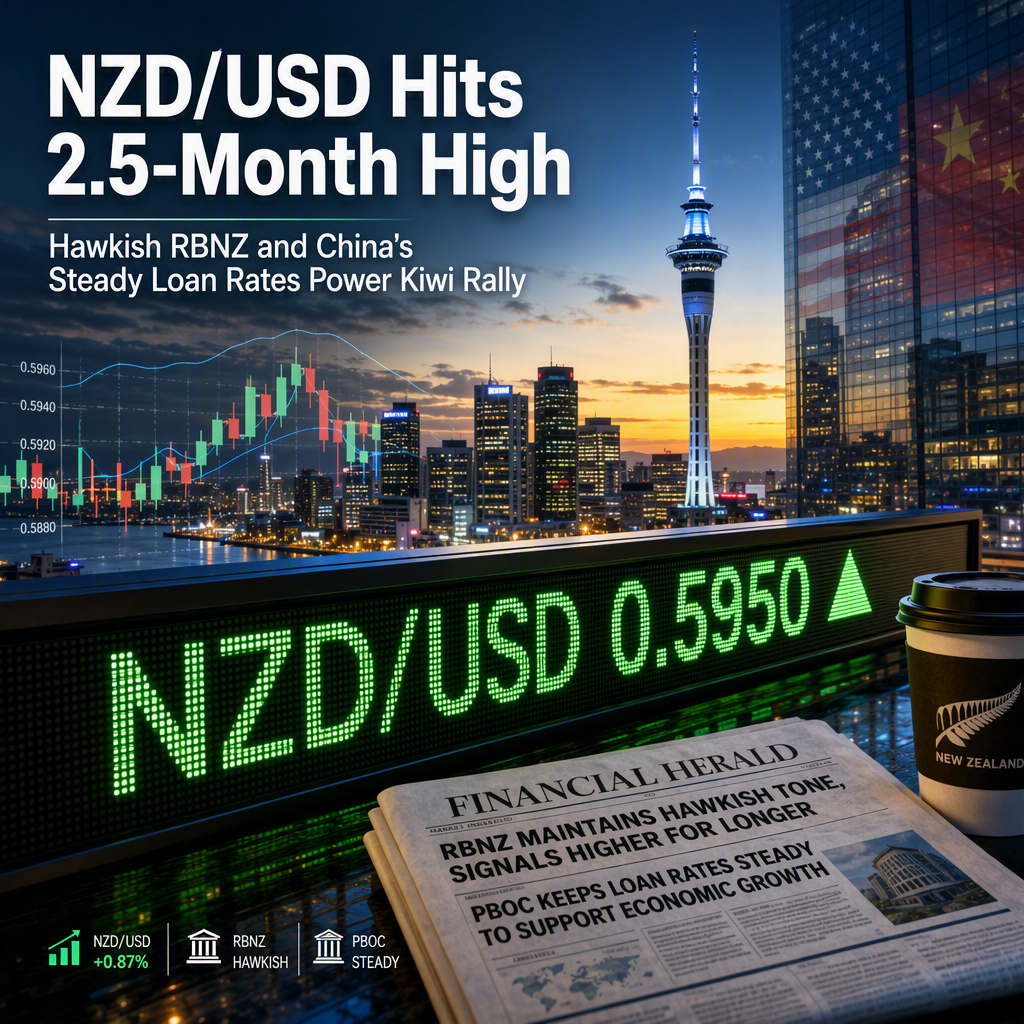
The New Zealand Dollar (NZD) strengthened against the US Dollar (USD), with the NZD/USD pair approaching 0.5950 during Asian trading hours on Thursday, marking a two-and-a-half-month high. This upward momentum was supported by the Reserve Bank of New Zealand's (RBNZ) hawkish stance and softer US inflation data, which reduced expectations for further US Federal Reserve (Fed) rate hikes in the near term [1].
The People's Bank of China (PBOC) kept its Loan Prime Rates (LPRs) unchanged, with the one-year LPR at 3.00% and the five-year LPR at 3.50%. Additionally, China's Commerce Ministry announced a decision on corporate tax rates for enterprises related to anti-dumping measures on imported polyoxymethylene from the US, EU, Taiwan, and Japan [1].
Hotter-than-expected New Zealand CPI inflation data has led to market expectations of continued monetary tightening, with swaps pricing in up to three further RBNZ rate hikes through early 2027. In contrast, the probability of a Fed rate hike at the September policy meeting has dropped to 32.7%, down from 47% a month earlier, according to the CME FedWatch Tool [1].
Strategists at BNY noted that the NZD is now trading slightly above its rolling 12-month average but expressed skepticism about the market's pricing for further RBNZ hikes, suggesting that inflation expectations remain relatively well-anchored despite robust domestic activity. Technical analysis indicates that NZD/USD maintains a bullish near-term bias, holding above the 100-day simple moving average (SMA) and approaching resistance at the Bollinger upper band near 0.5960. Initial support is seen at the Bollinger middle band around 0.5865, with further support at the 100-day SMA at 0.5835 and the lower Bollinger band near 0.5775 [1].
CONCLUSION
The NZD/USD pair's recent strength is underpinned by a hawkish RBNZ and reduced expectations for US Fed rate hikes, while technical indicators suggest continued support for the pair. However, some analysts remain cautious about the market's pricing for further RBNZ tightening, highlighting well-anchored inflation expectations. Market participants will be watching for confirmation of a breakout above resistance levels to gauge the sustainability of the current rally.