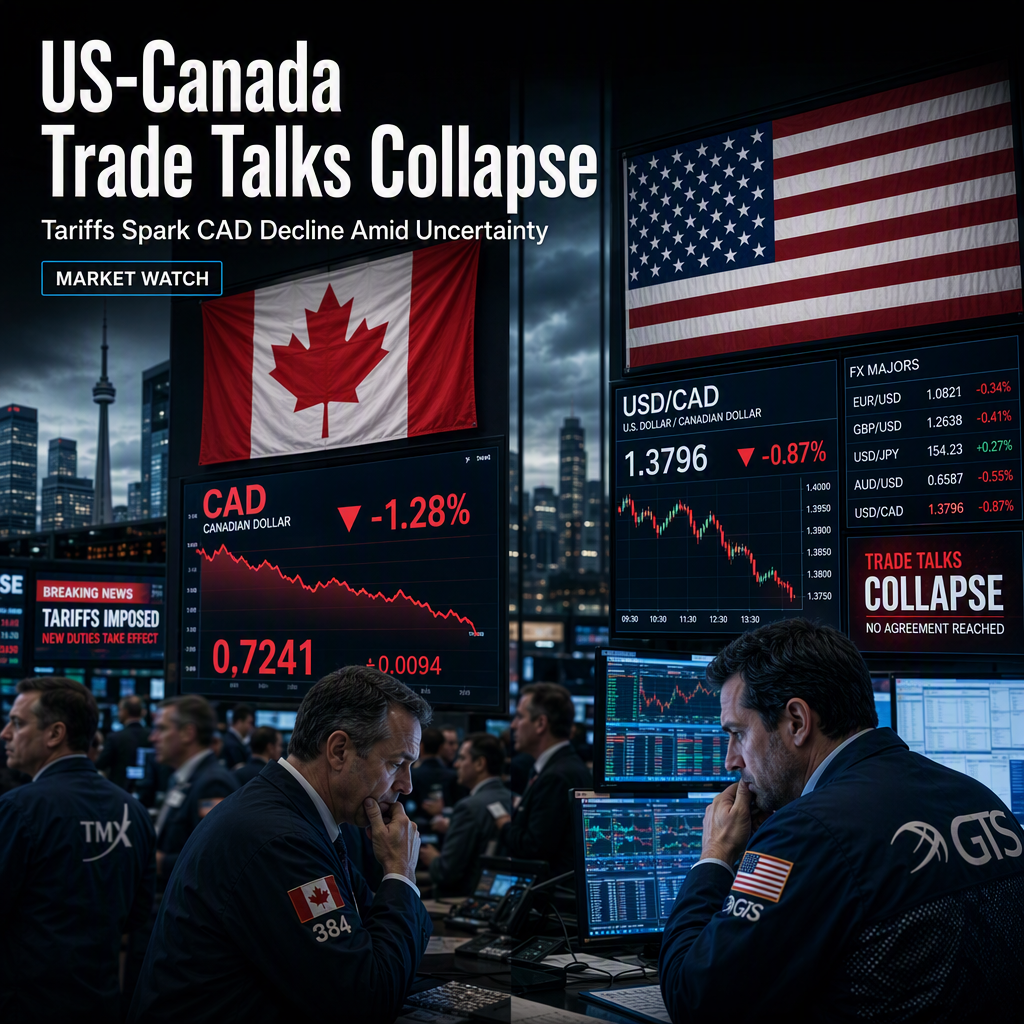
The collapse of US-Canada trade talks has triggered a significant market reaction, with the Canadian Dollar (CAD) weakening against the US Dollar (USD) and the USD/CAD pair recovering to near 1.3820 during the early European session on Monday [3]. According to CNBC, Washington imposed 50% tariffs on some Canadian products on Saturday after trade negotiations between the two countries broke down on Friday [3]. In response, Canadian Prime Minister Mark Carney announced retaliatory tariffs set to begin on September 8, stating that Canada would 'match Washington’s new tariffs dollar for dollar' and that the government was 'walking away from a bad deal' [3].
Commerzbank’s Michael Pfister notes that the breakdown in trade talks and Ottawa’s planned retaliatory tariffs point to a potentially protracted trade conflict, with Canada appearing increasingly unwilling to concede to new US demands [2]. Reports suggest that de-escalation is not expected before the US mid-term elections, and the Canadian government believes that yielding would only invite further demands [2]. In the short term, this stance is expected to weigh on Canadian sentiment indicators and undermine the recent tentative recovery of the CAD, although it could prove beneficial in the longer term due to political dynamics in both countries [2].
Analysts at Deutsche Bank highlight that the renewed trade frictions have quickly fed into market sentiment, reinforcing concerns over the trajectory of US-Canada trade relations and adding to broader tariff uncertainty [3]. Technical analysis indicates that USD/CAD maintains a bearish near-term tone, holding beneath the 100-day Simple Moving Average (SMA) and the Bollinger Bands’ middle band, with the Relative Strength Index (14) around 34 in oversold territory, suggesting that while downside pressure persists, the sell-off could be losing steam [3]. Key resistance levels are noted at 1.3915 and 1.3940, with support at 1.3745 [3].
Meanwhile, MUFG’s Lloyd Chan observes that the US Dollar has extended its recent soft patch despite upgraded US Q3 GDP growth forecasts to 2.5% annualized from 2.0% [1]. Elevated fiscal deficits and long-end Treasury yields are weighing on sentiment, and while speculative positioning data still show a modest net long USD bias, price action suggests fading Dollar upside momentum near key support levels [1]. The divergence between resilient USD positioning and weaker price action points to fading Dollar upside momentum for now [1].
Looking ahead, the upcoming Jackson Hole conference and remarks from new US Federal Reserve Chair Kevin Warsh are anticipated by traders for signals on the Fed’s commitment to fighting inflation, which could influence the USD/CAD pair in the near term [3]. Additionally, rising tensions in the Middle East could boost crude oil prices, potentially supporting the CAD as Canada is a major oil exporter [3].
CONCLUSION
The breakdown of US-Canada trade talks and the imposition of reciprocal tariffs have led to a sharp decline in the Canadian Dollar and heightened market uncertainty. While the short-term outlook for the CAD is negative due to trade tensions and sentiment concerns, upcoming events such as the Jackson Hole conference and developments in oil prices could influence future movements. The situation remains fluid, with both currencies sensitive to further policy announcements and geopolitical developments.