
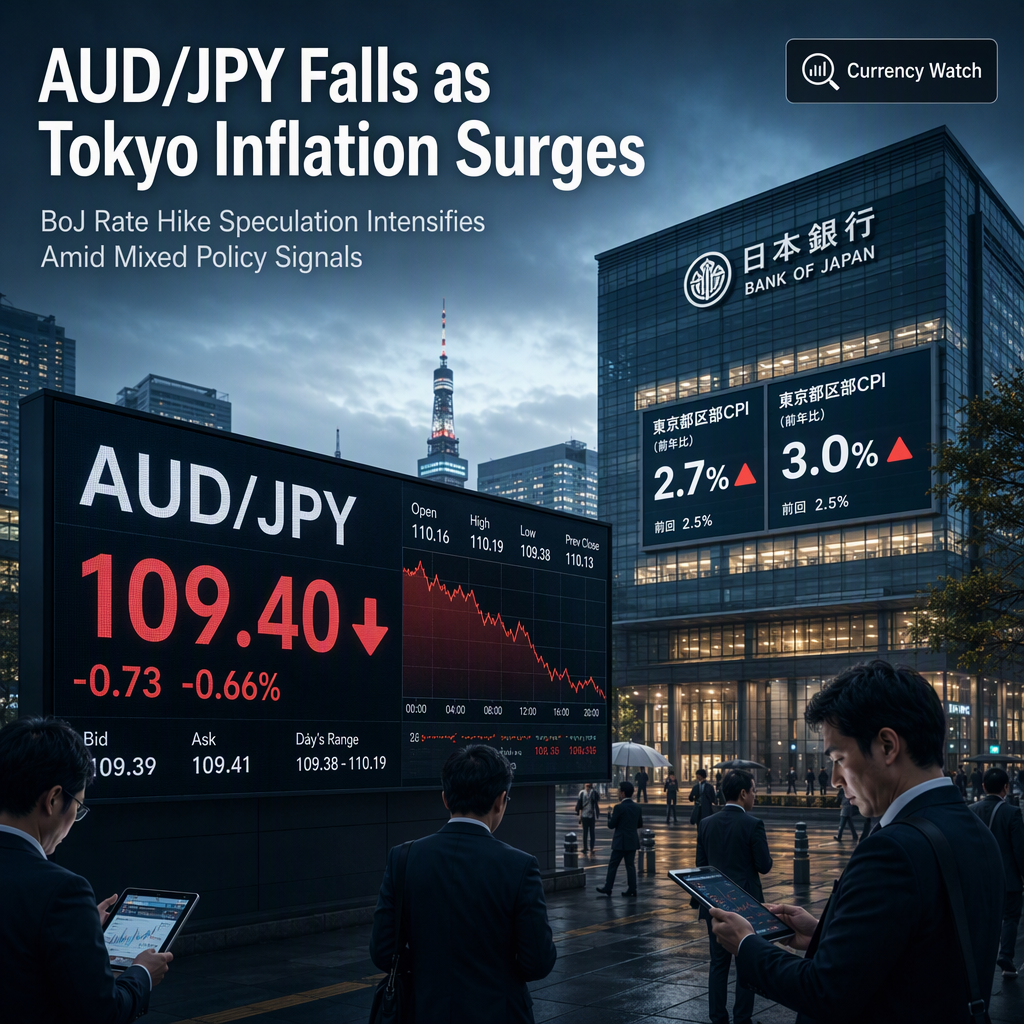
The AUD/JPY currency pair weakened further, trading near 109.40 during early European hours on Friday, as the Japanese Yen strengthened against the Australian Dollar. This move followed the release of Japan's Tokyo Consumer Price Index (CPI) data, which showed a significant rise in inflation for September. The headline Tokyo CPI increased by 2.7% year-on-year, up from 1.9% previously. The Tokyo CPI excluding fresh food also climbed 2.7% year-on-year, compared to 1.8% in August and surpassing the market consensus of 2.4%. Additionally, the Tokyo CPI excluding fresh food and energy jumped to 3.0% year-on-year from 2.0% previously [1].
Masato Koike, a senior economist at Sompo Institute Plus, commented that 'core inflation will continue to accelerate as a trend due to rising energy costs from the Middle East conflict and subsequent second-round effects,' and anticipated that the Bank of Japan (BoJ) could raise its policy interest rate in December [1]. However, analysts at Rabobank noted that the BoJ remains cautious about further rate hikes, with September meeting notes revealing a split Governing Council. While some members advocated for more tightening, others warned against hasty action due to weak private consumption, and government representatives urged consideration of the cumulative impact of previous rate increases. Despite this, Rabobank highlighted that the latest Tankan survey showed the most positive sentiment among large manufacturers since 2018, potentially increasing pressure on the BoJ to act [1].
From a technical perspective, AUD/JPY maintains a bearish tone as it trades below the 100-day simple moving average (SMA) and the 20-period Bollinger middle band. The Relative Strength Index (RSI) at 32 indicates that downside momentum remains dominant but may be losing some intensity. Immediate support is seen at the lower Bollinger band at 109.15, with a break below this level likely opening the path toward the October 1 low of 108.71 and the February 17 low of 107.69. Resistance levels are identified at 110.00, 110.70, 112.30, and the 100-day SMA at 112.60 [1].
CONCLUSION
The AUD/JPY pair is under pressure as stronger-than-expected Tokyo inflation data fuels speculation of a potential BoJ rate hike, despite internal policy debates. Technical indicators suggest further downside risk unless key support levels hold, while market sentiment remains cautious amid mixed signals from Japanese policymakers.