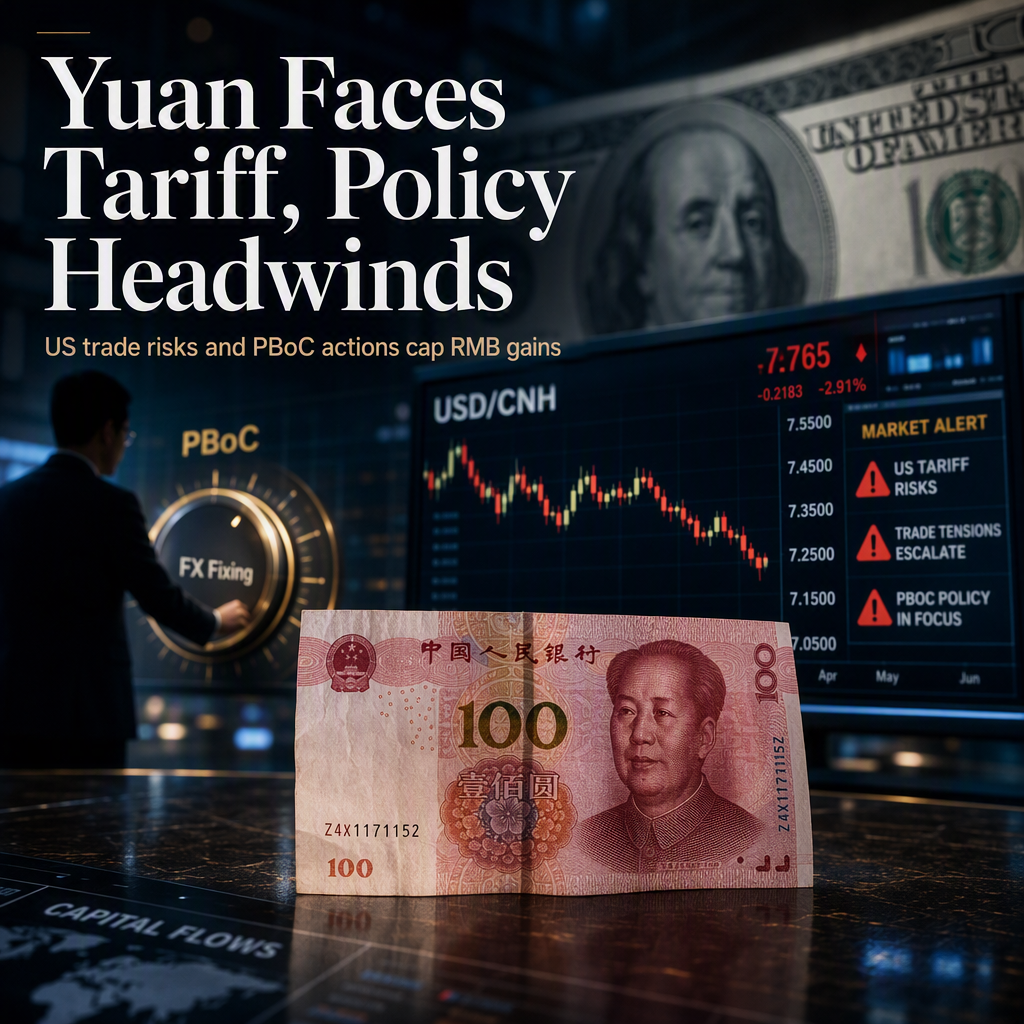
According to OCBC analysts Sim Moh Siong and Christopher Wong, the Chinese Yuan's (RMB) recent gains against the US Dollar are being constrained by trade risks and central bank policy actions [1]. Reports indicate that the US is considering imposing a 7.5% tariff on Chinese goods, which introduces uncertainty ahead of the upcoming Trump–Xi meeting next month [1]. Despite these developments, the market reaction has been limited so far, with USD/CNH trading close to recent lows, suggesting that investors do not currently view this as a major escalation risk [1].
The People's Bank of China (PBoC) has also been actively managing the pace of RMB appreciation, as evidenced by Monday's fixing, which was set around 600 pips above market expectations [1]. This action signals the central bank's resistance to rapid gains in the Renminbi [1]. Additionally, a firmer US Dollar overnight has further limited the potential for RMB appreciation, even though the broader bias for RMB strength remains [1].
From a technical perspective, mild bearish momentum in USD/CNH persists, but the Relative Strength Index (RSI) is showing tentative signs of turning higher from oversold conditions, indicating that a modest rebound in USD/CNH cannot be ruled out [1]. Key resistance levels are noted at 6.74 and 6.7460 (21-day moving average), while support is seen at 6.72 and 6.70 [1].
CONCLUSION
The Chinese Yuan's appreciation is currently capped by both external trade risks and domestic policy measures. While the market has not reacted strongly to potential US tariffs, the PBoC's actions and a stronger US Dollar suggest that further RMB gains may be limited in the near term.