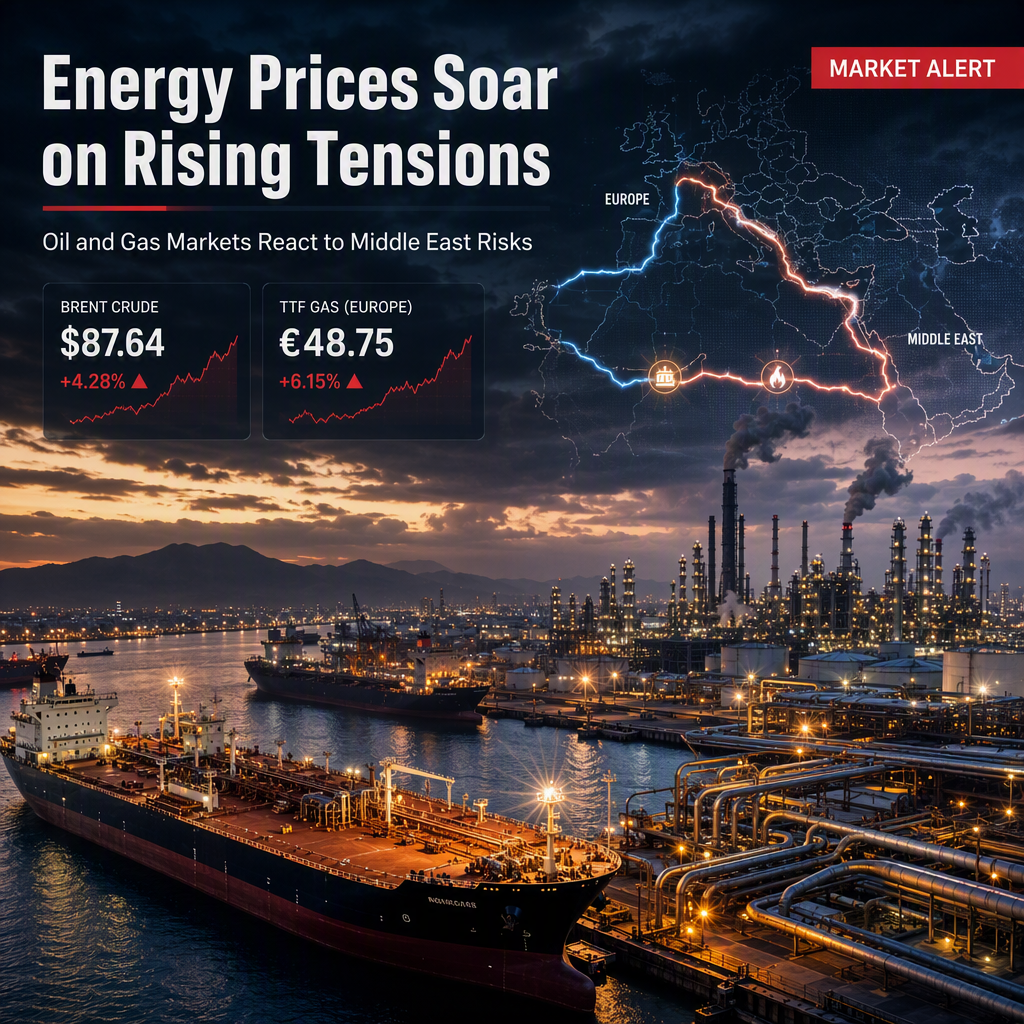
Oil and European natural gas prices experienced notable increases this week, with Brent crude rising by 6.5% and European gas prices climbing by just under 9% [1]. According to Commerzbank’s Norman Liebke, these moves reflect diverging reactions to ongoing Middle East supply risks: Brent crude is supported by rerouted flows, while European gas remains constrained due to lost LNG from Qatar and US cargoes being diverted to Asia [1].
The situation in the Middle East continues to be the primary driver for energy prices. While an agreement between Iran and Oman regarding transit rules through the Strait of Hormuz appears to be nearing, significant issues remain unresolved [1]. Liebke notes that markets are likely to remain focused on developments in the Iran conflict, with energy markets receiving increased attention as a result. He suggests that a sustained reopening of the Strait of Hormuz could provide noticeable relief to oil prices, but expects the European gas market to remain tight even in that scenario [1].
On the supply and demand front, both the IEA and OPEC have revised their oil demand forecasts for the year downwards by 200,000 barrels per day. The IEA now expects demand to fall by 1.6 million barrels per day, while OPEC still anticipates an increase of 580,000 barrels per day [1]. The IEA also projects that oil supply from outside OPEC+ will rise by 690,000 barrels per day. However, significant production losses in the Gulf region are expected to result in a total supply drop of 4.3 million barrels per day, leading to a significant undersupply in the oil market this year. The IEA estimates the supply deficit in the third quarter at 1.8 million barrels per day, which is 1 million barrels per day more than previously expected [1].
Looking ahead, China’s industrial production figures, set to be released next Monday, are seen as particularly important for the oil market. These figures will provide further insight into China’s crude oil processing in July, which has played a key role in easing pressure on the global oil market due to lower demand from reduced refinery processing [1].
CONCLUSION
Energy markets remain highly sensitive to geopolitical developments in the Middle East, with both oil and European gas prices rising sharply. While a potential agreement on the Strait of Hormuz could ease oil prices, supply constraints and ongoing risks suggest continued volatility. Market participants are closely watching upcoming Chinese industrial data for further direction.