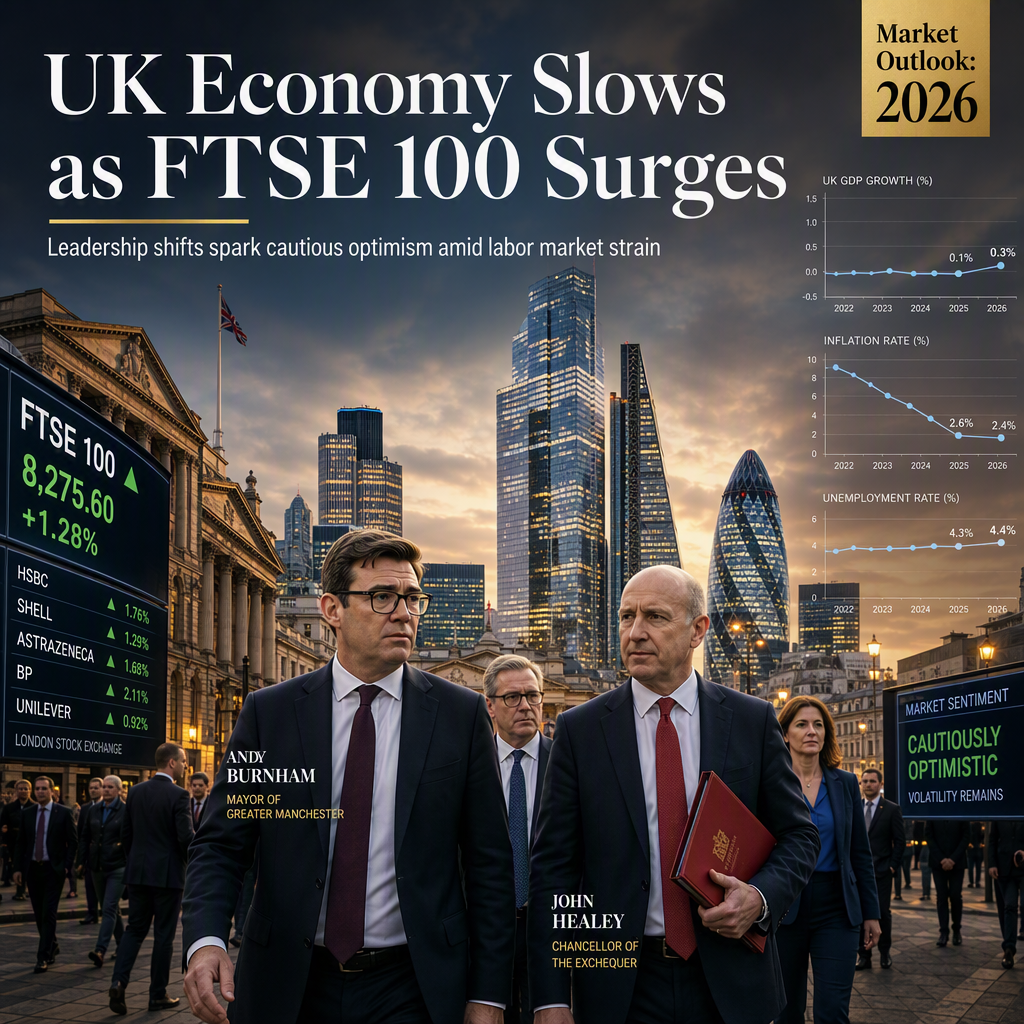
The United Kingdom's economy has experienced sluggish growth over the past 15 months, presenting significant challenges for Prime Minister Andy Burnham and Chancellor John Healey. Since Labour's return to power, the FTSE 100 index has climbed by nearly one-third, a rise attributed to its international exposure, while the British pound has remained resilient despite broader economic and political difficulties [1].
Economic data shows that after a strong first quarter in 2025 with 0.6% GDP growth, subsequent quarters saw minimal expansion: 0.1%, 0.2%, and 0.2%. The first quarter of 2026 saw a rebound to 0.6% growth, matching Japan for the best performance among G7 economies at that time. However, the economy contracted by 0.1% in April 2026 due to higher oil prices following attacks on Iran, but still managed 0.4% growth for the second quarter. Business surveys indicate that modest growth continued into July 2026 [1].
Political changes have also shaped the economic landscape. Rachel Reeves, the former chancellor, was replaced by John Healey after her resignation, which was triggered by defense spending issues that also led to Keir Starmer's resignation as prime minister. Andy Burnham, the former Greater Manchester Mayor, now faces the challenge of stimulating economic growth. Reeves's decision in her first budget in October 2024 to increase employers' national insurance and lower the threshold for payment has been linked to a rise in unemployment and a drop in job vacancies to their lowest level since 2014 (excluding the pandemic), straining relations between business and government [1].
There are signs that business sentiment may improve under Burnham's leadership. Healey's appointment as chancellor and Lucy Rigby as his deputy have been positively received, as has Burnham's pragmatic approach to North Sea oil and gas extraction. The appointment of Kanishka Narayan as the first AI minister attending cabinet was also well-received, signaling a potential shift in government-business relations [1].
CONCLUSION
The UK economy continues to face slow growth and labor market challenges, but the FTSE 100's strong performance and recent political appointments offer some optimism. Market sentiment remains cautiously positive, with hopes that new leadership and policy shifts may improve business confidence and economic prospects.