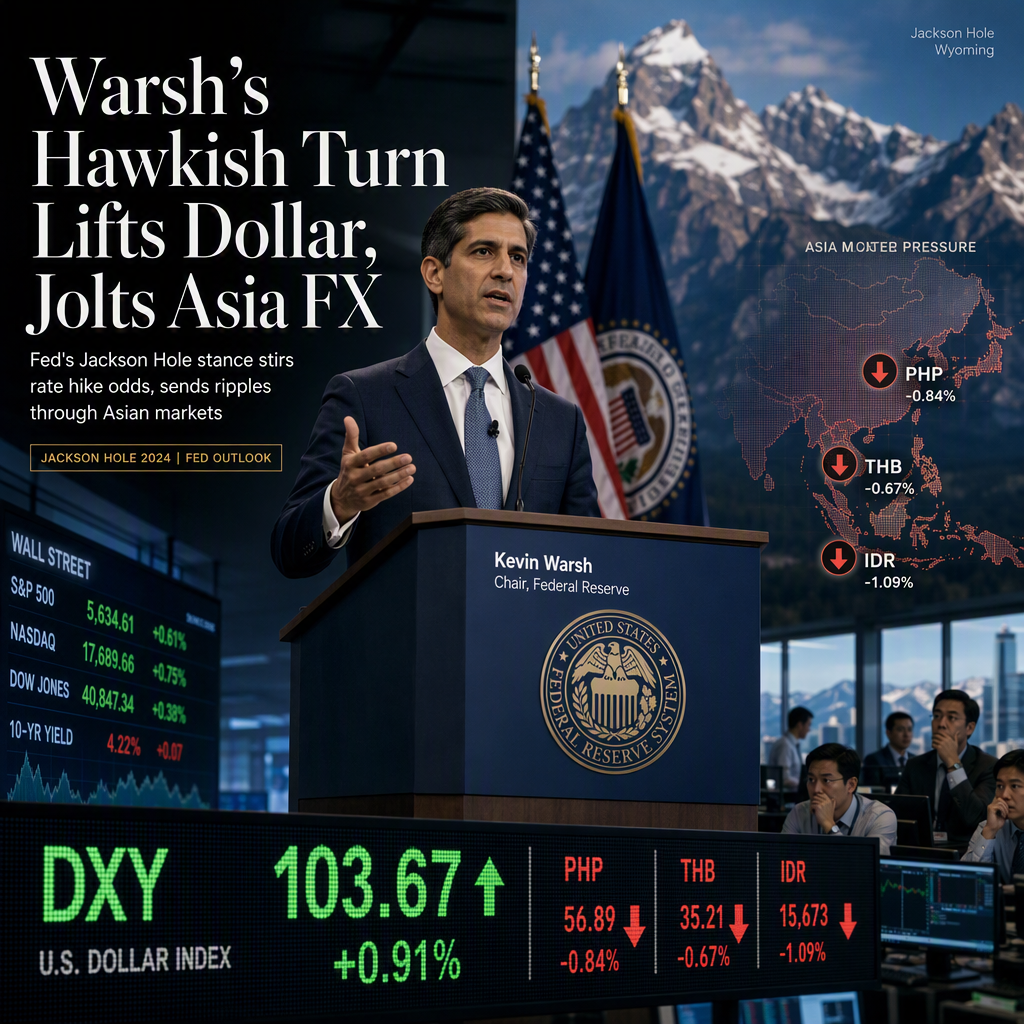
Federal Reserve Chair Kevin Warsh's speech at Jackson Hole has triggered a significant reassessment of US monetary policy expectations, with markets now pricing in a higher likelihood of a September rate hike. Warsh emphasized that inflation remains insufficiently contained and reaffirmed the Fed's commitment to its 2% target, suggesting that current financial conditions are not restrictive enough [1][2][3]. Following the speech, Fed funds futures now price a 60% chance of a 25 basis point hike for September 16, up from 35% prior to the event, and imply 60bps of tightening over the next twelve months [2]. This hawkish shift has lifted the US Dollar and short-term Treasury yields, with the market narrative now focused on whether inflation remains sticky enough to warrant further tightening [1][2][3].
The stronger Dollar has pressured regional Asian currencies, particularly those with weaker fundamentals or limited yield support. The Philippine peso has reached fresh record highs against the Dollar despite hawkish rhetoric from the Bangko Sentral ng Pilipinas (BSP), as markets remain concerned about balancing inflation containment and growth [1]. Among ASEAN currencies, the Thai baht and Indonesian rupiah appear especially vulnerable to rising US rate expectations, with Thailand offering limited yield support and Indonesia facing domestic challenges such as protests over living costs and softening government approval ratings [1]. In contrast, the Singapore dollar (SGD) and Malaysian ringgit (MYR) have shown more resilience, supported by stronger external positions and policy credibility [1].
Market participants are now closely watching upcoming US economic data, including the August ISM and jobs reports, which are expected to be crucial in maintaining the elevated rate hike expectations and underpinning Dollar strength [2][3]. The July JOLTS report is anticipated to reinforce the US labor market's low hire, low fire backdrop, while consensus expects August nonfarm payrolls (NFP) to recover with gains of +55k versus a loss of -23k in July, and the unemployment rate to remain at 4.1% [2]. However, Commerzbank notes that while a September hike is considerably more likely, it is not guaranteed, as the Fed remains highly data dependent and upcoming labor market and inflation figures, as well as developments in the Iran war, could still alter expectations [3].
There is some discrepancy in the interpretation of the Fed's stance: while BBH and MUFG highlight the increased odds and market reaction, Commerzbank urges caution, noting that only three out of twelve FOMC members voted for tightening at the last meeting and that recent consumer price data has been moderate, which could prompt the Fed to remain patient [3].
CONCLUSION
Kevin Warsh's Jackson Hole speech has sharply increased market expectations for a September Fed rate hike, boosting the US Dollar and pressuring several Asian currencies. However, the Fed's path remains highly data dependent, with upcoming labor market and inflation reports set to play a decisive role. While the Dollar's rally has immediate market impact, analysts caution that further developments could still shift the outlook.