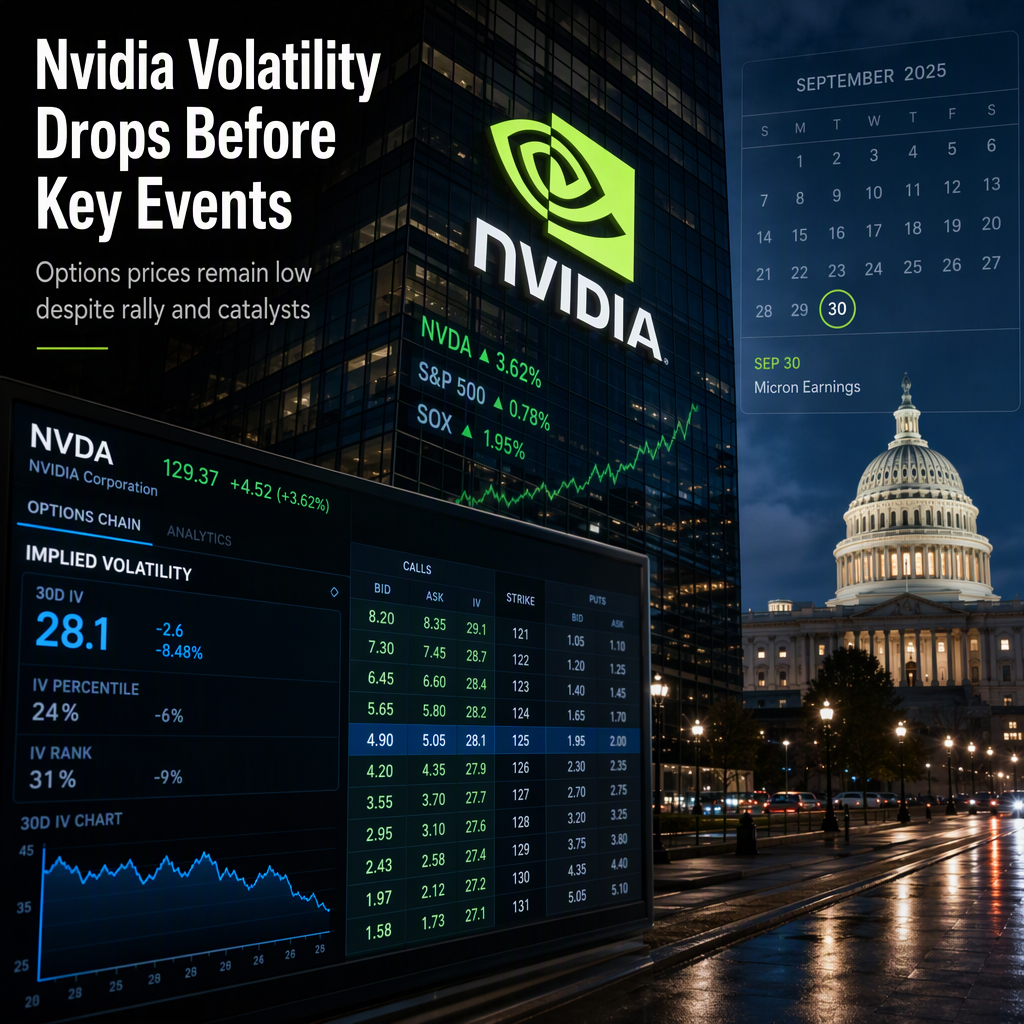
Nvidia shares have surged 24% in 2026, with the stock currently just 3.5% below its all-time closing high of $235.74 set in May, after rallying for five consecutive sessions [1]. Despite this strong performance and several upcoming catalysts, Nvidia's options prices are unusually low, with implied volatility near its lowest level of the past year. This suggests the market is not pricing in significant movement for Nvidia in the coming weeks, making options relatively cheap compared to the past year [1].
Two major catalysts are on the horizon: Nvidia CEO Jensen Huang is expected to attend a state dinner for Chinese President Xi Jinping during his visit to Washington to meet with President Trump this Thursday, where AI is anticipated to be a main topic of discussion [1]. Additionally, Micron is set to report its fiscal Q4 earnings on September 30, which is seen as a barometer for AI memory demand and could have ripple effects on Nvidia [1].
One options strategy highlighted is a reverse iron condor, involving the purchase of the Oct 16 210/220 put spread and the Oct 16 235/245 call spread for a total debit of roughly $4.86. This directionally neutral strategy is structured to profit from a large move in Nvidia in either direction before October 16th. The maximum loss is $486 if Nvidia remains between $220 and $235, while the maximum gain is $514 if Nvidia closes at or beyond $210 or $245. Breakeven points are at $215.14 and $239.86, requiring a 5% to 6% move from current levels for profitability [1].
The article notes that the semiconductor sector has a recent history of significant movement, suggesting that these catalysts could lead to increased volatility, despite current market pricing [1].
CONCLUSION
Nvidia's options are trading at unusually low prices ahead of key events, including a high-profile state dinner and Micron's earnings report. With the stock near record highs and implied volatility subdued, options traders may find attractive opportunities for strategies that benefit from increased movement. The market currently appears to underestimate the potential for volatility in Nvidia shares.