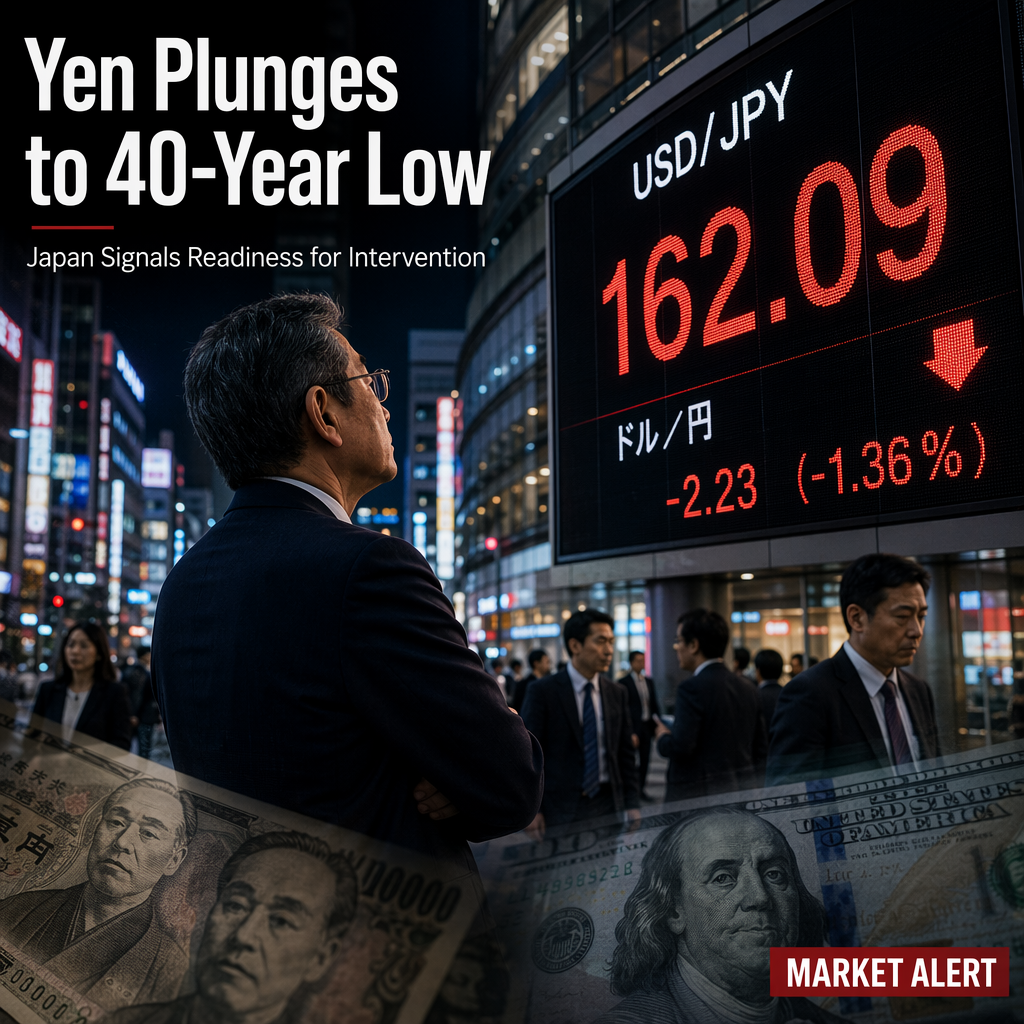
The Japanese Yen (JPY) plunged to a fresh four-decade low against the US Dollar (USD), with the USD/JPY pair surging past the critical 162.00 level during the Asian session on Tuesday [2]. At the time of reporting, USD/JPY was trading at 162.09, up 0.09% on the day, though slightly off its peak [1]. This sharp depreciation has prompted Japanese officials to reiterate their readiness to intervene in the currency markets. Finance Minister Satsuki Katayama stated that the government 'will respond appropriately to currency moves at any time as needed,' and noted that action could include decisive measures as agreed in a joint statement with the US [1]. Additionally, Katayama and US Treasury Secretary Scott Bessent have agreed to take steps on currencies if necessary [2]. Japan’s Chief Cabinet Secretary Minoru Kihara also affirmed last week that officials are prepared to act against excessive foreign exchange moves [2].
Market participants appear cautious about placing further bearish bets on the Yen, given the Bank of Japan's (BoJ) recent hawkish outlook. The BoJ's June meeting summary revealed that policymakers discussed rising inflation risks, with some advocating for faster rate hikes to approach neutral levels for the economy [2]. Signs of accelerating inflation in Japan are supporting the BoJ’s gradual policy tightening, although Japanese borrowing costs remain lower than those in the US, sustaining the JPY carry trade [2].
The USD/JPY pair’s rally is also being supported by mixed signals regarding US-Iran talks and expectations for further Federal Reserve rate hikes, which have helped the US Dollar stall its recent pullback from a 13-month high [2].
A currency performance table for the week shows that the Japanese Yen was the weakest against the US Dollar, with a -0.23% change, and was the strongest against the Australian Dollar [2].
CONCLUSION
The Japanese Yen's plunge to a 40-year low against the US Dollar has heightened concerns about potential intervention by Japanese authorities. Official statements underscore a readiness to act if volatility persists, while the BoJ’s tightening stance and global rate dynamics continue to shape market sentiment. The situation remains fluid, with traders closely monitoring both policy signals and macroeconomic developments.