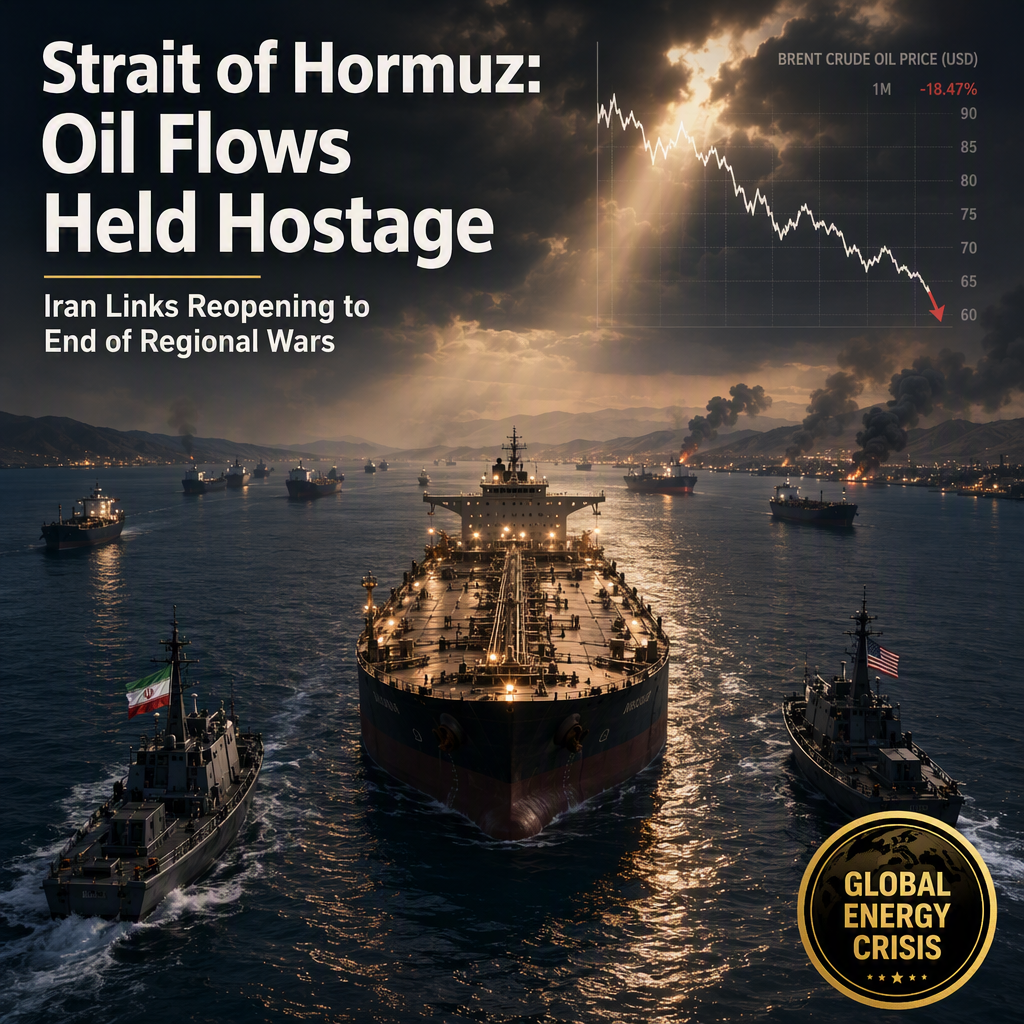
Iran has linked the reopening of the Strait of Hormuz, a critical oil export corridor, to the cessation of regional wars in the Middle East, specifically demanding an end to the conflict in Gaza, Israel's withdrawal from Lebanon, and a halt to attacks on Syria [1]. Mohsen Rezaei, Secretary of Iran's Supreme National Security Council, stated that any agreement with the U.S. regarding the strait would require these conditions to be met, emphasizing that the Strait of Hormuz cannot be separated from broader regional conflicts and that the U.S. must demonstrate its commitment before trust can be reestablished [1].
Despite these demands, diplomatic progress appears unlikely. The Wall Street Journal reported that President Donald Trump has rejected a return to the June memorandum of understanding with Iran, opting instead for a strategy focused on economic pressure. The U.S. recently announced an 'economic D-Day' campaign, threatening countries that conduct business with Iran and shifting its focus from military action to economic measures [1].
Currently, Iran is permitting a 'temporary and limited' corridor for ships to pass through the Strait of Hormuz, with future maritime traffic contingent on developments in negotiations with Washington [1]. Oman and Iran have discussed establishing a temporary joint shipping route and a mission to clear mines from the strait. U.S. Central Command (Centcom) forces, led by Admiral Brad Cooper, have facilitated the transit of approximately 1,500 commercial vessels and 750 million barrels of crude oil over recent months, and Cooper stated that international shipping lanes are now open with momentum building [1].
However, shipping activity remains significantly reduced. Kpler data shows only five ships crossed Hormuz on Tuesday, compared to about 130 ships before the war began in February, highlighting the ongoing disruption to global oil flows [1].
CONCLUSION
Iran's conditional reopening of the Strait of Hormuz and the U.S.'s pivot to economic pressure signal continued uncertainty for global oil markets. Shipping volumes remain far below pre-war levels, underscoring the high market impact and persistent risks to energy supply. Diplomatic resolution appears distant, keeping the region's geopolitical tensions elevated.