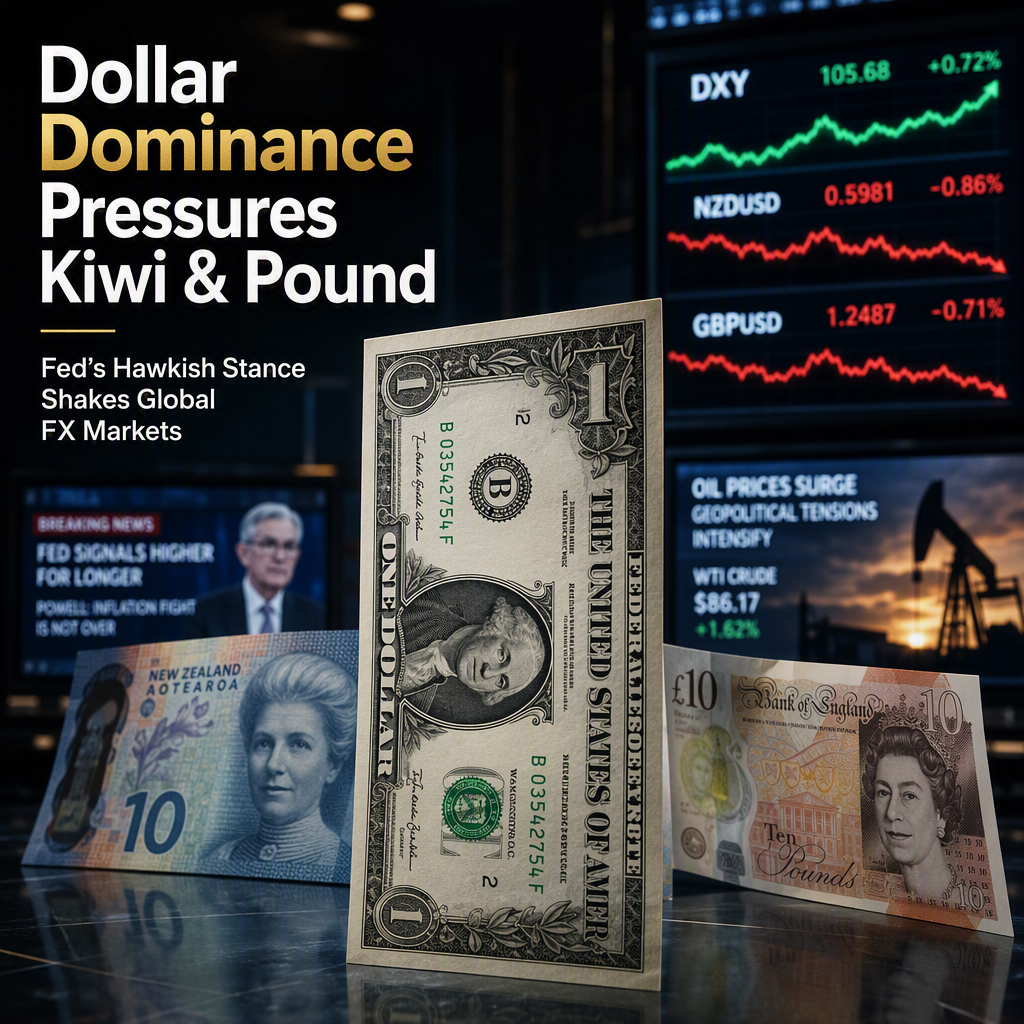
The US Dollar (USD) maintained its strength against both the New Zealand Dollar (NZD) and the British Pound (GBP) during Asian trading on Monday, driven by a hawkish outlook from the US Federal Reserve (Fed) and ongoing geopolitical uncertainties. The NZD/USD pair traded around the 0.5720-0.5715 zone, remaining close to a two-month low set last week, as the New Zealand Dollar continued to underperform following a dovish rate hike by the Reserve Bank of New Zealand (RBNZ) and weak domestic growth. In contrast, the Fed's recent 25-basis-point rate hike—its first in three years—was accompanied by signals of at least one more hike this year, with Nordea economists highlighting the resilience of the US economy and persistent inflationary pressures as reasons for a potentially more restrictive policy stance. Nordea maintains a forecast for two more Fed hikes, with risks tilted to the upside, suggesting the Fed may need to act more aggressively than currently anticipated [1][2].
Geopolitical developments also contributed to the USD's safe-haven appeal. Iran-backed Houthis in Yemen claimed attacks on sensitive sites in Riyadh, while Iran outlined seven conditions for restarting negotiations with the US, keeping the geopolitical risk premium elevated and supporting the Greenback [1]. Meanwhile, a recovery in Saudi oil shipments led to a drop in oil prices to a one-week low, easing immediate inflation fears and keeping US bond yields below recent multi-year highs [1].
For the British Pound, the GBP/USD pair hovered around 1.3390, slipping after modest gains in the previous session as the USD's strength persisted. The Fed's hawkish stance was reinforced by Fed Chair Kevin Warsh, who stated, "the plain fact is that inflation is too high and has been for too long," and noted that recent inflation readings have not shown meaningful improvement. Market expectations for another US rate hike at the Fed's October meeting rose to nearly 56.5%, up from 42.5% a week earlier, according to the CME FedWatch tool [2].
Despite the USD's dominance, the UK political backdrop remained supportive for the Pound, with strategists at Scotiabank citing ongoing confidence in the government's fiscal responsibility. The Bank of England (BoE) flagged stronger inflation risks, projecting CPI to exceed 4% in early 2027 versus a previous peak of 3.2%. However, the BoE maintained a gradual tightening path, holding rates at 3.75% with a 3-vote dissent for an immediate hike to 4%. The BoE's decision to pause APF gilt auctions until April 2027 and retain a large stock of long-dated gilts to maturity signaled a cautious approach to balance-sheet risks, tempering the hawkish inflation rhetoric and suggesting a measured outlook for the Pound [2].
Technical analysis for NZD/USD indicated a bearish near-term tone, with the pair awaiting a break below the 78.6% Fibonacci retracement support near 0.5700, which could expose further downside to 0.5624. Resistance levels were identified at 0.5763, 0.5806, 0.5849, 0.5853, 0.5902, and 0.5988 [1].
CONCLUSION
The US Dollar's strength, underpinned by the Fed's hawkish policy outlook and persistent geopolitical risks, has weighed heavily on both the New Zealand Dollar and British Pound. While the RBNZ's dovish stance and weak growth pressured the Kiwi, the Pound found some support from UK fiscal stability and a measured BoE approach. Market sentiment remains cautious, with further USD gains possible if the Fed continues tightening as anticipated.