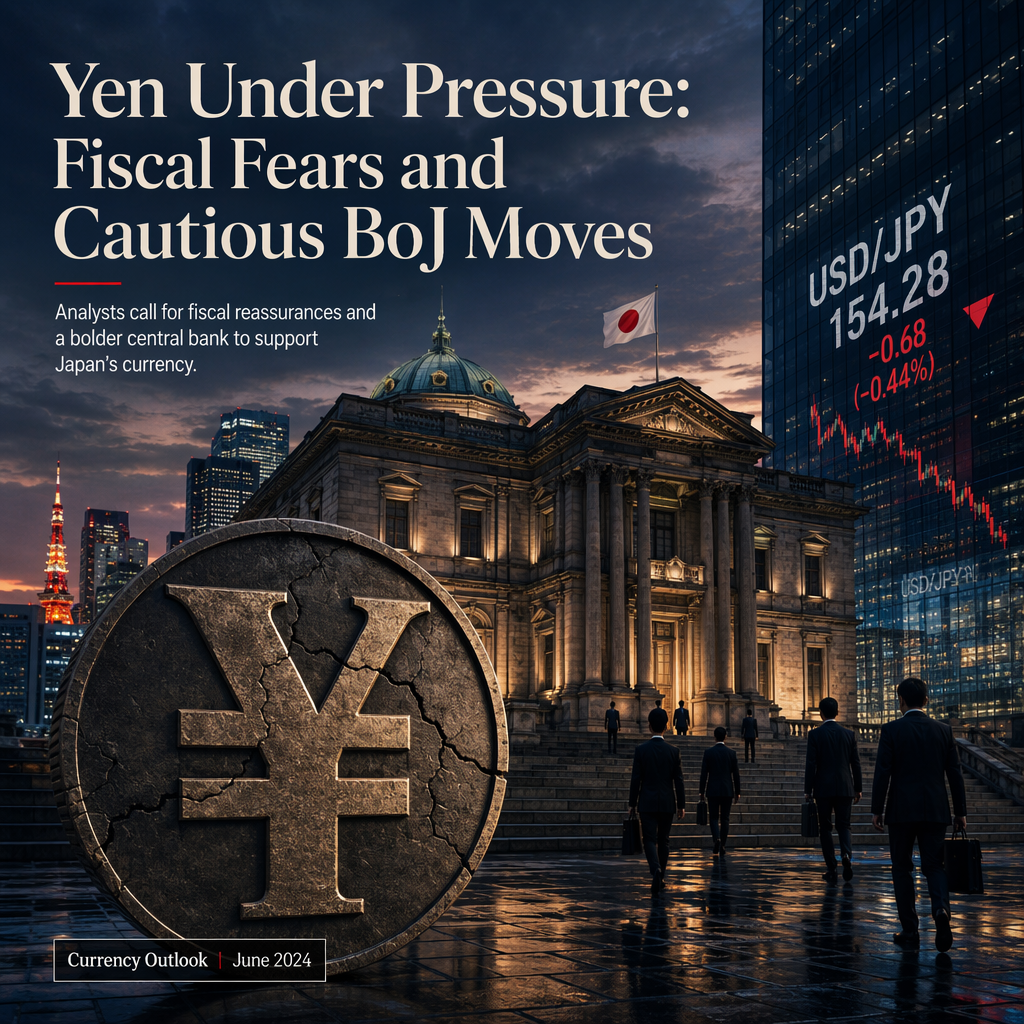
Rabobank highlights ongoing concerns regarding Japan’s elevated debt-to-GDP ratio, which has risen significantly above the G7 average over the past thirty years due to stagnating GDP and persistent fiscal spending. The report notes that while Japan’s exit from deflation has allowed the Bank of Japan (BoJ) to begin normalizing monetary policy, rate hikes have been slow and cautious, limiting the Japanese Yen’s (JPY) ability to benefit from short-term interest differentials [1]. Rabobank forecasts USD/JPY at 159 on a three-month horizon, contingent on a more hawkish BoJ stance and reassurances over fiscal policy, stating that both are necessary for a sustained JPY recovery [1].
Japan’s Finance Minister Satsuki Katayama reiterated that the government maintains its stance that specific monetary policy decisions are the sole purview of the BoJ, emphasizing no change in this approach [2]. Prime Minister Sanae Takaichi added that the government aims for a stable reduction in the debt-to-GDP ratio and will discuss the food tax before making a decision in early August [2]. Katayama also stated that the government is closely monitoring daily market movements and economic data, and will work to avoid causing any misunderstanding in markets regarding its fiscal and monetary policy stance [2].
At the time of reporting, USD/JPY was down 0.02% on the day at 162.35, indicating a marginal strengthening of the Yen, though the overall market reaction remains muted [2]. Rabobank’s outlook suggests that unless there is a more aggressive pace of BoJ rate hikes and clearer fiscal policy reassurances, the Yen may continue to face downward pressure [1].
Both sources underscore the importance of fiscal credibility and BoJ policy normalization for the Yen’s prospects. While the government is committed to reducing the debt-to-GDP ratio, it is leaving monetary policy decisions to the BoJ, which is proceeding cautiously with rate hikes [1][2].
CONCLUSION
The Japanese Yen remains under pressure due to concerns over fiscal sustainability and the BoJ’s gradual approach to policy normalization. While the government is focused on fiscal discipline and defers monetary policy decisions to the BoJ, analysts suggest that a more hawkish central bank stance and clearer fiscal reassurances are needed for a sustained Yen recovery. Market reaction has been limited, with only a slight move in USD/JPY, reflecting ongoing uncertainty.