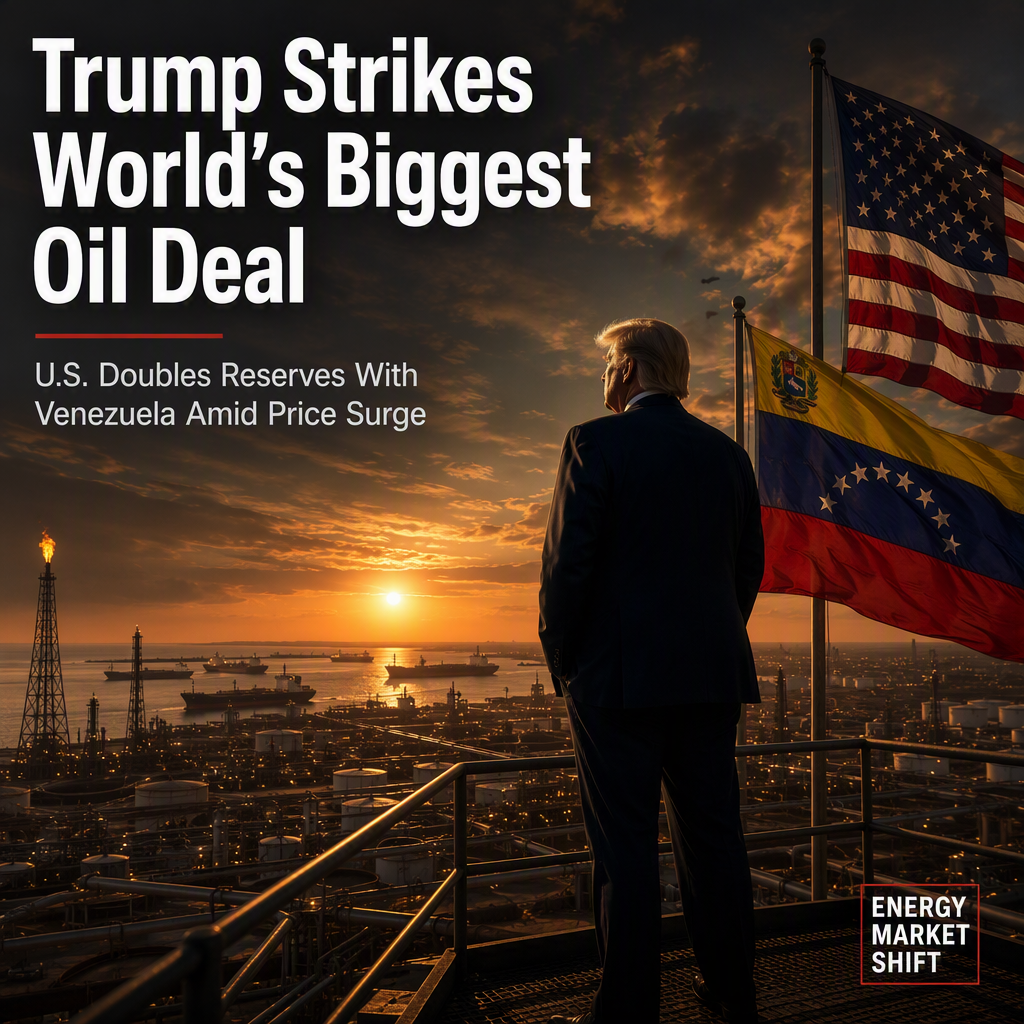
President Donald Trump announced that the United States has struck a deal with Venezuela to gain majority control of more than 65 billion barrels of oil reserves, which he described as 'THE BIGGEST OIL DEAL IN WORLD HISTORY' [1]. Trump emphasized that the agreement comes 'at no cost to' U.S. taxpayers and will more than double the U.S. oil reserve, addressing recent lows in the Strategic Petroleum Reserve not seen since the 1980s [1]. The deal follows a U.S. military strike on Venezuela in January, during which then-president Nicolás Maduro and his wife, Cilia Flores, were captured [1]. Trump stated that U.S. officials coordinated with Venezuelan government leaders and partnered with unnamed private businesses to secure the transaction, which he believes will strengthen the relationship between the two countries [1].
The announcement arrives as U.S. consumers face spiking energy prices ahead of the midterm elections. Trump asserted that the Venezuela deal should help reduce prices at the pump, with the average price of a gallon of gas reaching around $4.09 on Friday, marking a 27% year-over-year increase according to AAA [1]. In the oil markets, West Texas Intermediate crude prices fell 4% this week, the first weekly decline in three weeks, although prices have surged more than 24% since the U.S. war with Iran began [1].
The ongoing conflict with Iran has disrupted transit through the Strait of Hormuz, a critical global passageway for crude oil. According to the International Monetary Fund's PortWatch tracker, only a handful of ships have crossed the Strait each day recently, compared to about 100 daily crossings a year ago [1]. This disruption has contributed to volatility in oil prices and heightened concerns about energy security [1].
Trump's forward-looking statements suggest that the Venezuela deal will not only bolster U.S. energy reserves but also potentially ease consumer pain at the gas pump and stabilize the market amid geopolitical tensions [1].
CONCLUSION
The U.S.-Venezuela oil deal represents a significant shift in global energy dynamics, doubling U.S. reserves and aiming to alleviate high gas prices. Market reactions have been mixed, with crude prices falling this week but remaining elevated due to ongoing geopolitical risks. The deal is expected to have a high impact on both energy markets and U.S. consumer sentiment.