
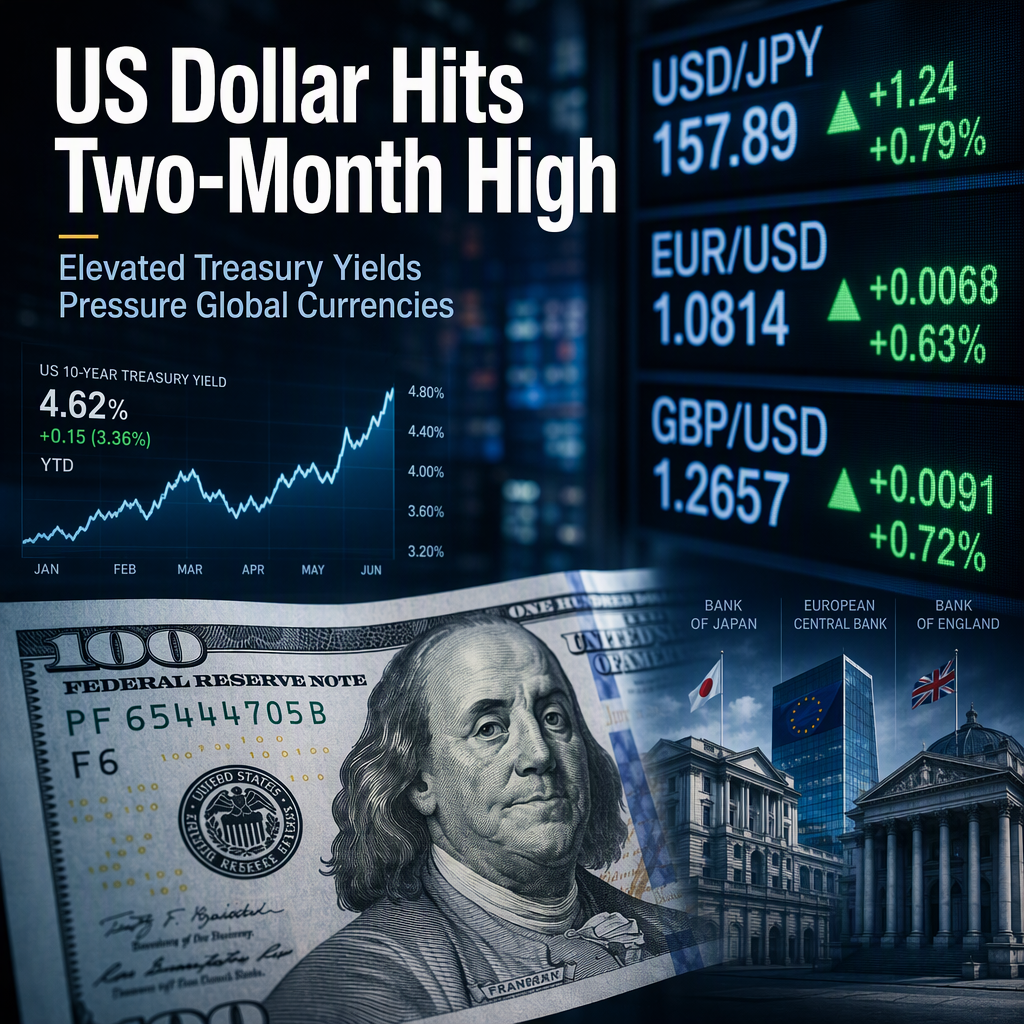
The US Dollar (USD) climbed to a two-month high against major currencies during Thursday's Asian session, buoyed by persistently elevated US Treasury yields and ongoing geopolitical uncertainties, particularly the US-Iran standoff [1][2][4]. The USD/JPY pair advanced beyond the 158.00 mark, reaching a fresh weekly high as strong bullish sentiment surrounded the Greenback. This move followed a rebound from the 156.40-156.35 region, a one-and-a-half-week low, and was supported by US bond yields remaining near multi-year peaks [1]. The upward revision of US Q2 GDP growth and oil-driven inflation risks further contributed to the USD's strength [1].
The softer-than-expected US Personal Consumption Expenditures (PCE) report for August initially tempered market bets for an October Federal Reserve (Fed) rate hike, with the PCE Price Index rising 0.3% month-over-month and 3.4% year-over-year, while core PCE increased 0.2% monthly and 3.0% annually, both below forecasts [2]. However, this effect was short-lived as traders continued to expect another Fed hike by year-end, with CME Group's FedWatch Tool indicating an 87% probability of a rate increase by December [4]. Shorter-dated Treasury yields retreated slightly, but 10- and 30-year yields hit new highs overnight [2].
The Japanese Yen (JPY) dropped to a weekly low against the USD, despite intensified verbal interventions from Japanese authorities signaling a strong determination to support the currency. Japan's top currency diplomat Atsushi Mimura and Finance Minister Satsuki Katayama issued warnings to markets, and expectations of a potential Bank of Japan (BoJ) rate hike in October or December could limit further JPY losses [1]. The BoJ's Q3 Tankan survey showed a slight improvement in business sentiment, though it missed forecasts, and the BoJ's September meeting summary indicated most members favored further rate hikes after September's increase to 1.25%, a 31-year high [3].
Other major currencies also weakened against the USD. The Euro (EUR) fell below 1.1350, pressured by higher US yields and a dovish tilt from European Central Bank (ECB) President Christine Lagarde, who advocated a measured response to inflation and noted that rising bond yields would curb economic expansion [2]. Despite this, TD Securities maintained a bullish EUR/USD year-end forecast, expecting the ECB to deliver a final 25bp hike in December [2]. The British Pound (GBP) retreated from a one-week high, trading just above the mid-1.3200s, as strong USD buying offset support from an upward revision of UK Q2 GDP growth to 0.4% and expectations for a 25bp Bank of England rate hike in November [4].
Market participants are now focused on upcoming US economic data, including Weekly Initial Jobless Claims, ISM Manufacturing PMI, and especially Friday's Nonfarm Payrolls (NFP) report, which is expected to provide further direction for the USD and major currency pairs [1][2][4].
CONCLUSION
The US Dollar's rally to a two-month high, driven by elevated Treasury yields and resilient economic data, has pressured major currencies including the Yen, Euro, and Pound. Despite some central bank hawkishness abroad, the USD remains supported by expectations of further Fed tightening and geopolitical uncertainties. Market attention now turns to key US economic releases, particularly the Nonfarm Payrolls report, for the next catalyst.