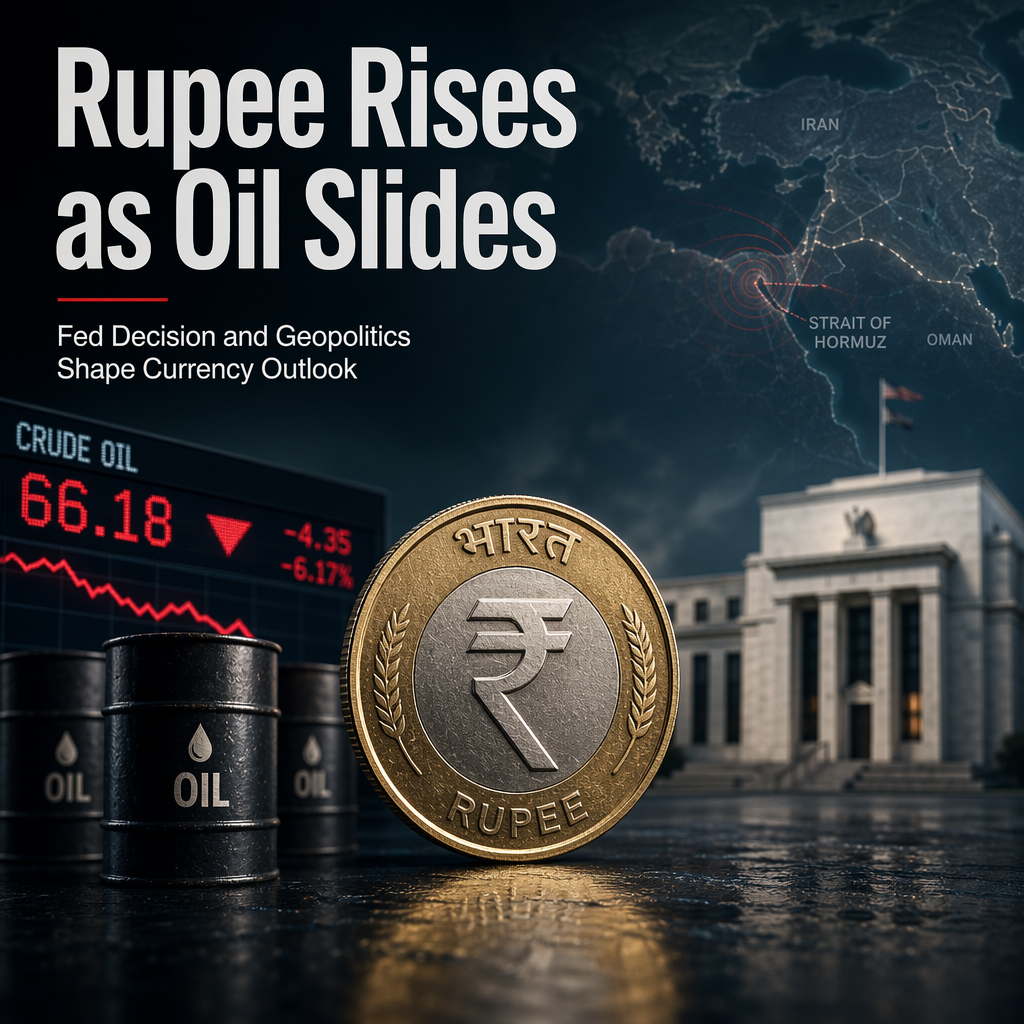
The Indian Rupee (INR) extended its gains against the US Dollar (USD) for the third consecutive trading day on Tuesday, with the USD/INR pair falling to near 95.65. This appreciation was driven by a further decline in oil prices, which bolstered the Indian currency due to India's reliance on imports for 85% of its energy needs. The MCX Crude Oil contract expiring on August 19 was down 1.4% in opening trade at around Rs. 7,848, marking the lowest level in a week. Lower oil prices reduce foreign outflows from India, thereby improving the appeal of the Rupee [1].
Geopolitical developments also influenced market sentiment. US President Donald Trump confirmed that Iran is negotiating with Washington about a potential deal, stating that 'reaching one is possible.' Trump emphasized that there is ample time for negotiations and that he halted strikes on Iran to allow for diplomacy, while maintaining a stance of potential military escalation if talks fail. The pause in hostilities between the US and Iran contributed to the sharp decline in oil prices, although the Strait of Hormuz remains closed, indicating that energy supply has not yet returned to normal [1].
Looking ahead, the Federal Reserve’s monetary policy announcement on Wednesday is expected to be a major market trigger. According to the CME FedWatch tool, traders assign a 62% probability that the Fed will keep interest rates unchanged in the 3.50%-3.75% range, with a strong possibility of a rate hike in September. US President Trump urged Fed Chairman Kevin Warsh to lower interest rates, citing a favorable inflation report and rapidly falling costs, and suggested that prices should drop significantly once the Gulf War ends [1].
On the domestic front, a Reuters poll forecasts India’s GDP growth at 6.6% year-on-year for the fiscal year ending March 2027, down from 7.7% in FY2025-26, with growth expected to edge up to 6.8% in FY2027-28. The poll highlights that weak private investment and higher oil prices could weigh on India’s economic growth. The Reserve Bank of India’s monetary policy announcement next week is anticipated to be a key driver for the Indian currency [1].
From a technical perspective, USD/INR is trading below its 20-day exponential moving average (EMA) at 95.93, indicating fading upside momentum. The Relative Strength Index (RSI) at 50.6 suggests a consolidative market tone rather than a strong directional move at present [1].
CONCLUSION
The Indian Rupee's recent strength is primarily attributed to falling oil prices and easing geopolitical tensions, though uncertainty remains regarding energy supply routes. Upcoming monetary policy decisions from both the Federal Reserve and the Reserve Bank of India are expected to be significant market catalysts. Analysts caution that India's economic growth may slow due to weak investment and potential oil price volatility.