
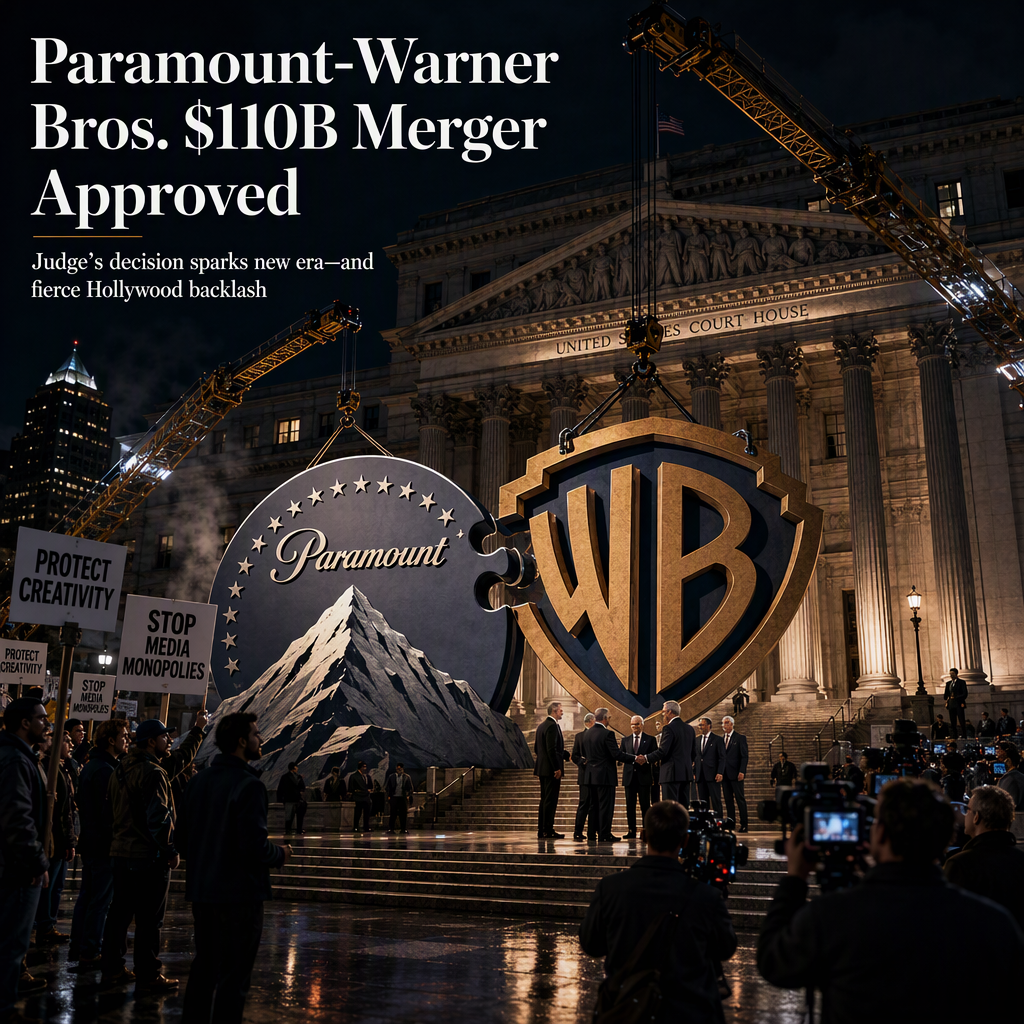
A federal judge has approved Paramount's $110 billion acquisition of Warner Bros. Discovery, allowing the historic Hollywood merger to proceed after a lengthy legal battle [1]. The decision came on Wednesday, with U.S. District Judge Araceli Martínez-Olguín describing the deal as a 'reasonable factual and legal resolution' and rejecting calls for broader restrictions [1]. The approval follows a settlement between Paramount and a coalition of 12 state attorneys general led by California, who had previously sued to block the merger over concerns about reduced competition and increased market power in film distribution and basic cable programming [1].
As part of the settlement, the combined company has made several enforceable commitments. Paramount agreed to release at least 30 movies annually for each of the first two years post-merger, increasing to 32 movies per year for the following three years, with at least four independent films each year [1]. Additionally, Paramount committed to spending at least an extra $1.5 billion on U.S. film production over five years compared to its 2025 spending levels [1]. The deal is expected to close on October 6, according to Reuters [1].
The merger has faced significant opposition from within Hollywood. Actor Mark Ruffalo, a vocal critic of the deal, called the outcome 'incredibly disappointing,' arguing that it would 'stifle creativity, weaken free speech, and cost people their jobs' [1]. Ruffalo emphasized that the grassroots movement against the merger would continue, stating, 'This was never about just one merger: this was about fighting back against corrupt oligarch billionaires trampling the interests of everyday people to line their own pockets' [1].
Despite the settlement and court approval, the controversy highlights ongoing concerns about industry consolidation and its potential impact on competition, employment, and creative diversity in Hollywood [1].
CONCLUSION
The approval of the $110 billion Paramount-Warner Bros. Discovery merger marks a significant shift in the Hollywood landscape, with new commitments to increased film production and investment in the U.S. market. While the deal is set to close soon, it continues to face strong criticism from industry figures and advocates concerned about its broader implications for competition and creativity.