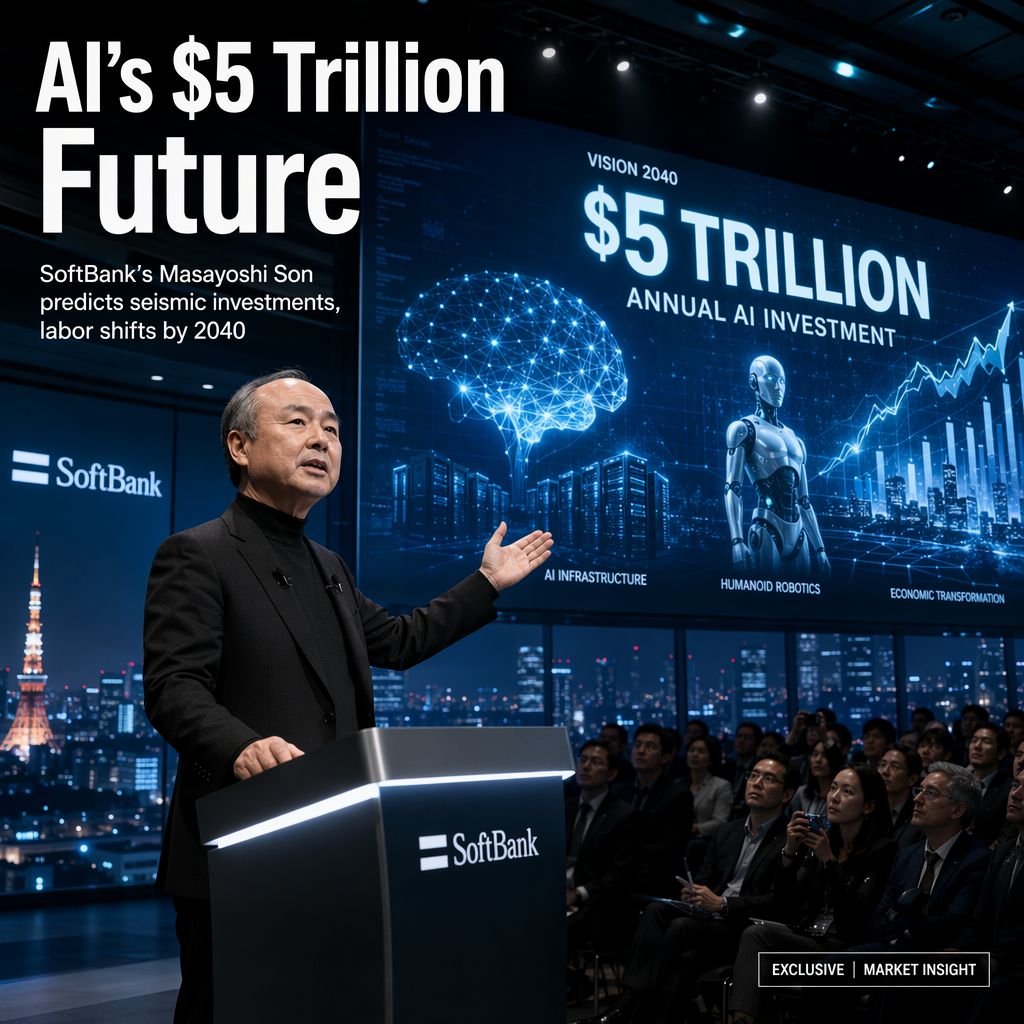
SoftBank Group founder and CEO Masayoshi Son delivered a keynote presentation at SoftBank World 2026 in Tokyo, projecting that global artificial intelligence (AI) infrastructure will require $5 trillion in annual investment by 2040 to support the proliferation of AI agents, data centers, power supplies, and humanoid robots [1][2]. Son emphasized that the widespread adoption of AI agents will fundamentally reshape both business and daily life, with AI expected to account for up to 20% of world GDP by 2040 [1][2]. He described a future where AI agents and humanoid robots autonomously perform physical and cognitive tasks, driving significant productivity and efficiency gains for companies [1][2].
Son outlined that the $5 trillion annual investment figure encompasses hardware, software, energy provisioning, and manufacturing capacity for AI-related devices [1]. He cited ongoing and planned projects, such as SoftBank's $88 billion AI data hub in France and Mitsubishi Estate's $9 billion data center construction in Japan, as evidence of the sector's rapid expansion [1]. Government-backed initiatives, including a $6.2 billion investment in SoftBank-led AI models, were highlighted as further institutional support for the AI boom [1].
Market sentiment, according to both sources, is strongly bullish on AI infrastructure, with expectations of rising price levels and increased funding commitments as the industry matures [1][2]. Son directly addressed market skepticism by stating, "Calling AI a bubble is blasphemy," reinforcing his optimistic outlook [1]. In the broader market, there is a growing view that investment in AI-related infrastructure, semiconductors, and IT sectors will accelerate, with particular attention on the stock performance of semiconductor and infrastructure companies [2]. Investors anticipate capital inflows into growth areas driven by AI agent proliferation, and the market is expected to become increasingly active around the AI sector [2].
SoftBank's financial strategy includes partnerships and co-investments, such as a potential $1.9 billion investment in 7-Eleven parent companies alongside PayPay, and a shift in top lenders from Mizuho to JPMorgan Chase, reflecting evolving capital market dynamics [1]. While technical analysis and specific price or chart data were not detailed in the NHK World article, there is consensus that monitoring the stock trends of AI infrastructure and semiconductor firms, as well as supportive policy developments, will be crucial for future investment strategies [2].
CONCLUSION
Masayoshi Son's bold projection of $5 trillion in annual AI investment by 2040 underscores the scale of transformation anticipated in global infrastructure and labor markets. Both sources highlight strong institutional and investor support for AI-driven growth, with significant implications for related sectors such as semiconductors and data centers. The prevailing market sentiment is highly positive, with expectations of continued expansion and active investment in the AI ecosystem.