
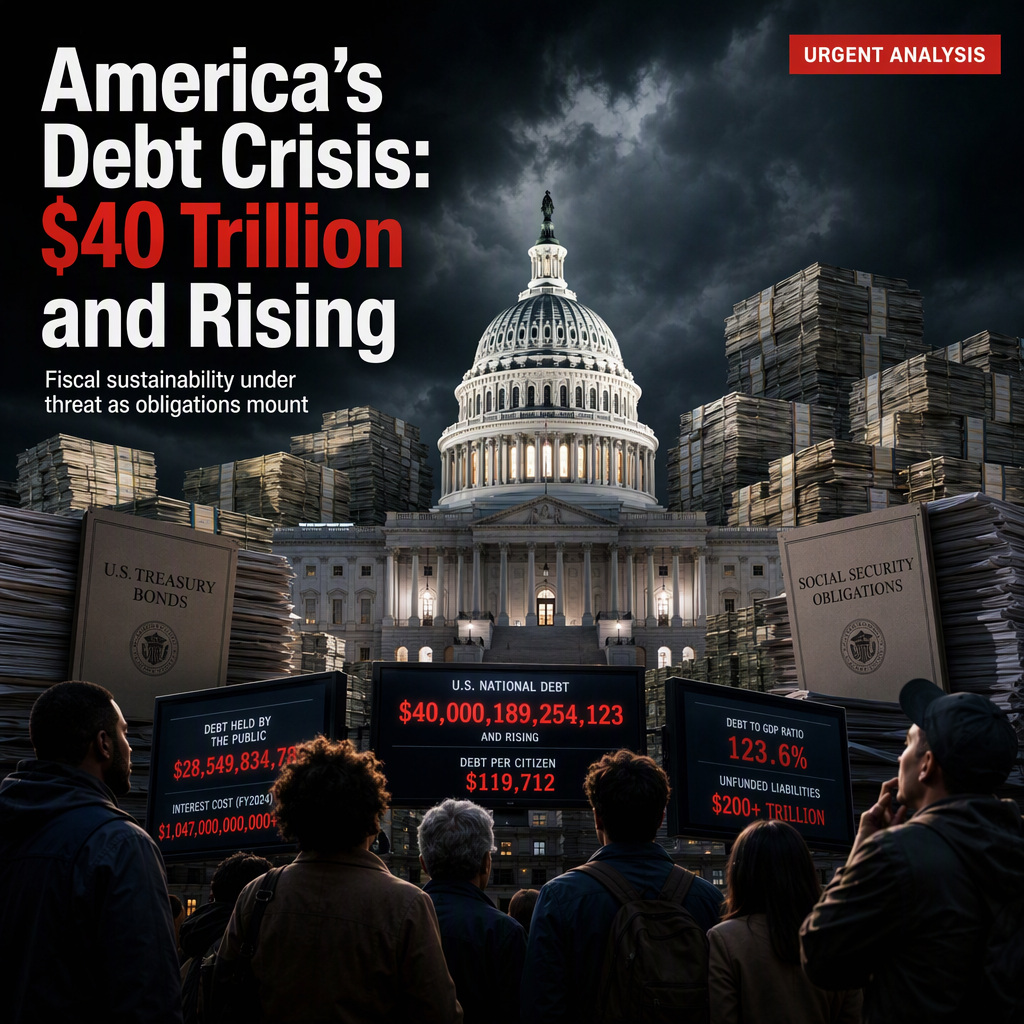
The United States is facing a significant fiscal crisis as the national debt has now exceeded $40 trillion, which equates to approximately $117,000 for every American, including men, women, and children [1]. The federal government continues to run multi-trillion-dollar deficits annually, with no end in sight to this trend [1]. Social Security and Medicare are highlighted as carrying unfunded obligations in the tens of trillions of dollars, and there is currently no serious plan in place to address these gaps. The trust funds for these programs are projected to be exhausted within a few years, which, under current law, would result in major benefit cuts [1].
Interest costs on the national debt have already surpassed $1 trillion per year, consuming more than one fifth of total federal revenue, and this share is expected to grow further [1]. The Government Accountability Office has stated that the federal government is on an unsustainable fiscal path, posing serious economic, national security, and societal challenges [1]. The article warns that if investors lose confidence and stop buying U.S. debt at sustainable rates, a fiscal crisis could ensue, likened to a collapse of a Ponzi structure [1].
The opinion piece emphasizes that there is no painless solution to the problem, and that addressing it will require government spending restraint, entitlement reform, stronger economic growth, and difficult choices that may not be popular with voters [1]. The author frames the issue as a moral obligation to future generations, warning that failure to act could leave the country bankrupt [1].
No specific market reactions or analyst opinions are provided in the article, but the tone and data presented suggest significant concern about the long-term economic implications of the current fiscal trajectory [1].
CONCLUSION
The article underscores the unprecedented scale of the U.S. national debt and the urgent need for fiscal reforms to avoid a potential economic crisis. With interest costs and unfunded obligations mounting, the piece calls for immediate action to ensure economic stability for future generations. The market takeaway is one of heightened risk and the necessity for policy intervention.