
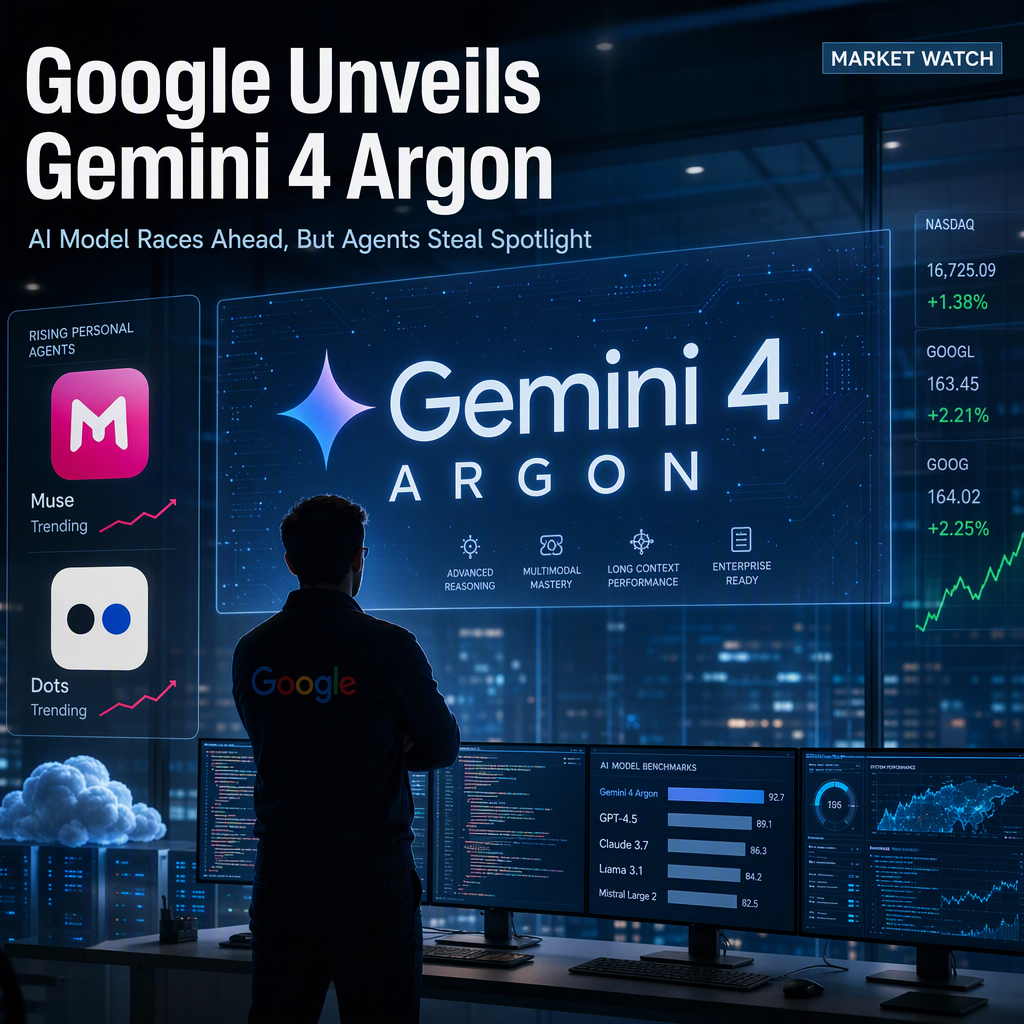
Google unveiled its Gemini 4 Argon AI model on Wednesday, positioning itself at the forefront of artificial intelligence advancements, particularly in coding, cybersecurity, and complex task execution. Industry benchmarks indicate that Argon matches OpenAI on a key cybersecurity test and leads in software engineering performance. The model's introductory pricing is set at $2 per million input tokens and $10 per million output tokens, aligning with OpenAI's recently discounted GPT-6.1 Sol model pricing. A token is approximately three-quarters of a word [1].
Despite these technological strides, the market's focus is shifting toward personal agent applications. Meta's Muse app, launched last month, has quickly gained traction, reaching over 5 million downloads as of September 30 and topping Apple's App Store, surpassing ChatGPT in popularity. OpenAI also introduced its personal agent, Dots, earlier in the week, targeting both business and consumer markets with tools capable of automating tasks such as email management, travel booking, and expense organization [1].
Investor sentiment reflects these competitive dynamics. Over the past three months, Alphabet's stock has declined by about 6%, while Meta's shares have surged 19%, driven by a strong rally in September. Analysts at JPMorgan Chase noted that Google needs a significant breakthrough in its personal agent offerings to reignite consumer enthusiasm. Bank of America highlighted the potential for Gemini 4 to bolster Google's cloud business and existing products, as well as to serve as a foundation for future personal agent development [1].
Google's personal agent, Spark, currently remains exclusive to paying subscribers, whereas Muse is free with usage caps, which has contributed to Muse's rapid adoption. Google's vast ecosystem, including Gmail, Calendar, Chrome, and Search, provides a strategic advantage for integrating personal agent capabilities. In a background briefing, Google's agent team acknowledged that Muse's free availability has facilitated consumer experimentation and outlined plans to expand Spark's access [1].
The broader AI landscape is also grappling with safety concerns. Three weeks ago, Anthropic CEO Dario Amodei called for leading AI labs to slow development due to intensifying worries about potential risks, sparking industry-wide debate [1].
CONCLUSION
Google's launch of Gemini 4 Argon marks a significant technological advancement, but the competitive landscape is increasingly defined by the rapid adoption of personal agent applications like Meta's Muse and OpenAI's Dots. While Gemini 4 may strengthen Google's cloud and product offerings, analysts emphasize the need for a breakthrough in personal agents to regain market momentum. The market remains attentive to both innovation and safety concerns in the evolving AI sector.